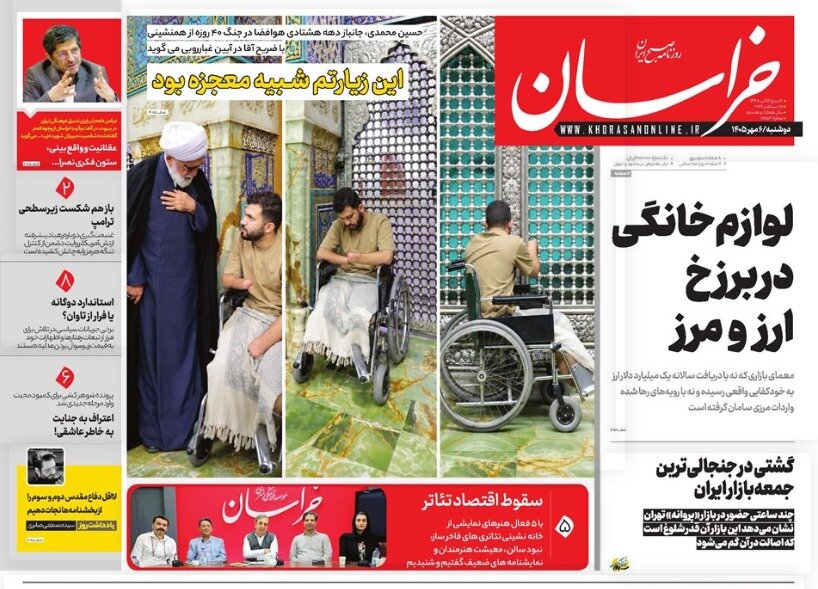
Khorasan, in an analysis of Iran’s repeated seizure of enemy equipment in the Strait of Hormuz, wrote: The IRGC Navy has announced the capture of a second advanced uncrewed surface vessel (USV) belonging to the terrorist US military.
Twenty days earlier, the IRGC had also captured the first advanced enemy drone vessel. At the time, the Pentagon claimed that the incident had been caused by a technical malfunction. The repeated seizure of enemy assets in the Strait of Hormuz has not only challenged Trump’s claims regarding control of the strait, but has also highlighted the capabilities and strength of Iranian forces in intelligence gathering and electronic warfare. Another significant point is the connection between these captures and the targeting of several vessels described as violating regulations in the Strait of Hormuz. Taken together, these developments once again demonstrate the falsity of Trump’s claims about control of the Strait of Hormuz. In other words, besides facing setbacks in surface engagements, it is also experiencing defeat in subsurface warfare.
Jam-e-Jam: Washington’s scenario is a war of attrition until the elections, then a return to hard confrontation
Jam-e-Jam examined recent developments and the US approach toward Iran. According to the paper, a comprehensive assessment of recent statements by Trump, the activities of the State Department under Secretary of State Marco Rubio, and the positions adopted by American security institutions suggests that the United States is skillfully managing a dual-track strategy. On the one hand, it is keeping the door to diplomacy open as a means of containing Iran, while on the other, it is intensifying military preparations behind the scenes. Washington has no desire to reach a meaningful compromise or ease sanctions before the results of the November midterm elections become clear. Trump’s current strategy is based on a suspended war of attrition. Within this framework, Washington is allegedly exploiting the willingness of Iranian diplomats to engage in talks and return to the so-called Islamabad understanding. By doing so, it seeks to keep Tehran’s strategic initiatives, such as closing the Strait of Hormuz or responding reciprocally to aviation-related sanctions, in a state of suspension. The United States is reportedly preparing itself to move, after passing the electoral hurdle, toward a phase of direct confrontation or the imposition of surrender-like conditions, relying on the accumulation of threats it has already established.
Donya-e-Eqtesad: The story is not over yet
Donya-e-Eqtesad published an article regarding Trump’s rejection of Tehran’s seven-day proposal. According to the paper, Iran presented a seven-day proposal in New York. Under this plan, if a series of measures sought by Tehran were implemented, the process of reopening the Strait of Hormuz would begin, while negotiations aimed at ending the conflict and resuming nuclear talks would proceed simultaneously. Trump, however, rejected the proposal. Nevertheless, the US president’s reaction should not necessarily be interpreted as an end to diplomatic communications. A key point emphasized in Foreign Minister Abbas Araghchi’s remarks is the distinction between Trump’s public comments and Washington’s official response conveyed through negotiation channels. Araghchi does not suggest that Trump’s statements are unimportant. Rather, he indicates that Tehran is still waiting for the United States’ final position to be communicated through intermediaries. This distinction is significant because last week’s negotiations also largely followed this mechanism. Messages were exchanged between the two sides through Qatar, Pakistan, and other regional channels. There was even a meeting between Araghchi and Steve Witkoff, Trump’s envoy, on the sidelines of the United Nations General Assembly.
Arman-e-Emrooz: The countdown to determining the future of Iran-US negotiations
Arman-e-Emrooz, in an article, referred to intensive efforts by mediators to arrange another meeting between Iranian and American officials. These efforts are particularly focused on New York, where mediating parties hope to use the remaining time available to draft a ceasefire proposal and create conditions for the restoration of free maritime navigation through the Strait of Hormuz. The primary objective is that, after achieving initial progress on this sensitive issue, the main negotiations can continue at a faster pace in locations such as Doha, Muscat, or a European city and ultimately reach a conclusion. This approach reflects the mediators’ desire to create a new diplomatic environment and reduce existing tensions, which have had far-reaching effects on both the region and the wider international community over recent months. The dual-track policy of remaining open to dialogue while firmly adhering to core principles continues to be the cornerstone of Iran’s current foreign policy. Relying on its diplomatic efforts across multiple dimensions and on the implicit support of many countries for its principled position, Iran considers itself prepared to enter negotiations founded on mutual respect and the protection of its legitimate rights.
Disclaimer : This story is auto aggregated by a computer programme and has not been created or edited by DOWNTHENEWS. Publisher: tehrantimes.com