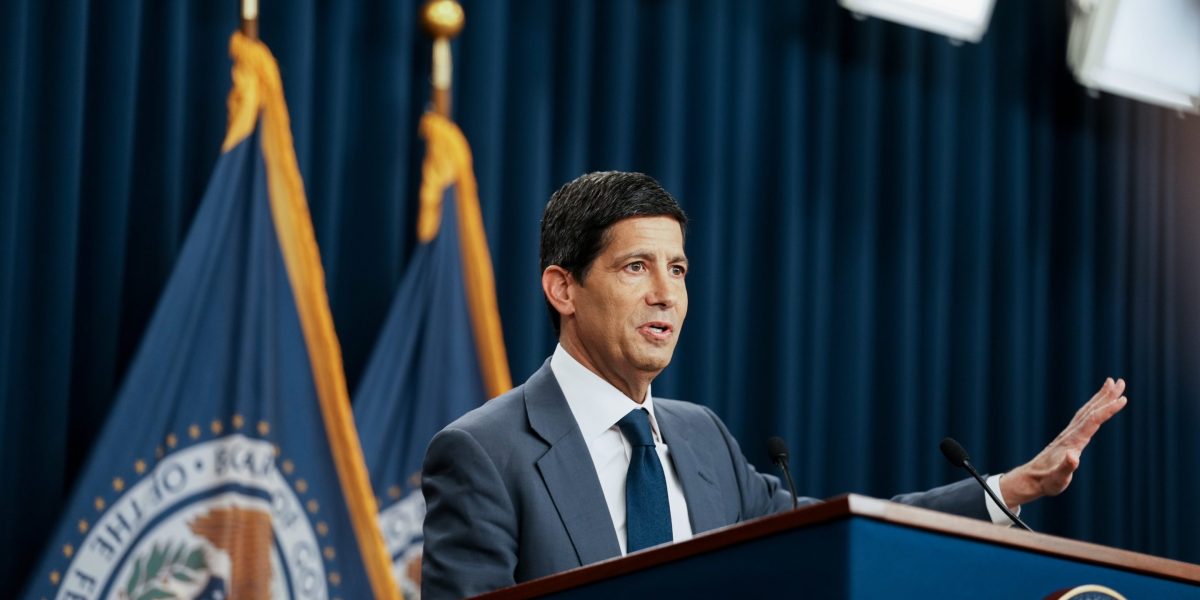
Federal Reserve Chairman Kevin Warsh has talked tough on inflation since returning to the central bank this spring. And yet, despite prices rising comfortably ahead of target in recent months, the Federal Open Market Committee (FOMC)—led by Warsh—appears to be taking its foot off the gas in terms of raising interest rates.
Yesterday, the boomerang board member confirmed that the Federal Funds Rate would be held steady at 3.75% to 4%. Two voting members disagreed with the hold: Governor Lisa Cook and Beth Hammack, president of the Federal Reserve Bank of Cleveland, dissented in favor of a 25bps hike.
The seemingly at-odds inflation data and the passive, consensus rate response are essentially a geography problem: The key source of the FOMC’s inflation headache lies in the Middle East.
Over the past half a year, inflation has been far above the Fed’s mandated 2% target. That is despite Warsh insisting that it is the Fed’s “charge to keep” inflation at, or toward, the target.
But September’s reading came in at 3.7% over the past 12 months, following 3.4% increases in both July and August. Driving that increase is oil prices: Gasoline was up 34.2% from last year, per the Bureau of Labor Statistics’ September report. Warsh is well aware of this. In his post-FOMC press conference he said: “I am not going to be the guy who says that oil prices haven’t gone up.”
The source of this rise is the conflict between the U.S. and Iran. Despite President Trump’s promises of a short-lived war, the conflict has yet to show any signs of ending. Iran sits along both the Persian Gulf and the Gulf of Oman, and notably, the narrower Strait of Hormuz, which links the two. Oil from Kuwait, Qatar, Saudi Arabia, and the UAE needs to pass through the Strait of Hormuz to be exported around the world—some 20 million barrels a day, according to figures from 2024.
The disruption to oil supply from the region, coupled with Russia’s war with Ukraine affecting supply from another major production hub, has sent prices rocketing. Prices have been over $100 a barrel since October 7.
The central bank’s traditional mandate is independence, meaning it must do its best to ignore pressure from the politicians on its doorstep or react to Tehran’s interference in the oil market. U.S. Treasury Secretary Scott Bessent (and other economists) have urged Warsh and the FOMC to “look through” the price pressure for this reason, though he said in September (when rates were unanimously voted to increase by 25bps) that it was to prevent a “broaden[ing] out” of the impact of the supply shock.
Iran’s influence
The Fed’s decision to hold rates—coupled with the market consensus that hikes will occur at every other meeting rather than consistently—suggests it will not allow the shock to dictate the path of interest rates, blocking any indirect sway from Tehran.
The Iranian regime is well aware of the influence it wields in D.C.—though it is perhaps more concerned with making life difficult for the White House than for the Fed. That said, higher interest rates have famously earned the ire of President Trump. As Trump’s former commerce secretary, Wilbur Ross, previously told Fortune: “We’re about to go into the midterm elections, and so there’s an unusual political factor which I’m sure both sides are aware of. The Iranians seem to be betting that they can outlast the president, and that has been a characteristic theory of their prior discussions.”
That doesn’t help the Fed, which must walk the line between credibility on inflation, and not using the sweeping tool of interest rates to control one—albeit significant—factor.
“There’s been a stable correlation between oil prices, as they’ve moved up this year generally, and interest rates. Not the interest rates that we control but the interest rates set in the market,” Warsh said yesterday afternoon. “Until very recently. We’ve seen oil prices continue to move up, largely due to geopolitical events … [but] interest rates have rolled over to the downside.”
“I am not a Wall Street newsletter, I’m just telling you, when I look out the window over the last several months, that is what we’ve seen. To the extent that oil prices were to move lower, again probably due to geopolitical events, that’s something that we’re going to have to interrogate. What are the effects on the Fed’s dual mandate? What are the effects on financial market prices, and what are we going to do about it?”
Ahead of the meeting, UBS’s Paul Donovan had weighed the same issue, writing to investors: “Oil prices are a one-off shock, beyond central banks’ control. Unfortunately, they are the fourth successive one-off shock: pandemic supply chain issues, the Russian invasion of Ukraine, tariffs, and the Gulf war. Four successive temporary shocks give an illusion of permanence.”
Disclaimer : This story is auto aggregated by a computer programme and has not been created or edited by DOWNTHENEWS. Publisher: fortune.com