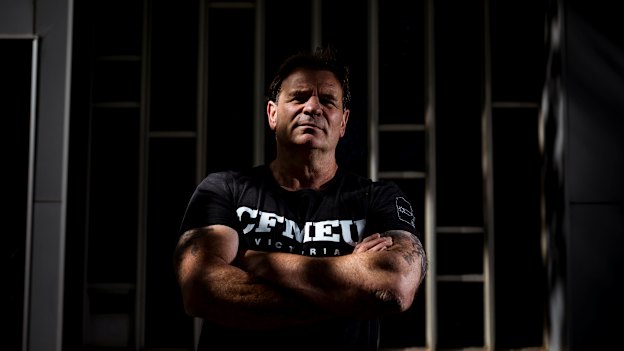
The 2023 burial of the father of disgraced former building union chief John Setka revealed the deep interconnections of Victoria’s troubled construction industry.
On a cold, drizzly late-August day in 2023, John Setka prepared to bury his father, Bob. The service was at St Leopold’s in Sunshine, a modern church built by the local Croatian community in the 1980s, and whose stunning stained-glass windows helped brighten the interior in defiance of the chilly weather. Amid the pews stood an ornate statue of St Leopold himself, a Croatian Catholic priest famous for hearing confession for up to 15 hours a day.
Despite the grim event, Setka, the then-leader of the Construction, Forestry & Maritime Employees Union (CFMEU), felt at home. Those around him were his people, his backers from the trade union movement and his supporters from Melbourne’s tight-knit Croatian community. There were other attendees, too. Sitting among the pale-orange pews at St Leopold’s that day was Jacinta Allan, the state Labor minister responsible for Victoria’s enormous Big Build program.
Allan struck something of an incongruous figure amid the burly unionists and proud Croatian community members. But her attendance was as much about supporting Bob Setka’s son as it was about paying tribute to the deceased. John Setka’s union members were being paid handsomely on the Big Build while the fast-expanding city of Melbourne got the infrastructure it needed. Allan, from Labor’s socialist left faction, was also overseeing projects where the CFMEU had out-muscled the rival right-wing Australian Workers’ Union (AWU) run by her ex-husband, Ben Davis. The senior minister would likely need Setka’s support if she ever wanted to become the premier of Victoria, so it was time for a public show of support for the grieving CFMEU leader.
Setka senior was lucky to have lived so long. He should have died in 1970. On October 15 of that year, Bob, an ironworker and rigger, was smoking a cigarette while looking out over Port Melbourne from high up on the West Gate Bridge when he heard a terrific cracking sound. “The bridge go down and I go like this, higher,” Bob Setka recalled years later of being catapulted upwards. As he flew through the air, he thought of his young family, which included six-year-old John. The next thing he knew, he was lying in the mud of Stony Creek, far below the bridge. He looked around and thought, Oh, my god, I’m still alive.
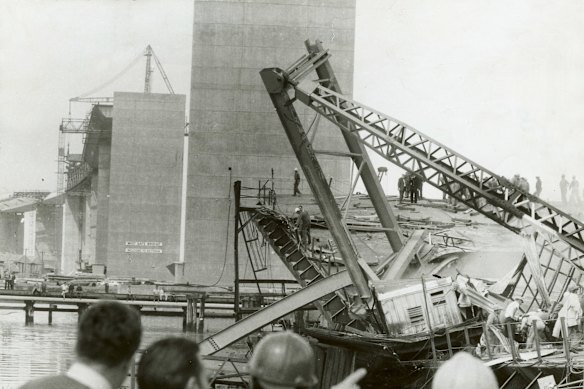
As soon as Bob’s brother heard the news, he rushed to the scene, unsure whether Bob was alive or dead, and somehow he found him. Many of the other men lying in the muck amid a twisted mess of concrete and steel were not so lucky. The dead numbered 35, with Bob being one of only 18 survivors. He gave aid to the fallen and never forgot to pay his dues to the only buggers he believed cared about workers’ safety: the men of the union, the Builders Labourers Federation (BLF).
When Bob Setka was buried at St Leopold’s, it was not just a family and Croatian community affair. Underworld figure Mick Gatto had published a message in The Age offering his “deepest and sincerest condolences to John and all the Setka family”, while politician Luba Grigorovitch would later pay tribute to Bob in the Victorian Parliament.
The worlds of his famous son – of power, politics and organised crime – had come together for Bob Setka’s funeral.
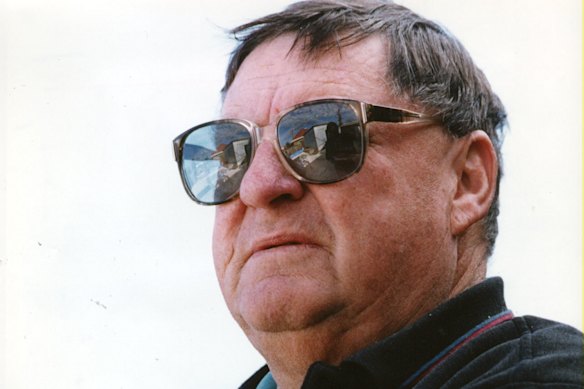
Boze Setka was born in 1934 in the short-lived Kingdom of Yugoslavia, but when he arrived in Australia in the 1960s, he became known simply as Bob. Those who worked with Bob described a quiet, humble man. He was tall, with an enormous frame like his son, but he lacked John’s gregariousness and had none of his son’s mercurial ability to combine menace with charm and humour.
But there were shared threads in their respective lives, whether it was unionism or pride in their background. For John Setka, the story of his father’s survival was a pivotal moment, a touchstone he returned to over the decades to explain his choice of career: that of a union man. “That’s why my lucky number’s 18,” he would say, referencing the West Gate disaster. “There was 18 survivors that day.”
Then-PM Bob Hawke described the BLF as being run by the principle, ‘If you get in their road, you get bashed in the head with an iron bar.’ John Setka was often that iron bar.
Years later, John Setka remembered going to school in Melbourne’s west with children whose dads did not survive the fall. On Father’s Day at school, they would make gifts for their fathers and those children would be haunted by their loss. Setka the son never forgot. In one CFMEU video clip, he can be seen choking back tears as he hugs his own son while Bob speaks about surviving the West Gate calamity.
Like so many other Croatian migrants to Melbourne in the 1960s and 1970s, Setka senior gravitated to the growing diaspora communities in the city’s industrial west and Geelong. Work was plentiful in the factories and building sites of the burgeoning city, and there were opportunities for men like Bob Setka to make a new life for their families.
The Setka family lived in working-class Footscray, and by John Setka’s own telling, he was a tearaway and often in trouble. When police arrived at the front door of the family home looking for him, Setka’s mum, Mila, never doubted her son. “Johnny’s a good boy,” she’d say on repeat. Decades later, Setka would laugh at his mother’s unwavering devotion, no matter what wrong he’d done.
By the time he was 19, John Setka was following his father’s footsteps into the construction industry as a labourer and part of what was then the Maoist-led Builders Labourers Federation (BLF), the union Bob had long been a proud member of. John Setka’s union mentor was the much-feared and admired BLF leader John Cummins, a man who was twice jailed for contempt of court after ignoring orders not to visit building sites. A photo from that time shows Setka listening intently to Cummins, the giant younger man stooping to not miss a word from his much shorter boss.
It was an enduring relationship. Even 20 years after Cummins’ death, Setka ensured he remained the patron saint of the CFMEU, with his image and that of the Eureka flag plastered on cranes. The precise political learnings Setka took from Cummins remain in dispute today, but one lesson was unmistakable: project power and take no prisoners.
The BLF was renowned for its unforgiving approach to industrial relations and politics. They wanted it all and nothing was too good for building-industry workers. Then-prime minister Bob Hawke described the union as run by the principle, “If you get in their road, you get bashed in the head with an iron bar.”
Setka was often that iron bar. As a young union agitator, he was convicted of dozens of trespass-related offences – and some for assault – for entering building sites once the BLF had been deregistered by Hawke amid revelations that one of its leaders, Norm Gallagher, had taken kickbacks from construction company bosses.
One witness described Setka in the 1980s taking on eight police officers, with three on each arm and another two lifting his legs as they removed him from a picket line – literally the giant Setka against the world or, in this case, eight cops. It was one of numerous such incidents throughout the 1980s and into the 1990s. When one unionist was dragged offsite by police, the 19-year-old Setka said, “I’m going to stick to the bitter end.” And he did.
After it was outlawed, the BLF began running as a rebel union, its membership shrinking to several hundred by 1990 after the federal parliament voted to extend its deregistration. By that stage the union could only employ three people: Cummins, leader Gallagher and Setka. Two years later, the fight was all but over as the BLF ran out of members and money.
The branch executive moved on Gallagher, claiming he’d misappropriated funds, and later removed him as leader. Gallagher in turn called the police on his comrades and testified against Setka, with Cummins calling the former leader the “police pimp”. The BLF, having shrunk to next to nothing, went out in a bitter whimper, not glory.
That same year, 1992, a successor union was on the scene. The construction branch of the CFMEU was emerging out of the ashes of another, less-militant building union: the Building Workers’ Industrial Union. Setka, by then 28, was now a young father, with his son, born in 1990 to his first wife. He faced an uncertain future, with attempts made to block him from joining the CFMEU due to his infamous reputation. But after tense and extensive negotiations in 1993, Setka and Cummins moved over to the new union.
Setka and his erstwhile mentor helped shape the nascent union in Victoria, bringing over some of the rebel culture of the BLF. By 1996, Cummins was president of the Victorian branch, a position he held until his death in 2006 at just 58. Setka became a prominent organiser, rising through the ranks to look after the crucial CBD building sites where many of the union’s members worked. It brought inevitable conflict – old habits die hard. In 2003, Setka, by then 38, was arrested after he threatened a building company manager, telling him, “You just f—ing watch, I’ll get you. I’ve got a 12-year-old son and I swear on his f—ing life, I swear on my son’s life, you watch, I’ll fix you up.”
It did nothing to stop his ascent. Outside the Magistrates’ Court, about 50 unionists held a noisy rally in support of Setka while the union’s then secretary, Martin Kingham, defended his organiser, who was found guilty and fined. Promotions followed: Setka was elected to the position of union assistant secretary, and then, in 2012, its boss. But the lessons he’d learnt at the family dinner table about community, politics, militant unionism and power, he never forgot.
Similar to the experiences of so many migrant families of the time, Setka had grown up in a community with one foot in the new country and one still in the old. The politics of many in the overwhelmingly working-class Croatian diaspora weren’t particularly left-wing. Instead, many were fiercely anti-communist and celebrated Croatia’s fascist past, which included the mass murder of Serbs, Jews and Romani.
One of the founders of local Croatian soccer club the Melbourne Knights, Srecko Rover, had been an intelligence officer for the ultranationalist organisation Ustaše. Setka later became a director of the Knights and had a Croatian coat of arms tattooed on his chest.
Setka would regularly lunch at Footscray’s Croatian Club, known for its generous serves of seafood and cevapcici, a Croatian delicacy of spicy pork or beef sausage. A stone bust of wartime Ustaše leader Ante Pavelic has pride of place in the club’s foyer. Pavelic was leader of a pro-German government in Croatia from 1941 to 1945 and the club was once named after the fascist Pavelic, but that was changed amid complaints by the local Jewish community. That said, rooms at the venue are still named after other Croatian war criminals.
Like his dad, John Setka hated to be called “comrade”, a greeting still commonly used among the left of the union movement. He preferred the term compare, which translates loosely into “brother”.
Setka looked after his Croatian compares. Some, like his old mate John “Perky” Perkovic, were given well-paid jobs as union shop stewards for large building firms, before being elevated to roles as senior union organisers. Others, like businessman Jadran Delic, had their building companies introduced onto sites by the CFMEU with a nod and a wink that their engagement would signal the end of union trouble. It didn’t seem to matter that Delic’s business partners included some of Australia’s most notorious drug traffickers, or that he’d once declared, in a court case brought by one of his injured workers, that he structured his companies to make it harder for his union-member employees to sue him.
When policeman and Croatian Club identity Tony Juric was charged and jailed for corruption, the CFMEU was waiting for him with a cushy role upon his release. Tony Crnac, a Croatian drug trafficker who served time for a massive cannabis importation, was elected to the CFMEU’s governing body, its branch committee of management.
When a former Melbourne Knights football club chairman, Matt Tomas, started his first crane company, TJF (it was whispered in the industry its initials stood for “The Job’s F—ed”), the CFMEU made sure it flourished. Tomas was something of an entrepreneur. He started a waste-disposal firm with a Hells Angels bikie boss and one of Setka’s ex-girlfriends.
But Tomas’s most enduring business relationship was with another of Setka’s closest friends. When TJF collapsed, owing both the Tax Office and workers, Tomas launched Elite Cranes, which quickly became another favoured CFMEU firm. His partner in the business was Mick Gatto.
Setka’s detractors in the trade union movement constantly whispered about the unsavoury culture he appeared to be championing within the CFMEU, but no one could argue that his wasn’t an extraordinary ascent to power. It was a rise his father could never have dreamed of: from being muscle on building sites to running one of the country’s most important unions.
If anyone doubted John Setka’s influence, they needed only to watch Jacinta Allan moving among the mourners at Bob’s funeral. As the stained glass split the winter sunlight into colourful shafts, it was clear what had drawn the politician to St Leopold’s – even if she regarded Setka warily. Her husband, Yorick Piper, was a former CFMEU official, albeit from the union’s timber workers division, who was suspicious of Setka and his shady friends.
All the same, Setka had emerged as a key figure in a nascent but powerful Labor Party faction known as the industrial left. Its fundraising muscle and control of a bloc of votes within the Australian Labor Party (ALP) could influence political careers. Allan was not immune to the industrial left’s power.
Nor was Setka impervious to Allan’s power, being the politician overseeing the Big Build. The CFMEU’s ability to wield its industrial strength on major rail and road projects would undoubtedly be aided by a good relationship with the infrastructure minister. For instance, if Allan didn’t resist the CFMEU push to replace the rival AWU on the Big Build, Setka’s power and resources would grow even more.
If Boze Setka’s funeral was all about the most powerful unionist in the land burying his much-loved father, Allan’s presence was also a nod to the realpolitik of the ALP. And even though none of the mourners knew it, Allan’s kindly disposition towards the CFMEU was about to pay even greater dividends. In just under a month’s time, the premier of Victoria, Dan Andrews, would resign. In his place, he would install Jacinta Allan, the minister for the Big Build and friend of the CFMEU.
This is an edited extract from Building Bad: The explosive inside story of the CFMEU by Nick McKenzie and Ben Schneiders (Hachette), out October 27.
Read more from Good Weekend magazine:
Get the best of Good Weekend delivered to your inbox every Saturday morning. Sign up for our newsletter.
Disclaimer : This story is auto aggregated by a computer programme and has not been created or edited by DOWNTHENEWS. Publisher: www.smh.com.au