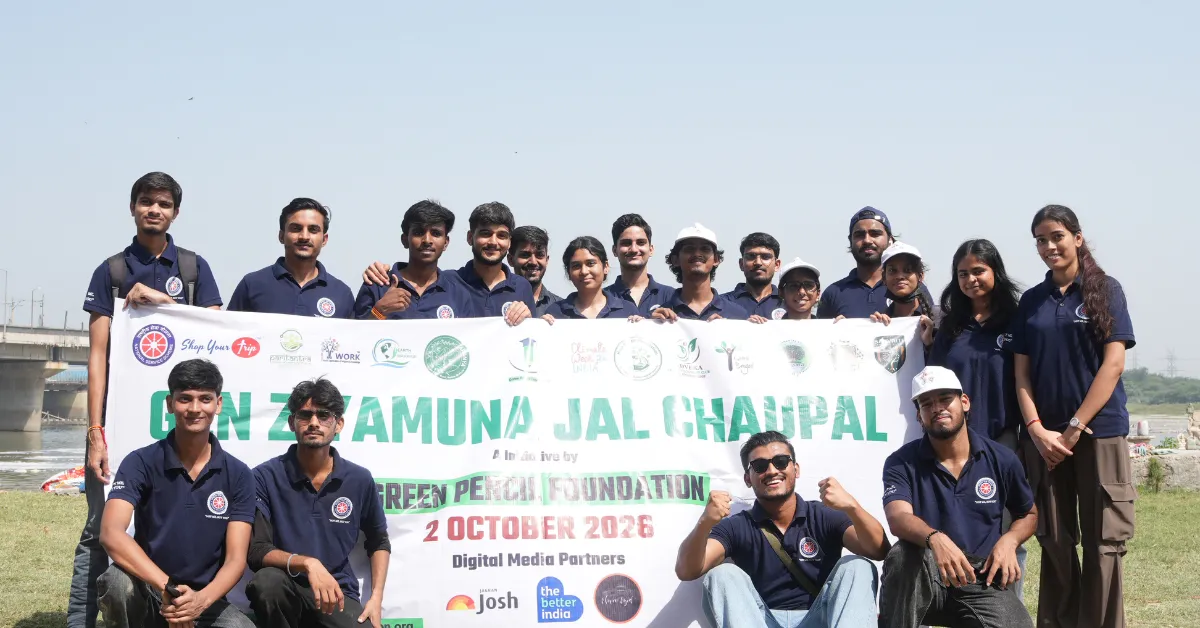
On Gandhi Jayanti morning, nearly 1,000 young people gathered at Delhi’s Kalindi Kunj with the Yamuna in front of them. Before they picked up a single piece of waste, they took off their shoes and walked towards the river barefoot.
There were students from different Delhi University colleges, groups of friends, Eco Club members and NSS volunteers. Some carried gloves and bags. Others had come simply to be part of the morning. For a few minutes, though, everyone was doing the same thing: walking towards the river together.
It was a small gesture, but one meant to make the Yamuna feel a little less like someone else’s problem.
Soon, the gloves went on and the real work began. By the end of the cleanup, the students had collected more than 2,000 kg of waste from the riverbank.
The morning was part of the Gen Z Yamuna Jal Chaupal 2026, organised by Green Pencil Foundation in collaboration with The Better India. But at its heart, it was less about a one-day cleanup and more about getting young people to look at a familiar problem differently: what happens when we stop passing by and start taking responsibility for the places around us?
Starting with the river, not a lecture
The Padyatra was led by Sandy Khanda, founder of Green Pencil Foundation, along with Pankaj Kumar, founder of Earth Warrior, and Hiba Khan, founder of Hiba Green Foundation.
Walking barefoot towards the Yamuna was meant to create a sense of solidarity with the river and, perhaps, make a familiar environmental problem feel a little less distant.
“We wanted young people to feel that the Yamuna is not someone else’s problem,” says Sandy. “The barefoot walk was symbolic, but the larger message was about reconnecting with the river and taking responsibility for what happens to it.”
For students who often encounter environmental issues through classrooms, campaigns and social media, the morning offered something different: a chance to stand beside the river itself.
Then came the cleanup.
From talking about waste to picking it up
The students split into three teams. One collected dry waste, another handled wet waste, while the third moved the segregated material to a designated point for collection by the Municipal Corporation of Delhi.
The work was simple, physical and, at times, probably less glamorous than talking about sustainability online. But that was also the point.
“When you actually stand beside the river and start collecting waste, the problem feels very different,” says Priyanshu, representing EnviSAGE, the environmental society of Sri Guru Nanak Dev Khalsa College. “It makes you think about where our waste comes from and where it eventually ends up.”
/filters:format(webp)/english-betterindia/media/media_files/2026/10/07/yamuna-cleanup-2026-10-07-13-53-17.jpg)
For Bhumi Pathak of Haritashray, the Eco Club Society, the experience made the Yamuna feel closer.
“Many of us grow up in Delhi without really having a relationship with the Yamuna. Coming here, working together and seeing the river closely makes the issue much more personal,” she says.
Students from groups including EnviSAGE, Haritashray, Paritantra, NSS ARSD, Green Brigade, Samvriti, Adveka, Aranya, Prithvi The Eco Club and NSS SRCC were among those who participated.
A cleanup can only go so far
By itself, cleaning one stretch of a riverbank cannot solve the Yamuna’s much larger problems. The students knew that too.
“We can clean one stretch of the riverbank today, but if we don’t understand why the waste is reaching the river, the problem will continue,” says Durgesh Kumar of Paritantra, Acharya Narendra Dev College. “The cleanup has to be followed by conversations and changes in our everyday behaviour.”
That idea ran through the day: civic sense is not just about cleaning a public space after it has become dirty. It is also about asking what we do before the waste reaches that space.
/filters:format(webp)/english-betterindia/media/media_files/2026/10/07/yamuna-cleanup-2026-10-07-13-54-32.png)
The gathering brought students from different colleges together around that shared responsibility. For Kartik Paliwal of NSS ARSD, that was one of the most encouraging parts.
“Environmental issues don’t belong to one college, one organisation or one group. They require collective participation,” he says.
Young people don’t want to wait
There was also a larger question underneath the cleanup: what happens after everyone goes home?
For Prachi Jayara of Green Brigade, College of Vocational Studies, the answer begins with changing how young people are viewed in environmental conversations.
“We are constantly told that young people are the future. But we are also the present,” she says. “We want to participate in solving environmental problems now, rather than waiting for someone else to take action.”
Others spoke about taking that responsibility back to their campuses. Yuvraj Singh of Adveka, the Environment Club of Dyal Singh College, believes the conversation around the Yamuna needs to continue throughout the year, through campus activities and everyday choices.
/filters:format(webp)/english-betterindia/media/media_files/2026/10/07/yamuna-cleanup-2026-10-07-13-55-29.jpg)
For Prerna Bhati of Prithvi The Eco Club, young people should be involved not only in campaigns but also in deciding what happens after them.
“Young people should not only be called when there is a campaign,” she says. “We should also be included in the conversations about what happens next.”
That may be the more difficult part of any civic initiative: keeping the feeling alive after the gloves come off and everyone returns home.
Going beyond a single-day cleanup
The Yamuna Jal Chaupal cannot change the river in a morning. But it did something smaller and perhaps more immediate: it brought a generation that often hears about the Yamuna as a problem face to face with the river itself.
They walked barefoot. They collected waste. They spoke about what could change on their campuses and in their daily lives.
/filters:format(webp)/english-betterindia/media/media_files/2026/10/07/yamuna-cleanup-2026-10-07-13-56-20.jpg)
As Swanman Koul of NSS SRCC puts it, “When hundreds of students come together, even a simple act like cleaning a riverbank becomes a collective statement. The challenge now is to carry this responsibility beyond one day.”
And perhaps that is where civic sense begins.
Not with a slogan or a one-day campaign, but with the realisation that the places around us are not somebody else’s responsibility. The river belongs to the city, and the city belongs to all of us.
All images courtesy of Sandy Khanda
Disclaimer : This story is auto aggregated by a computer programme and has not been created or edited by DOWNTHENEWS. Publisher: thebetterindia.com