The discovery of folders of negatives from nearly 50 years ago creates a photographic time machine for the original snapper.

It all started with pictures at an exhibition.
Old pictures in an exhibition of work by women photographers, one of whom had taken candid shots of life in an inner-city share house in the 1970s. Standing in the gallery, admiring them, it suddenly hit me: hang on, I also took photos in and around a share house in the ’70s.
But where were they?
I thought I knew. So, later, I rummaged in some cupboards and there it was – an old-style, half-arch file with an inscription in black capital letters on the spine: OLD NEGS etc. The “etc” suggested a less-than-scientific filing system.
Inside, above pages of film negatives in opaque paper sleeves, was another folder in an alarming shade of bright green – a souvenir from a business management conference in 1976. Not something I ever attended. But there, at the bottom, was this: With Compliments, John Scott Educational Book Supply.
Of course. The Book Supply place was my holiday job over several summers, after school and in my uni years – mundane work with the benefit of close proximity to books and surplus stationery like conference folders. It was the first job that lasted long enough for me to save money and splurge some on a new camera and one lens. Then I was away.
I was a black-and-white guy from the start, largely because of its DIY element. Colour meant sending films away for development; black-and-white negatives could be processed in an improvised darkroom like the one I created in my North Carlton share-house bathroom, with boards over windows and a sign forbidding entry to thoughtless people needing to use the toilet.
Tucked inside the folder were 10 slim negative files that opened like a concertina, some with much more information on the back than others. The first (I numbered them) had a pencil inscription: St Kilda/Luna Park/Melbourne General Cemetery, Sunday 30/1/77. A lot of ground covered in one day, ending with angel statues in the cemetery, close to where I lived.
But another folder left me guessing: Carlton Kids/City … and no date. I must have thought I’d remember. The flimsy negatives were in good shape: none torn; none stuck to their sleeves. I’d be amazed if our disc drives or memory sticks are readable in another 49 years. (I’ll never find out, so don’t worry about this much.)
Holding the negatives up to a window, I could read them once again – everything back-to-front, clear for black and black for white. Some I remembered: ah yes, the pensive little girl alone on a Luna Park ride. I also found contact sheets for most of the rolls, created by placing negatives on photo paper under an orange safelight in the darkroom, keeping everything flat with a plate of glass, then flicking on the enlarger light before dunking the paper in a bath of toxic developer.
I haven’t printed photos for decades. Too many chemicals; too much wasted water. Any films I develop now can be scanned and printed from the computer. A nice mix of old and new technology. And with this same scanner, I ended up deep-diving into the old negs. The ones without contact sheets; the ones that seemed to offer something worth exploring.
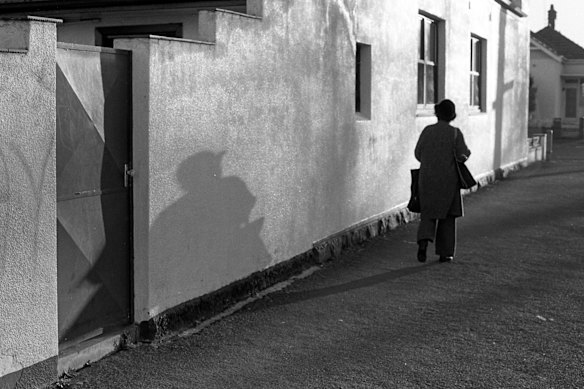
There were no “Eureka!” moments. No stumbling on pictures worthy of an exhibition. Many are mundane (cemetery monuments don’t age well). But some were worth a second look. Sometimes I had, indeed, seen things: an old woman dwarfed by her twilight shadow; commuters rushing to a station.
And there were pleasant surprises. Pictures I had forgotten taking, such as ones from Sydney in 1979, when I spent a morning at Speakers’ Corner in the Domain and focused on a lively orator named John Webster, now long-gone but still with his own Wikipedia page.
The past is another country. But fragments of the past are now present again. These pictures weren’t lost, then found; I just hadn’t looked for them. Hadn’t really looked at them. I’ve been to places I can now revisit, thanks to technology unimaginable when I first clicked the shutter.
I still have the camera I used all those years ago, retired to a spot on a bookcase shelf. I even have the obsolete battery that might make the meter work again. But I doubt I’ll try. Its work is done. Besides, any camera is just a box that lets the light in. What matters more is the film, or sensors, that capture an image.
I’m still working my way through the old negs. Skimming over many; puzzled by some; quietly proud of a few. People frozen in time. There’s something tangible here that seems more real than corruptible data files; images that have survived changes of cities and states and countries. I’m in a photographic time machine, finding positives in negatives.
 Alan Attwood is a former Age writer, section editor and foreign correspondent.
From our partners
Disclaimer : This story is auto aggregated by a computer programme and has not been created or edited by DOWNTHENEWS. Publisher: www.smh.com.au