
From its roots as a cabbage patch to one of rugby’s most iconic stadiums, we look back at the history of the Allianz Stadium.
It had previously been a market garden used to grow cabbages, and had been bought by RFU Committee member Billy Williams in 1907 for a little over £5,500. It would go on to become one of the most well-known arenas in world rugby.
The first stands at Twickenham, affectionately known as ‘Twickers’, were constructed in 1908, along with roads and pedestrian pavements.
The new ground hosted its first match in 1909 as Harlequins secured a four-point win over Richmond on a dreary day in south-west London. The following year, Twickenham welcomed 22,000 fans to its maiden international, as England faced Wales.
Between the wars
The First World War brought rugby at Twickenham put a temporary halt, and the ground was used for grazing cattle, horses and sheep during the conflict.
The sport returned once the fighting stopped, and Twickenham has since hosted some of the most memorable matches in rugby’s history.
Following the construction of the 10,500-seat North Stand in 1925, a then-record crowd of 60,000 poured in to watch England take on New Zealand as part of the All Blacks’ so-called ‘Invincibles’ tour.
In a landmark moment for the sport, the first rugby match broadcast live on television took place at Twickenham, when England welcomed Scotland for the 52nd Calcutta Cup match in 1938.
It was the Scots who prevailed 21-16 after Robert Wilson Shaw’s late try, which is considered one of the greatest scores of all time, sparking wild scenes of celebration.
Twickenham became a civil defence depot during World War II and the upper tier of the West Stand sustained damage. It was stitched up in time for a Victory Test match played between England and Scotland to honour those who had given their lives to defend the country.
Growing ambitions
Twickenham’s expansion from its original 22,000 capacity to the all-seater behemoth of the present day has been a long and gradual affair.
In 1932, an investment of £75,025 brought upgrades to the West and South stands, increasing capacity further and bringing staff offices inside the grounds.
In 1979, planning permission was granted for the new South Stand, which included a new tier. It was opened in 1981.
A new 14,800-seat North stand opened in 1991, followed by 25,000-seat East and West stands in 1993 and 1995, respectively.
The last (to date) major change came in 2006, when the updated South Stand opened its turnstiles, bringing Twickenham up to its current 82,000 capacity.
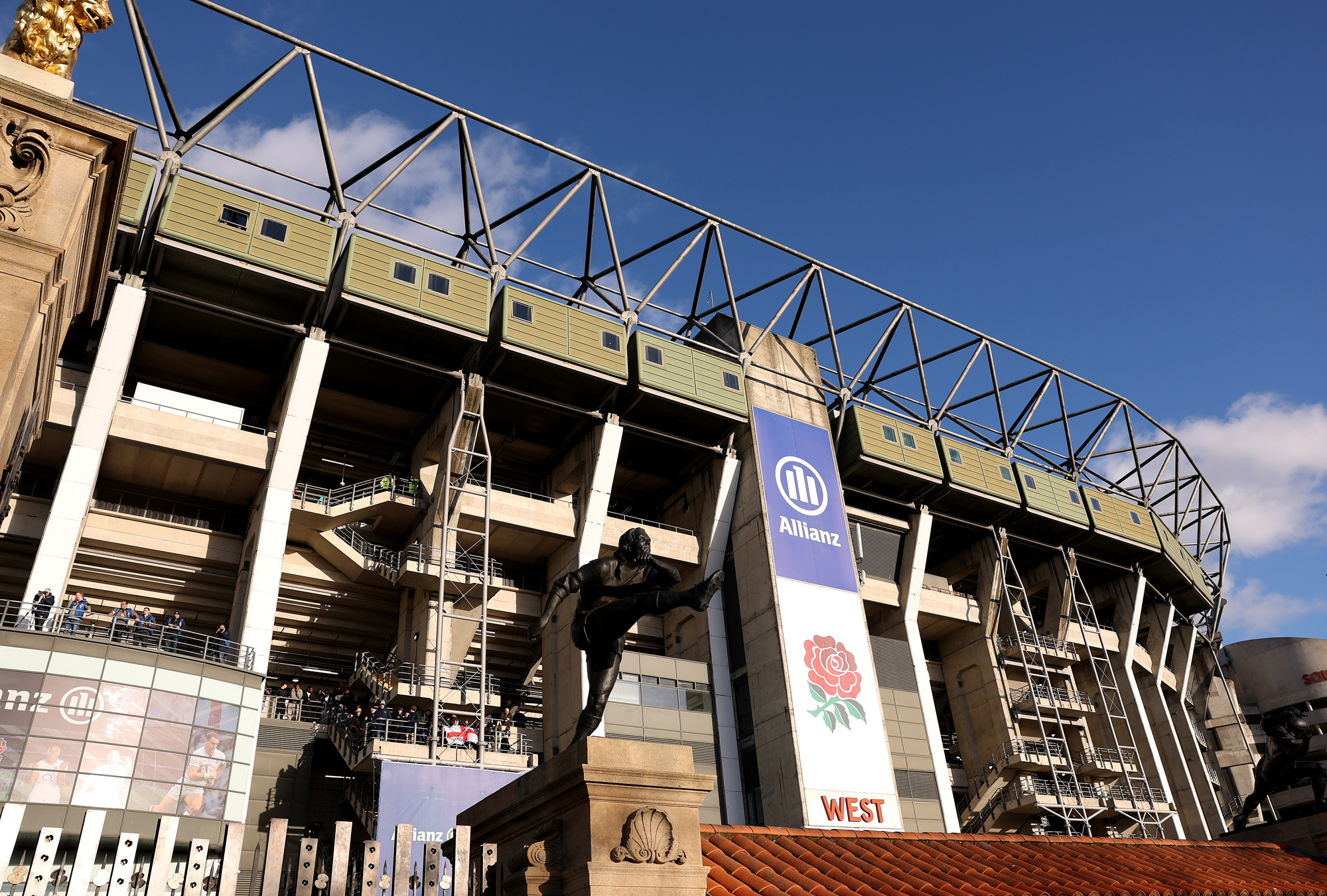
The modern 82,000 capacity Allianz Stadium, Twickenham (David Rogers/Getty Images)
More than a rugby ground
In addition to hosting home internationals for the men’s and women’s teams, Twickenham has become one of the most iconic venues in the UK.
It’s one of only three stadia (along with Eden Park in Auckland and the Stade de France in Paris) to have hosted two Men’s Rugby World Cup finals, in 1991 and 2015. The Red Roses’ sell-out victory over Canada in the 2025 Women’s Rugby World Cup final was the highest attendance for a women’s rugby match in history.
And since the Rolling Stones became the first band to perform on its hallowed turf in 2003, Twickenham has hosted many of the biggest acts on the planet, including U2, REM, the Police, Metallica, Lady Gaga, Bon Jovi and Rihanna.
The RFU has permission to host three non-rugby events per year at the stadium (with the capacity capped at 55,000 spectators), though it has consistently lobbied Richmond Council in the hope of hosting more lucrative gigs. Requests have repeatedly been rejected, but the RFU announced updated proposals for a new planning application in May 2026.
What’s in a name?
In early 2024, news broke that the RFU had considered selling Twickenham the previous year, to buy a 50% share in Wembley, the home of English football. The plan was subsequently abandoned (the FA was reportedly never approached), as English rugby’s ruling body opted to stay put in south-west London.
The RFU has, however, announced expensive plans to redevelop its home, reducing its capacity from 82,000 to 80,000 to increase spectator comfort, while repairing the roof, and improving transport links around the stadium.
But perhaps the biggest change in Twickenham’s recent history had nothing to do with architecture or redevelopments. In August 2024, the RFU announced it had sold the stadium’s naming rights for the next 10 years. Now officially named the Allianz Stadium, one of the most famous grounds in world rugby had had a major rebrand.
It’s come a long way since those agricultural origins over a century ago.
Download the digital edition of Rugby World straight to your tablet or subscribe to the print edition to get the magazine delivered to your door.
Disclaimer : This story is auto aggregated by a computer programme and has not been created or edited by DOWNTHENEWS. Publisher: rugbyworld.com