
None of us is getting any younger. But the way we age – and the quality of life we enjoy as the years tick by – depends on a number of factors.
While some may have won the genetic lottery for long life, lifestyle factors such as diet can play a key role in reducing the risk of certain cancers, as well as diseases like dementia and Parkinson’s. Exercise can also minimise the risk of falls and diseases such as osteoporosis.
But in an effort to keep ourselves in prime health with gym memberships and dietary overhauls, are we overlooking the asset hidden in plain sight? Could our homes be the secret weapon in supporting our physical and mental wellbeing as we age?
Future ready
Whenever the topic of designing for ageing comes up, talk naturally turns to creating safe home environments, particularly to reduce the risk of falls. So, start with clearing pathways, removing clutter and smoothing out trip hazards like rugs, as well as thresholds between transition spaces, say, from a living room to an outdoor deck. Good artificial and natural lighting can also improve safety while supporting circadian rhythms, promoting healthy sleep patterns.
If the opportunity to renovate or build is available, the key is to future-proof as much as possible, without sacrificing aesthetics.
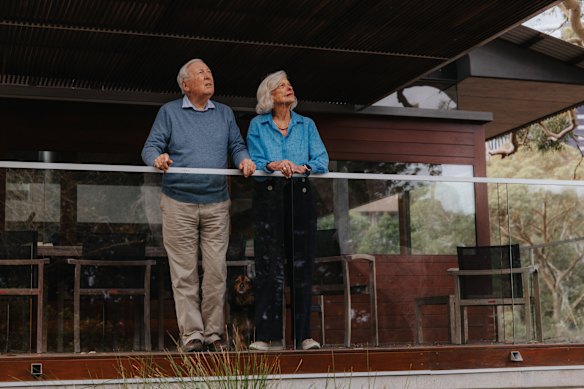
Architect Richard Cole says all this and more came up when he spoke to his parents, Terence and Tina, about designing their home on Sydney’s lower north shore more than a decade ago.
“We had lots of conversations about things, like if they ended up in a wheelchair and their needs would be about accessibility,” he says. “A lot of the things like allowing for corridors to be a bit wider and clearances around bathrooms can improve the quality of the spaces as well.”
The couple also enjoys hosting family and friends, so the house has an open-plan kitchen and living space that can open up to the deck or close down as required.
“My parents love living there,” Cole says.
Staying connected…
Research reveals that almost one third of Australians over the age of 60 experience loneliness, with rates increasing the older we become. The health impacts can be significant, with studies linking loneliness to an increased risk of dementia and even premature death.
A home that is “friendly” can reduce the barriers to receiving visitors. This could include a clear path from the front gate to your door, or a spot in your house to enjoy a coffee with a relative or neighbour. This also offers the ability to leave the house and reconnect with your network in the wider neighbourhood.
Architect Vanessa Wegner says some families take it a step further. A few years ago, she completed a multi-storey house in Epping for three generations of the same family.
“The older couple have their kids and grandkids onsite and it benefits both parties because of the social interaction,” she says.
…but separate
Most of us still value a little space to ourselves, though. The grandparents Wegner designed for also have their own apartment within the floorplan for a little separation.
“But every Friday everyone gets together for drinks,” says Wegner.
Cole says his parents’ house also works well when it is just the two of them. A separate study was high on his father’s list of priorities for the new house.
“It has an outlook over the garden and the rock face is exposed and dad has spent a lot of time in there managing his super and keeping up with the world.”
Healthy mind…
For those still in the family home, newly available bedrooms can allow space for pursuing other interests, says Emeritus Professor from the School of the Built Environment at the University of NSW, Bruce Judd.
“People need space for hobbies, and some of those bedrooms that would appear surplus are used for study or an exercise room,” he says. “You need space for all kinds of things.”
Professor Antony Moulis, deputy head of the School of Architecture, Design, and Planning at the University of Queensland, says houses with flexible rooms that can be put to multiple uses over time are desirable.
“Think of a media room – it’s not flexible or connected to the outside and cannot be used for anything else,” he says. “Houses need to be more flexible and adaptive in the way they are set up so they are ready for the changes and needs of the people who live there over time.”
Sales agent for Ray White Touma Taylor Real Estate, Walter Burfitt-Williams, says that built-in flexibility can have broader appeal than you might expect.
“Where my mother lived, the previous owner had modified the hallway to make it wider [providing a view of the water]. The other apartments [in the building] didn’t have that and it felt so different – buyers loved that sense of space,” he says.
…healthy body
While it can appear to make sense to opt for single-level living to eliminate stairs, removing all activity from the floorplan may be counterproductive for a longer, healthier life.
Architect James McNally has extensive experience designing for aged care and has noticed a shift in objectives for residents in recent years.
“They used to wrap people in cotton wool but now it is about encouraging [activity] through simple design,” he says. “It is simple things around the house to provide that support to encourage people to get up and move around, like an outdoor area.”
In some cases, stairs may even be beneficial. A 2018 study in Japan showed women over 65 living in walk-up residences showed a lower risk of decline in instrumental activities of daily living or IADLs, the complex, cognitive-heavy tasks that support our overall wellbeing.
For Cole, the proof is in his parents’ enjoyment of the house and their overall wellbeing. Sometimes, the hard part is keeping up.
“My mother has a busier social life than I do,” he says.
 Robyn Willis is a property reporter and the former lifestyle editor for The Sydney Morning Herald and The Age.
Property listings
From our partners
Disclaimer : This story is auto aggregated by a computer programme and has not been created or edited by DOWNTHENEWS. Publisher: www.smh.com.au