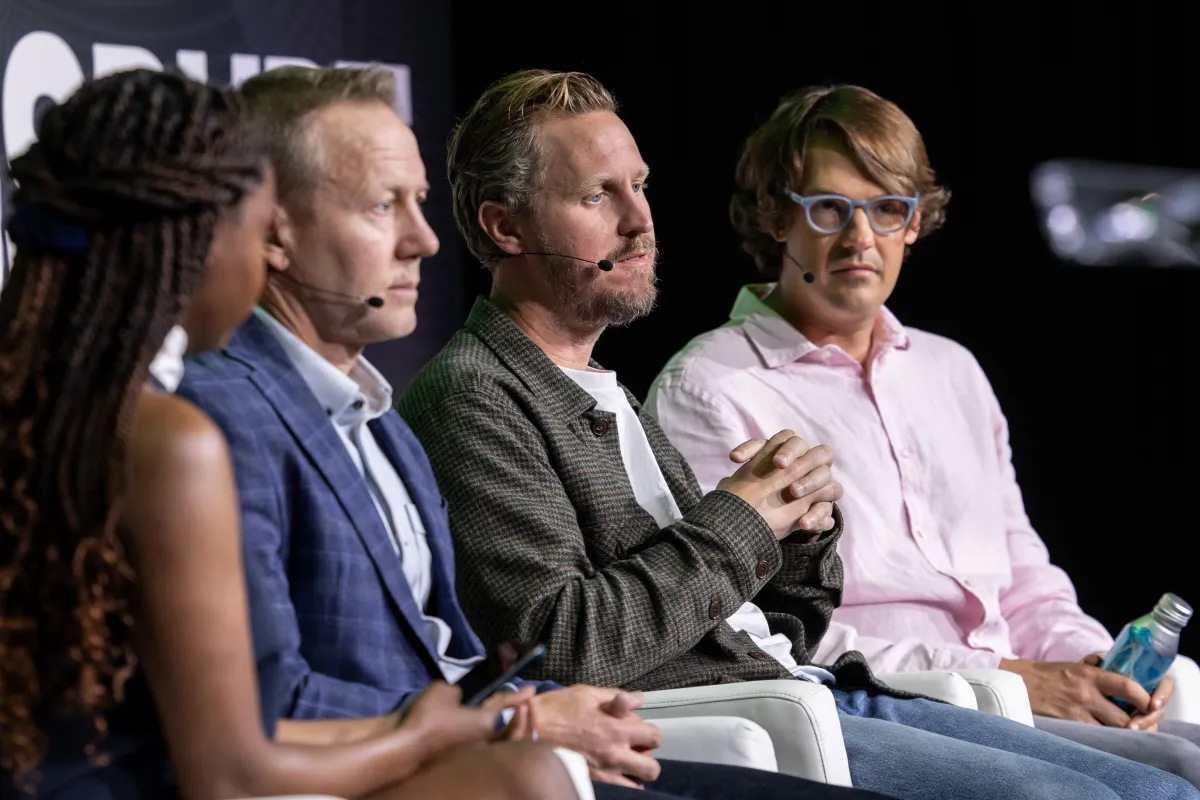
The AI era has changed how fast startups can grow. Startups can grow so fast that they hit high annual recurring revenue (ARR) numbers, only to crash and burn a few months later. At this year’s TechCrunch Disrupt, Lovable go-to-market lead Luke Arno, Ben Broca of the AI platform Polsia, and Theory Ventures’ Tomasz Tunguz gave founders some tips on how to set their companies up for success in those first 90 days.
Broca, whose company Polsia uses AI agents to build and run businesses with almost no human staff (Broca says he is its only employee), said that product-market fit is one of the hardest things to find right now, especially in an era where so many products can easily be copied by competitors. In response, Arno said that durable go-to-market strategies are those that can be reliably repeated.
“The most critical thing for founders or earlier-stage companies to do is develop learning density or pattern recognition for where your customers are,” Arno said. “Don’t rush to build out a top-down go-to-market motion if you’re not there yet.”
That’s why, in those first 90 days after launching a commercial product that’s ready to sell, founders should not mistake early, fast revenue for a sign that the startup is ready to scale, Arno said.
Once a startup finds use cases that work, it will only be ready to build out a sales team and go for growth after it can attract new customers by repeating what has worked. If every sale requires new tactics, the startup hasn’t truly hit product-market fit.
“If I bring on 10 new customers in 10 different ways to solve 10 different problems, sure, I brought revenue in, but I don’t have a way to go scale a go-to-market,” Arno said. “If I bring three customers in with a similar motion to solve a similar problem, now I have high confidence that I can go scale.
Lovable, the AI app-building startup, set a lot of those early benchmarks with how fast it grew, and now founders everywhere are feeling the pressure to do the same. Lovable is valued at more than $13 billion by its investors, says its ARR has passed $600 million, and has raised more than $700 million in funding to date.
“The expectations for overall execution speed are absolutely tremendous,” Tunguz said.
But Tunguz said growth like Lovable’s is still the exception, though founders should still move fast. The pressure they feel is real, he said, because far more money flows through the startup ecosystem at every stage than when he began investing in 2008. Today, a seed deal brought in by one of his partners could just as easily be a $5 million raise, a $50 million raise, or a $500 million raise.
The winners all focus on one thing: understanding their customers well enough to know what will keep them around even after any hype subsides.
“Community building is very important and being close to customers is very important,” Broca said. He said founders can send emails and throw events, and he personally likes to talk to a lot of his customers: “The general rule is always to be talking to customers.”
When you purchase through links in our articles, we may earn a small commission. This doesn’t affect our editorial independence.
Disclaimer : This story is auto aggregated by a computer programme and has not been created or edited by DOWNTHENEWS. Publisher: techcrunch.com