MEXICO CITY — The U.S. is investigating two prominent Mexican governors, multiple sources said, as the Trump administration expands its campaign against high-level Mexican officials suspected of ties to organized crime.
The move against sitting government officials threatens to undermine Mexico’s ruling party — which came to power on a promise to combat corruption — and further strain the already tense relationship between the two countries.
For years, the U.S. refrained from investigating sitting politicians in its fight against drug trafficking, preferring to target cartel leaders. But as many of Mexico’s most notorious drug traffickers have been killed, arrested, or have turned themselves in, Washington has shifted its attention to prosecuting elected leaders and law enforcement agents suspected of involvement in organized crime.
Alfonso Durazo, the governor of Sonora, and Américo Villarreal Anaya, the governor of Tamaulipas, have both been stripped of their U.S. visas amid criminal probes, according to people familiar with the cases.
Both are members of Mexico’s ruling Morena party and allies of President Claudia Sheinbaum, who has criticized a recent spate of U.S. investigations into sitting Mexican leaders as electoral interference and a violation of her country’s sovereignty.
In April, the Justice Department revealed sweeping criminal charges against prominent members of Sheinbaum’s party, including Gov. Rubén Rocha Moya of Sinaloa. He was accused along with nine other current and former officials of helping the Sinaloa cartel smuggle fentanyl, heroin, cocaine and methamphetamine into the U.S. in exchange for millions of dollars in bribes and help winning elections.
“Is it truly a legitimate interest to combat organized crime?” Sheinbaum asked at a recent political rally. “Or are we perhaps witnessing how sectors of the American far right are using our country to position themselves for their 2026 elections? Or do they intend to influence the 2027 election in our country?”
Durazo, 71, the governor of the border state of Sonora, is one of the highest-profile leaders to date believed to be under investigation. He previously served as Mexico’s security minister, helping implement former President Andrés Manuel López Obrador’s controversial “hugs, not bullets” strategy, which emphasized addressing the root causes of crime instead of military confrontations. Sonora is a major drug trafficking transit route to the U.S.
People familiar with his case, who spoke on condition of anonymity to discuss internal matters, said Durazo’s visa was canceled last year, and the U.S. is investigating him for alleged ties to organized crime.
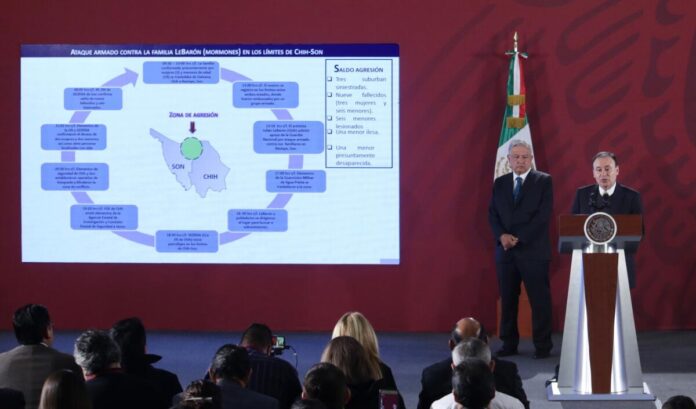
Alfonso Durazo, right, then Mexico’s secretary of public security, appears at a news conference with then President Andrés Manuel López Obrador in Mexico City in 2019. He has been a close ally of López Obrador.
(Sashenka Gutierrez/EPA-EFE/REX/Sashenka Gutierrez/EPA-EFE/REX)
They said Durazo travels to the U.S. regularly to receive specialized treatment for a medical condition under a parole program typically reserved for individuals who are cooperating with law enforcement. Durazo’s office did not respond for a request for comment.
The program, known as Significant Public Benefit parole, allows non-citizens to testify before a grand jury to mitigate consequences of actual or pending charges against them or others.
“It’s really meant to be used as a tool to get intelligence and obtain evidence,” Vanda Brown of the Brookings Institution said of the program. Mexican journalist Luis Chaparro previously reported that Durazo had lost his visa because of a U.S. investigation and was a recipient of parole. A typical tourist visa for the U.S. lasts up to 10 years with a possibility of renewal.
The investigation into Villarreal, 68, is connected to the smuggling of pirated fuel, a lucrative illegal trade known in Mexico as huachicol, according to people familiar with the case. The sources said Villarreal also has Significant Public Benefit parole. When he crosses into the United States he is often escorted by U.S. officials, said one person familiar with his case.
In a statement, Villarreal denied any wrongdoing, calling the claims false, biased and lacking evidence. He said that, as a public servant, he has always been transparent, responsible and followed the law.
Tamaulipas, which borders Texas, is a hub for fuel smuggling to and from the United States. Multiple previous governors have been investigated in Mexico for connections to criminal groups,
The new revelations are likely to exacerbate pressure on Morena, whose founder, López Obrador, rose to power on a promise to combat corruption, which he said fueled violence. He vowed that no one involved in corruption would be spared, even “brothers-in-arms.”
Sheinbaum, López Obrador’s political protege, has vowed to continue that fight, and her administration has arrested dozens of local officials accused of wrongdoing, including some affiliated with Morena.
Some members of her party have pushed Sheinbaum to sever ties with Rocha Moya and other leaders suspected of links to organized crime, lest Morena be tainted by the allegations. But Sheinbaum has instead closed ranks, insisting her government will not comply with the U.S. request that it extradite Rocha Moya.
At a rally over the weekend, Sheinbaum dismissed the U.S. investigation into Sinaloa officials as a politically motivated smear campaign against her leftist government.
Ronald Johnson, the U.S. ambassador to Mexico, criticized her comments. “The fight against cartels should unite us, not divide us,” Johnson wrote on X. “Every moment spent turning this shared security challenge into a political dispute is a missed opportunity to strengthen our partnership and protect the people we serve.”
The escalating rhetoric comes at a critical moment for the two countries, which next month will embark on a review of their free trade agreement with Canada.
Over the years, U.S. prosecutors have occasionally brought corruption cases against former Mexican officials, including Genaro García Luna, a former security minister who was sentenced to prison in 2024 for taking bribes from the Sinaloa cartel.
But targeting current elected leaders is a new — and more confrontational — approach. Members of the Trump administration insist it is necessary because the drug trade depends heavily on the officials who protect it.
At a meeting in May, Department of Homeland Security Secretary Markwayne Mullin told Sheinbaum that the Trump administration expects Mexico to send Rocha Moya to the U.S., according to sources.
Sheinbaum said her administration will decide the governor’s fate based on its own assessment of his conduct, and warned Mullin that further U.S. indictments against elected leaders would be considered political interference in Mexico’s affairs.
Sheinbaum may opt to prosecute Rocha Moya, which would signal to her base that she takes corruption seriously, but isn’t willing to bow to U.S. pressure.
U.S. officials, though, have little faith that Rocha Moya or other politicians will be convicted in Mexican courts.

Gen. Salvador Cienfuegos, in 2016 photo, once served as Mexico’s defense minister. He was arrested in Los Angeles in 2020 on drug-trafficking charges and was released to the Mexican government, which later exonerated him.
(Associated Press)
They point to former Defense Minister Salvador Cienfuegos, who was arrested on U.S. drug- trafficking charges in Los Angeles in 2020, and was released to Mexico after López Obrador vowed to carry out an investigation. Less than two months later, the Mexican government exonerated Cienfuegos. Later, López Obrador awarded him a top military honor.
Trump has made combating Latin American drug cartels a signature foreign policy priority, taking a maximalist approach that has included declaring gangs terrorist organizations, blowing up alleged drug boats at sea, and authorizing U.S. military strikes in Ecuador and Guatemala.
Trump has repeatedly threatened strikes against cartel targets in Mexico, which Sheinbaum says Mexico would consider an act of war. She has decried revelations of the recent participation of CIA officials in a raid on a drug lab in northern Chihuahua state, saying it was a breach of sovereignty.
The cancellation of visas is a quieter, but potentially powerful strategy.
Last year, Reuters reported that the U.S. had, without fanfare, revoked the visas of at least 50 politicians and officials in Mexico, although few have publicly confirmed they lost visas. One politician who acknowledged losing hers is Baja California Gov. Marina del Pilar Avila, who has denied links to organized crime.
The U.S. National Counterterrorism Center has taken the lead in canceling visas, sources told the Times. The center, a part of the Directorate of National Intelligence, now focuses more on the cartels that have been designated as terrorist groups and the politicians allegedly colluding with them than on possible threats from the Middle East, sources said.
Sources familiar with the new strategy said not all U.S. law enforcement agencies are on board with more visa cancellations, which they say can sometimes interfere with criminal investigations.

Mexican President Claudia Sheinbaum has repeatedly rejected President Trump’s offers to deploy the U.S. military against cartel targets in Mexico, saying such action would violate Mexican sovereignty.
(Cristopher Rogel Blanquet/Getty Images)
Inside the Sheinbaum administration, the indictment of Rocha Moya has caused an anxious parlor game of guessing which Mexican officials may be indicted next, people familiar with the matter said.
The targeting of officials comes as Sheinbaum looks toward midterm elections in 2027, where the entire lower chamber of the Mexican congress — where her party currently holds the majority — is at play, along with 17 state governorships. She must choose candidates to endorse carefully, political analysts said, because touting gubernatorial candidates that could end up targeted by U.S. law enforcement could throw the election into disarray and threaten the party’s majority.
Privately, Sheinbaum has urged members of Morena to resign if they are involved in corruption. Publicly, she has taken a defiant stance in the face of U.S. allegations that Mexico is “controlled” by cartels. On Tuesday, she responded to Ambassador Johnson, asking that he refrain from commenting on Mexico’s domestic issues.
“Mexico’s affairs belong to Mexicans,” she said.
This article was co-published with Puente News Collaborative, a bilingual nonprofit newsroom that covers stories from Mexico and the U.S.-Mexico border. Cecilia Sánchez Vidal in the Times’ Mexico City bureau contributed to this report.
More to Read
Disclaimer : This story is auto aggregated by a computer programme and has not been created or edited by DOWNTHENEWS. Publisher: latimes.com