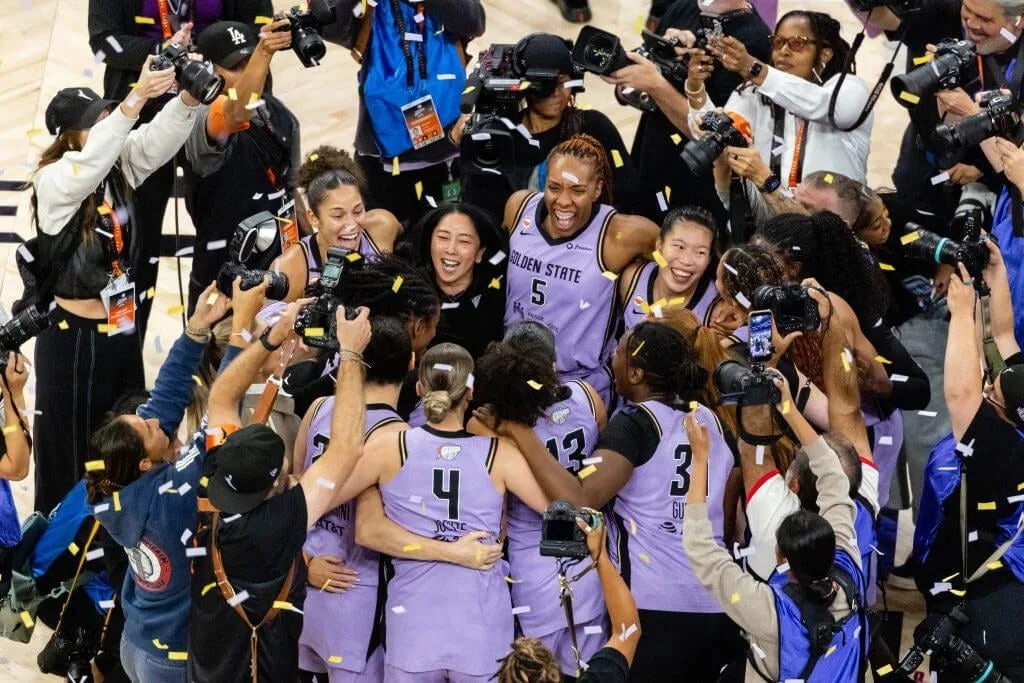
The wildest of the WNBA’s 30 seasons ended in defiant triumph. It ended with evidence that the league is greater than the labor battles, culture wars and institutional missteps. It ended with a gnarly defensive finals lasting seven games and holding interest all the way to a record-setting television audience for Game 7.
It ended with the Golden State Valkyries, a newbie full of substance, capturing the title in their second year. And it ended with coach Natalie Nakase, a 5-foot-2 former UCLA walk-on, standing atop women’s basketball and delivering a message about her team that resonated with the entire sport.
Advertisement
“This is for all the people that have been underrated, misunderstood,” she said. “This is for all y’all, because this is proof: If you put your heart and all your soul, you can (expletive) win championships!”
After a taxing season, there couldn’t have been a more perfect final scene: confetti and F-bombs bursting in air.
Two nights before that cinematic ending, the Valkyries-Atlanta Dream series played Game 6 at 12:30 p.m. on a Thursday because of drama and suspect planning over arena availability. Nobody wanted a lunch-hour conclusion in Atlanta, and fortunately, it wasn’t the final impression this season. Despite the confusion and criticism, that penultimate moment still managed to be compelling.
Now, let’s put both images side by side: Game 7 averaged 3.3 million viewers, the most-watched WNBA playoff game, and Game 6 averaged 1.5 million, a robust number even though office workers needed to sneak glances on their phones. That exemplified the WNBA in 2026. Two extremes stirred endless debate. Yet the sport won anyway.
Advertisement
That shouldn’t be viewed as a crisis. It’s a growth spurt. The league is wearing clothes that no longer fit. Now that another consequential offseason has arrived, with a vacant commissioner job and a handful of leadership jobs open at high-profile franchises, there’s time to revamp the wardrobe.
For the past few years, as leaguewide popularity has risen, critics have pointed to various controversies as proof of an unserious league: the ugly moments of a labor fight that dragged into March before resulting in a landmark new collective bargaining agreement; the players’ denunciation of the leadership style of retiring commissioner Cathy Engelbert; the ongoing perception of jealousy over Caitlin Clark’s popularity; the feud between newcomers who worship Clark and longtime loyalists with a broader view of the league; a manufactured culture war over transgender players (even though the league has none) that turned courtside seats into stages for provocateurs.
Those critics have some evidence, for sure, but their conclusion is off the mark. Unserious leagues don’t matter this much to people. Much of the drama wasn’t a sign of a clown show. It was an indicator of growth the league wanted but never fully prepared to handle.
For a long time, the league survived by doubting itself, by hedging its bets. From now on, it will thrive by believing.
Advertisement
Not surface-level confidence. Complete self-assurance. Ambition to maximize progress.
Look at what’s no longer in question. The salary cap went from $1.5 million to $7 million. Ratings and attendance numbers are surging. The Golden State franchise is worth $1 billion two seasons into its launch. Clark hasn’t arrived as a savior. She has been an amplifier. The survival question that has hung over the WNBA since 1997 doesn’t need to be asked anymore.
The greatest fix the WNBA can make isn’t really a fix. It’s a shift in mentality. The league doesn’t need repair anymore. Maybe it never did.
For three decades, the product has been better than its reputation. The basketball was good when crowds were sparse and TV execs were offering scraps. Skeptics, many of whom never watched and lazily repeated the assumption that women’s sports could only survive as charity, mistook neglect for a judgment. The WNBA absorbed that doubt and built a safe space for protection. It had to be careful, cost-conscious and grateful for the tiniest bit of acknowledgment. That approach kept the league alive. Now, those remnants hold it back.
Advertisement
It’s noticeable in the hedging. The WNBA took too many trepidatious stances on major issues, whether it was trans eligibility, policing nasty fan behavior or ensuring finals-worthy buildings were available. When the WNBA had less to lose, it took bolder positions, especially during the pandemic-era days of heavy collaboration with the players. Lately, it has been afraid to establish a clear identity, mostly because a diverse audience is contributing to this boom. But every time the league tiptoed, someone else filled the gap and co-opted the story. And those people never have the sport’s best interest at heart.
Golden State represents the sleekest new model of what it means to meet this moment. The Valkyries haven’t hedged. They went big from the start: turning the Chase Center into Ballhalla, sellouts and season ticket holders galore, a culture deliberately built around a coach and a roster that plays like a team rather than a collection of parts around a marquee superstar. They functioned like a major-league franchise before anyone permitted them. Now, they’re champions. Already, they’re champions. But that trophy didn’t make them successful. It was the culmination of their breakthrough. They’re the trendy avatar for what belief looks like.
The Valkyries aren’t alone. Franchises such as the Las Vegas Aces, New York Liberty and Seattle Storm have spent years outpacing the league in ambition, investing in facilities, staff and continuity and becoming model franchises. Under new ownership, the Phoenix Mercury are getting to that level, too. No operation is more stable than the Minnesota Lynx. The Indiana Fever, who endured a long stretch as one of the league’s worst-run organizations, are finally rising structurally to Clark’s level of transcendence. With a team president and general manager to hire, they could complete their transformation. The Dream, a franchise once known more for turmoil than basketball, ended this season with the best kind of problem: too much demand for its building to hold. The Dallas Wings look like they could be next. Or maybe the Washington Mystics, another good organization that won the title in 2019 and is currently stocked with enviable talent, are a budding dynasty.
A couple of franchises are struggling, but the general message throughout the league appears to be the same. Ambition isn’t as risky as it used to be. The teams that bet big on the WNBA are winning the bet. The league office should go all in, too.
Advertisement
That’s the task for Engelbert’s successor. The league doesn’t need a caretaker or a crisis manager. It doesn’t need a CEO above all other skills. It needs someone who believes fully and builds daringly. No need to be reckless, but this is now a maximizer’s job. Assume sellouts rather than hope for them. Draft and articulate a league-wide code of conduct so that the protection of players and fans isn’t dependent on which arena hosts the game. Box out the provocateurs by taking proactive measures to eliminate blind spots.
And this one is for Adam Silver and the NBA owners he serves: Empower a commissioner with greater autonomy to make decisions in the WNBA’s interests, even when they don’t align perfectly with the NBA’s.
None of this is radical. It just requires the league to stop acting as if one wrong investment will make it disappear.
Believing at this level carries risk. But the WNBA has spent 30 seasons managing risk. The bigger danger now is not being ambitious enough.
Advertisement
Engelbert deserves credit for navigating all of this and putting the league in a strong position, including an aggressive plan to expand to 18 teams by 2030 that has yielded incredible early returns. Her successor must be asked to do more than maintain. The opportunity exists to lift the WNBA out of the niche tier permanently.
The WNBA has spent three decades proving it was underrated. That part is over.
It’s time to shop for a new look, one fitting a league that knew it was always destined to be fashionable.
This article originally appeared in The Athletic.
Minnesota Lynx, New York Liberty, Seattle Storm, Los Angeles Sparks, Washington Mystics, Atlanta Dream, Chicago Sky, Connecticut Sun, Indiana Fever, Dallas Wings, Las Vegas Aces, Phoenix Mercury, Golden State Valkyries, Portland Fire, Toronto Tempo, WNBA, Opinion, The Athletic Women’s Basketball Show, WNBA Highlights
2026 The Athletic Media Company
Disclaimer : This story is auto aggregated by a computer programme and has not been created or edited by DOWNTHENEWS. Publisher: Sports.yahoo.com