
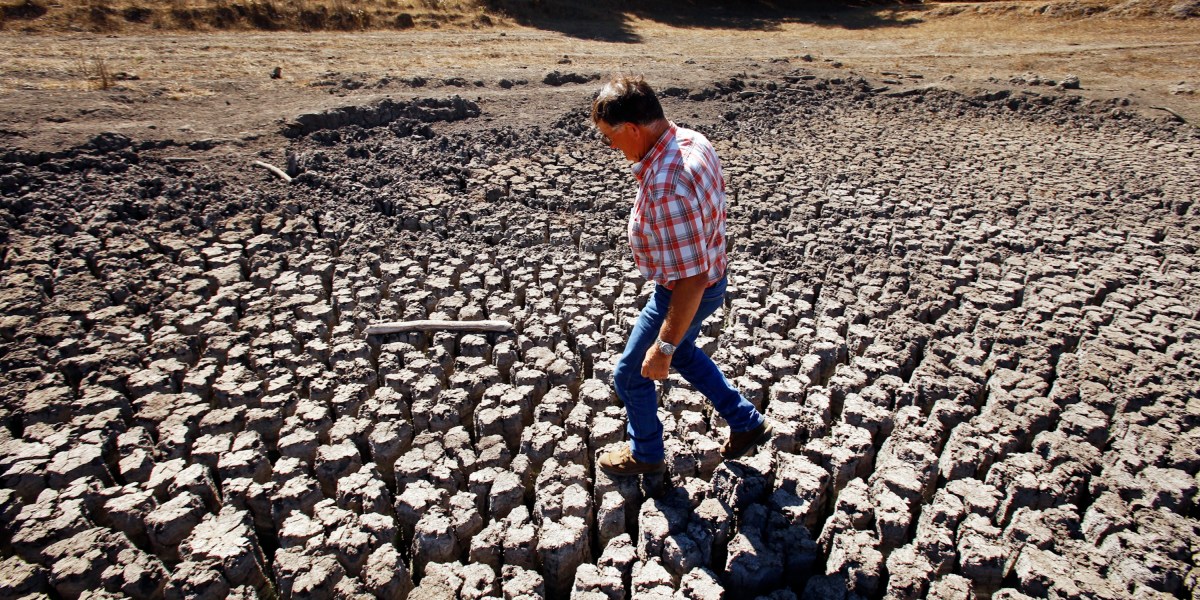
The world is in deep water, but only metaphorically. Basins, aquifers, and other natural storage systems have been drained past recovery in our lifetimes, and one analyst warns markets aren’t taking the matter seriously enough.
The United Nations University Institute for Water, Environment and Health (UNU-INWEH) released a bombshell report earlier this year warning of “global water bankruptcy,” finding humans have overdrawn water from the natural environment.
UNU-INWEH director Kaveh Madani put the crisis in economic terms in the report: “In finance, when you spend more than you earn for too long, you go bankrupt. We have done exactly that with our water ‘checking’ and ‘savings’ accounts.”
The natural emergency has widespread economic impacts. The value of water and freshwater ecosystems tallies up to $58 trillion, or about 60% of the global GDP, according to the World Wildlife Fund’s 2024 Living Planet Report. Within 25 years, about 46% of global GDP could come from parts of the world with the highest water risk, compared to 10% today.
EBC Financial Group market analyst Sana Ur Rehman said despite the ways in which a lack of water threatens economic growth, markets are not pricing in the costs of water-related risks, and are overlooking the need for key resources to replenish and sustain the crucial resource.
“Water has no globally traded futures contract. It has no liquid benchmark price. It has no standardized risk metric that flows into credit models, equity valuations, or sovereign debt assessments,” Ur Rehman wrote on a note on Tuesday. “The result is a systematic mispricing of water risk across nearly every asset class.”
About half of the world’s food supply is produced in areas where total water storage is on the decline, and that same area is home to three billion of the world’s population. Drought alone—much of which is from human-driven activities like deforestation, pollution, and climate change—is costing $307 billion annually, the UN report said.
Beyond its foundational role in farming and hydropower, H2O has become a critical resource in AI data centers, used to cool servers and prevent them from overheating. Some tech companies have committed to using wastewater to cool data centers, which can later be treated.
Ur Rehman argues that still not enough has been done to invest in solutions to create a sustainable supply of H2O as humans continue to guzzle up the resource.
“The gap between what water systems need and what they receive in capital investment is widening at exactly the moment when climate variability is accelerating the depletion of natural water storage,” he said.
Global water woes
Ur Rehman points to a number of water disputes draining economic gains, including the Nile River, from which Egypt relies on for 97% of its water supply. The agriculture industry in Egypt is massive, employing more than a quarter of its workforce and accounting for about 15% of its GDP. However, water availability per capita has plummeted from 2,526 cubic meters per year in 1947 to less than 600 today. The UN’s threshold for water scarcity is 1,000 cubic meters.
The Grand Ethiopian Renaissance Dam may exacerbate these troubles. A 2021 University of Southern California study found that filling this dam would reduce Egypt’s downstream water supply by about a third, reducing arable lands by 72%, which would result in $51 billion in economic losses from agriculture.
Troubles extend to the American Southwest, where the Colorado River, bolstering $1.4 trillion in economic activity in the region and northern Mexico, has experienced a structural deficit for more than 20 years. Areas such as Lake Mead and Lake Powell located along the river are key drivers of economic activity through recreational visits, and a 2023 University of Arizona study projected up to nearly $90 million in negative economic impacts as a result of fewer visits caused by lower lake levels.
In other parts of the U.S., impacts of water shortages aren’t theoretical. A seven-year drought in Corpus Christi, Texas, is on the verge of a water emergency that may hobble its refineries and petrochemical plants.
The agricultural industry in Kansas, Oklahoma, and Texas saw lowest crops, higher feed costs, and the need to sell cattle as a result of ongoing drought. Between 2020 and 2024, drought-related cutbacks cost the region an estimated $23.6 billion. Beyond drought, U.S. farmers are also navigating plummeting crop prices and increased input costs as a result of tariffs and the ongoing war in Iran that have left some unable to afford fertilizer.
“It’s kind of an unprecedented confluence of things,” Ariel Ortiz-Bobea, a resource economist at Cornell University, previously told Fortune. “Some naturally occurring, some geopolitical, and then some domestic policy that is all kind of converging.”
Missing investments
Most concerning to Ur Rehman from an economic standpoint is the lack of private funding for water management. He suggested markets have underinvested in water supply maintenance because it has for a long time been regarded as an environmental rather than an economic problem.
The UN conversely advocates for legal and governance institutions to take the lead in protecting water supplies, suggesting sweeping policy and legislative changes as part of a larger global conversation about climate change.
The World Bank Group announced earlier this month a global initiative called Water Forward to improve water security for $1 billion people. The organization will partner with development banks and financial institutions with the intention of improving water systems against droughts and eventually strengthen job creation from jobs requiring heavy water usage.
“When water systems work, farmers produce, businesses operate, and cities attract investment,” World Bank Group president Ajay Banga, said in a statement. “Our task now is to align reform, financing, and partnerships to deliver reliable water services at scale.”
Disclaimer : This story is auto aggregated by a computer programme and has not been created or edited by DOWNTHENEWS. Publisher: fortune.com



