When it comes to deciding the fate of the planet, Colleen Golja always thought science and reason would have a seat at the table. That was until one morning last September in London, when the climate researcher took part in the first in a series of war games. The goal: to prevent an uncontrolled global race to develop a technology aimed at cooling the planet but that comes with vast, unknown risks that could reshape life on Earth.
“I thought that would be such an easy thing. Like, we can all agree to do ethical research and make sure it’s for the better of all humans,” she told WIRED. “And boy, was I wrong.”
The simulation, titled Exploring Geopolitical Tipping Points and Climate Cooling Strategies, saw a couple dozen foreign-relations experts, scientists, military personnel, and former government officials from across the world convene in a meeting room at Queen Mary University of London. After making introductions over coffee and little yogurts, they sat at tables arranged in a square with the name of the country or organization each person was playing: national governments, climate NGOs and nonprofits, indigenous groups, and tech companies. Golja was assigned to provide technical advice to help participants make scientifically literate decisions.
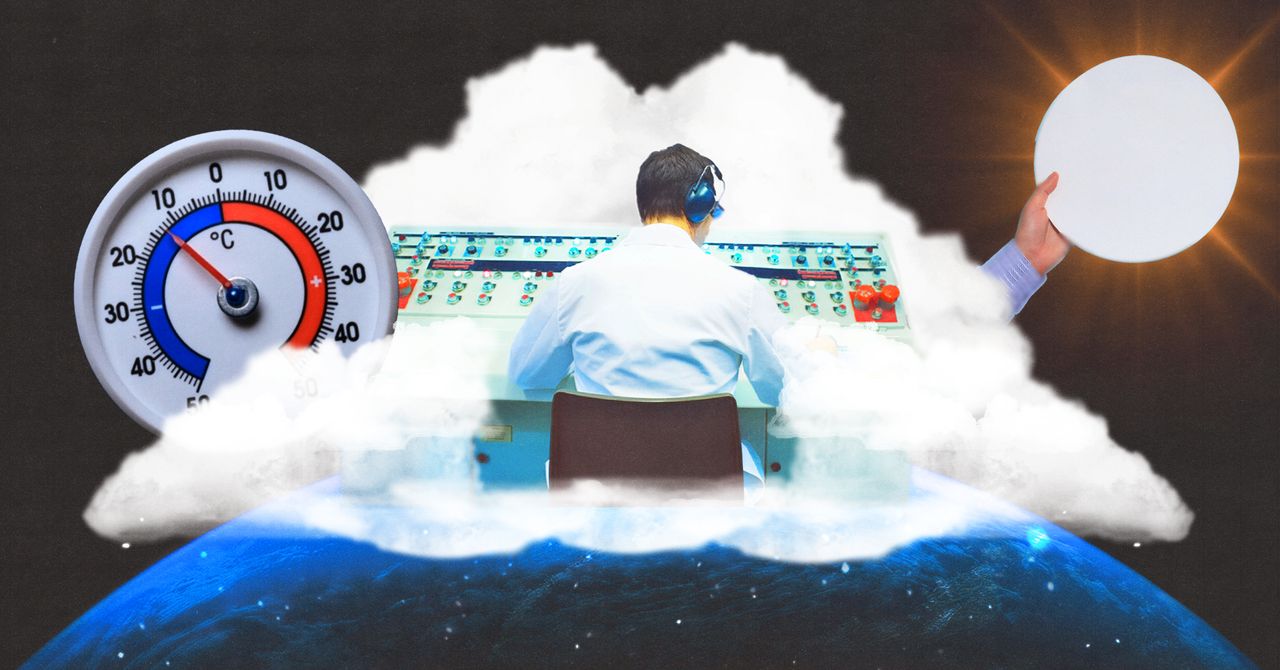
The point of the game was to stress-test the world’s response to a group of prospective technologies known collectively as solar radiation modification. These technologies promise to reverse global warming by reflecting away a portion of the sunlight reaching Earth, for example by spraying particles of sulphur dioxide or some other manufactured substance into the atmosphere. The cooling effect of this kind of solar geoengineering is widely accepted. It would mimic the well-known impacts of large volcanic eruptions, which temporarily cool the planet by half a degree or more. But the fallout is less certain—and less equal. Some regions will suffer: Models predict drying in sub-Saharan Africa and more intense tropical storms in the Atlantic. The cooling effect would also last only as long as the geoengineering continued; after that the global temperature could shoot back up with wild and hard-to-predict effects.
Until recently, the idea of solar radiation modification was a speculative niche of climate science. That has changed fast. Private firms are exploring solar geoengineering as a commercial opportunity: Last year, a US-Israeli startup called Stardust Solutions raised $60 million, and in May it released details of a suite of new inventions it claims would give humans the ability to dial down the global temperature as desired. In August, Elon Musk, whose company SpaceX might be a candidate for delivering geoengineering interventions, threw his voice behind solar geoengineering, writing on X: “Space satellites to control temperature and massive geo-engineering will be needed or it will be game over.”
The world is going to have to make decisions about how to govern this technology much sooner than most policymakers imagine, Cynthia Scharf, a former UN advisor, told WIRED. “It’s not 15 years from now; it’s in the next decade, easily.”
It was against this backdrop that Danielle Young, an assistant professor in international relations at Leeds University, arranged the war game. Its setting was a hastily convened UN committee charged with coordinating the international response to developments in solar geoengineering. The game unfolded over simulated meetings set at three points in time: the present, September 2027, and September 2028. Each step ratcheted up the stakes, with the game creators introducing new advances in sunlight-reflecting technology. As in real life, no one knew all the facts, and players had to respond to events that were bringing the world closer to a full-scale attempt at deploying solar geoengineering tech, even when they may not have a full picture of what had truly occurred—or what any of the others were up to.
The first session set the tone. Distrust and disinformation dominated. As participants discussed rules governing outdoor experiments in an attempt to agree an international deal, players representing both the US and China told the group they could not sign a deal that constrained their pursuit of research considered to be in their “national interest.” Nor could they accept a deal that would see their superpower rival taking the lead technologically. Speaking to WIRED, Jeffrey Nielsen, a major in the US Army who played the role of a US national security attaché, summarized the position as “worse than no deal at all is any deal that favors China.”
Tensions escalated when the team running the simulation handed the Russian delegates an “intelligence report” indicating they had found a plane near the Bering Strait believed to be involved in a US geoengineering research program. The US team—which was indeed flying research missions—accused Russia of disinformation.
Meanwhile, the US became convinced China was also conducting research and developing its own program. Beijing’s representatives had tried to insert language into a mooted deal that would ensure no retroactive punishment for past experiments. Then, China approached a player representing SpaceX to float the idea of a technology-sharing program. In a private discussion away from the group, the SpaceX player immediately reported the Chinese approach to the US team. The US demanded an international investigation. The finger-pointing continued, and countries abandoned the talks. The Canadian representative called it a “humiliating defeat.”
At the end of the session, Nielsen was pumped. He’d busted China and derailed any prospect of a global deal. In the context of the game, he told WIRED, it was a “humungous victory” for the Americans. But Young, the researcher who designed the scenario, said the Chinese were not, in fact, conducting experiments in the game. Mutual suspicion meant all parties left the room believing the others were moving as quickly as possible to build their own geoengineering capability.
What played out in the first session reflected “the likelihood, in my opinion, of the geoengineering arms race,” says Nielsen, who clarified he was speaking to WIRED in a private capacity and not representing the views of the actual US government. Most experts agree it would take a superpower’s reach to ensure the safe passage of planes needed to deliver payloads of dust to the stratosphere in a geoengineering exercise. But neither the US nor China would lightly cede control over the global thermostat, says Nielsen, and distrust and poor communication are a significant risk: “Any action related to the issue by one actor can be perceived as malintent by the other.”
The threat of falling behind a rival is “a very strong driver of research and development of capability,” a former British diplomat with a background in national security told WIRED. “But that’s not at all the same thing as deployment.” There are similarities with nuclear arms dynamics—though solar radiation management, unlike nukes, has more obvious benefits as well as downsides, many of which are poorly understood. “There is an interdependence here,” says the former diplomat, who was not involved in the game and spoke on condition of anonymity to preserve relationships. “It’s not an inherently zero-sum game.”
Scharf, who represented the US government alongside Nielsen in the game, told WIRED a “scientifically transparent international collaboration” between China and the US “might be the best we can do in terms of fending off a very dangerous competition between the two. But I certainly cannot imagine that happening under the Trump administration.”
Compounding the problem is a lack of information. Geoengineering has historically been viewed with suspicion and often ignored by the scientific mainstream. One researcher told WIRED he’d experienced ostracization and barriers to academic progression owing to his interest in the technology; he no longer works in the field.
This lack of scientific interest greatly frustrated Golja, who spent much of the game watching as a bystander while political posturing dominated. Given the low level of knowledge around solar radiation modification and its side effects, she was one of very few experts who could help the participants understand the climate impacts of what they were discussing—yet she was largely ignored.“I was just so surprised about how little anyone actually cared about the science,” she says.
In the next sessions, the organizers tried in vain to nudge the talks back toward the realities of climate change. The participants received frequent notifications of climate disasters. These barely registered. Golja had prepared an “emulator,” a real-world demonstration of the best available science on how solar radiation management might affect weather patterns in different regions. It was ignored. If country representatives asked her anything, it was usually a leading question looking for data that would serve their ends or frame a rival’s proposal as reckless.
Then, during the last day, players were trying to find a way to respond to reports that a major plume of aerosols had been detected. In the game, this had been caused by a joint US-Saudi test of Stardust’s technology, though not everyone knew this. Finally, scientific advice was at a premium. Countries needed to know how to establish a monitoring network of satellites and other observational tools in order to prevent tests like this from happening in secret. A player representing an NGO called the Climate Futures Cooperative approached Golja, offering her money to fund such a scheme.
“Great. Fabulous. Why wouldn’t I do that?” she recalls thinking.
But it soon came out that the Climate Futures Cooperative was actually backed by the fossil fuel industry. The organizers had recognized that fossil fuel companies and major producing countries like the US and Saudi Arabia would have a clear interest in removing barriers from the development of a technology that could combat climate change without having to immediately stop burning coal, oil, and gas. The shadowy NGO spent the game subtly wrecking the vibe and carping about process—though mostly they just sat back and let it burn. Some players—Russia, the US, SpaceX and Stardust—figured out the CFC was not what it seemed, says Young. “But they assessed it was to their benefit and didn’t draw attention to it.” Then the CFC chose its moment to offer money to Golja, only to crater her credibility, isolating and fragmenting the voice of science in the room.
“It was a whole mess,” says Golja.
That final lesson in fossil fuel realpolitik was about all Golja could endure. By the end of the last day, she was in tears.
At no point did the countries in the game agree to a deal, despite multiple proposals being put forward. European countries and Canada tried to build support for safeguards and open scientific research, but the talks constantly got bogged down by delay tactics and veered into tense showdowns over duelling strategic interests. In their final report, the researchers running the simulation—whose work was sponsored by the UK government-funded Advanced Research and Invention Agency—concluded that “strategic competition and state sovereignty drove the simulations, not climate concerns.”
Simulations like this one are not supposed to predict the future. The outcomes depend on the design of the game and the relative personalities and experience of the players. Many of those in the room lacked first-hand diplomatic and national security experience. The UN forum, which organizers selected as the game’s setting, may also not be as effective as talks between smaller groups of major countries. But the experiment in London echoed and refracted through the real world, during and after the months it was running.
In March, two papers from conservative US think tanks urged the Trump administration to take the lead on solar radiation modification and counter China’s threat. One memorably invoked a new, MAGA-coded term: “Weather sovereignty.” This month, the Observer newspaper in London revealed that the UK Ministry of Defense had paid a deep tech security consultancy to conduct research into sunlight reflection. Then, last week, the British government released its first official policy paper on the field, backing further research but stating firmly that it did not support deployment and “does not plan to do so.” Stardust has continued its lobbying of the US and governments around the world; CEO Yanai Yedvab told WIRED its job was getting easier as, unlike before, “the majority of policymakers … are already aware of this technology.”
Stardust has always maintained that it will not conduct large-scale outdoor experiments, let alone full deployment, before global governance is in place. “We are developing a very powerful tool,” Yedvab says. “When you develop this kind of powerful technology—and you have many precedents—national interests will play out. We’re not naive about it.”
Meanwhile, drivers of the climate crisis are intensifying. During the time span of the game, efforts to curtail the use of fossil fuels were being undermined by rising energy costs and political hostility. Week after week, an incredible summer of drought and heat pounded Europe. In the final week of August, the collapse of a glacier on the Tibet-Nepal border fulfilled the prophecies of decades of climate scientists, killing more than 1,450 people.
In the months since the simulation ended, Golja has reevaluated many things. On a corkboard behind her desk, she has pinned up a note to herself, laying out a vision for life in a world ruled by narrow geopolitical self-interest rather than science, evidence, and reason. Her answer: She plans to return to the small coastal town where she grew up in Connecticut and use her expertise to help local climate groups build the seawalls and coastal erosion buffers they will need to cope with the inevitable. “To try and make a difference where it feels like I actually have traction,” she says. After what she saw, pursuing science in the hope of informing global decisions no longer held as much appeal. “Now it feels a little bit more personal.”
Disclaimer : This story is auto aggregated by a computer programme and has not been created or edited by DOWNTHENEWS. Publisher: wired.com