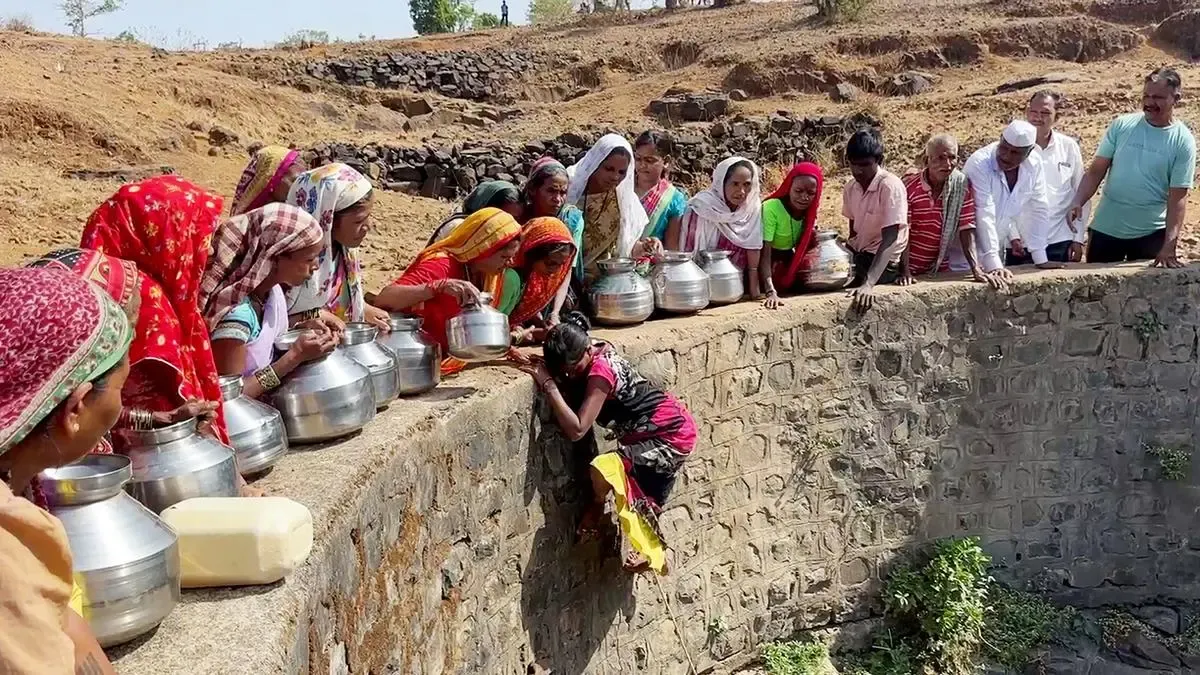
Imagine having to walk more than a kilometre every time you need to bring home drinking water. On a hot summer day, even filling a few pots can mean a tiring journey, with no guarantee that there will be enough water for everyone at home.
For years, this was a reality for families in Wadji, a village in Maharashtra’s Washim district. Residents travelled up to 1.5 km to fetch drinking water, a struggle made harder during the summer months when water sources became scarce.
But what if the answer to their water problem was all around them, quite literally, in the air they breathe?
That is the idea behind Meghdoot, a machine that draws moisture from the air and turns it into drinking water. Installed in Wadji, the technology can produce up to 500 litres of purified water a day, offering the village a new source of water without having to rely entirely on wells or groundwater.
Even a pot of drinking water meant a long walk
Wadji, home to nearly 2,000 people, is among the communities in Vidarbha grappling with water scarcity. The challenge extends beyond the village. According to Central Ground Water Board reports, nearly 40 villages in Risod taluka fall under the semi-critical groundwater category.
For residents, the problem becomes particularly difficult during summer, when temperatures rise, and reliable access to drinking water becomes harder to secure.
To address this, the Wadji Gram Panchayat adopted a technology that draws on a resource people rarely think of as a source of drinking water: the moisture present in the air.
The village is reported to be the first and only one in Maharashtra to have adopted this technology.
How does the technology turn air into water?
The system, called Meghdoot, uses Atmospheric Water Generation technology to extract moisture from the air and convert it into liquid water.
The process begins with fans drawing humid air into the machine. Filters remove airborne particles such as dust and pollen before a refrigeration-based mechanism cools the air to its dew point. As the air cools, water vapour condenses into droplets, much like moisture forming on the outside of a cold glass.

The collected water then undergoes further purification. Activated carbon filtration, ultraviolet (UV) disinfection and other treatment processes help make it suitable for drinking. The purified water is stored before being made available for consumption.
The unit has a reported capacity of around 500 litres a day. However, actual output from atmospheric water generators can depend on conditions such as humidity and temperature, as well as the machine’s operation.
Unlike conventional sources that draw directly on groundwater or surface water, this approach collects moisture from the atmosphere. It can therefore provide an additional source of drinking water in places where existing supplies are under pressure.
The Hyderabad scientists and villagers behind Wadji’s water innovation
The technology was developed by scientists at the Council of Scientific and Industrial Research-Indian Institute of Chemical Technology (CSIR-IICT) in Hyderabad, in collaboration with Maithri Aquatech.
Key contributors to the project include Dr Sridhar, Dr Nivedita Sahu and their team. The system was procured with support from CSIR-IICT under the guidance of its then director, Dr Chandrasekhar.
At the village level, the Wadji Gram Panchayat took the initiative to bring the technology to the community. The unit has been installed at the Zilla Parishad Primary School and Anganwadi, making drinking water accessible at locations used by children and local residents.

Its placement at these institutions also gives schoolchildren and Anganwadi attendees an opportunity to benefit from a source of drinking water close to where they spend part of their day.
Could this help other villages facing water shortages?
Atmospheric water generation is not a substitute for groundwater conservation, rainwater harvesting or reliable public water infrastructure. The technology also requires electricity, and its output depends on local atmospheric conditions. Its long-term usefulness will depend on operating costs, maintenance and consistent performance.

For Wadji, the promise of Meghdoot lies in something simple: bringing drinking water closer to the people who need it. What once required a journey of a kilometre or more could now be met, in part, by a machine that draws moisture from the air.
While the technology cannot replace long-term solutions such as groundwater conservation and rainwater harvesting, it offers another way to address water shortages. If maintained well and adapted to local conditions, such innovations could help more communities explore alternative sources of drinking water, one village at a time.
Source:
‘When wells run dry, Vidarbha’s Wadji literally taps drinking water from air’: by Bhaskar Mehare for The Times Of India, Published on 13 June 2026.
‘Video: Drinking water from the humidity in the air! Innovative experiment by Gram Panchayat’: by Loksatta, Published on 13 June 2026.
Disclaimer : This story is auto aggregated by a computer programme and has not been created or edited by DOWNTHENEWS. Publisher: thebetterindia.com