In a modest community space tucked behind Chennai’s bustling IT corridor in Perungudi, a group of women gather every afternoon, their hands moving with practised precision over strips of plastic wire.
The material bends and loops under their fingers, slowly taking the shape of sturdy, patterned baskets, each one built through a series of tight knots and careful tension.
It is painstaking work, one that demands both strength and patience. “After a while, your fingers start hurting… even your back,” one of the women says, pausing briefly before returning to the weave. “But when it’s finished, you feel proud.”
For many of them, this is not their only job. Their mornings are spent as housekeeping and support staff in the glass-fronted offices that define this stretch of the city, work that keeps the corporate world running, but rarely translates into financial security at home.
The weaving, then, becomes a second shift: a way to earn a little more, to make use of a skill they already possess, and, just as importantly, to sit together in a space that feels their own.
When Siraj Khan first noticed them, she was in the next room, teaching their children. Siraj, a teacher by profession and a single mother who had rebuilt her own life through years of financial and emotional strain, had come to the centre to conduct classes.
But what drew her attention was not just the quiet rhythm of the women at work, but the gap it revealed. “They knew the craft. They were already doing the work,” she recalls. “But there was no way for them to sell it, no system, no market.”
That realisation, simple yet difficult to ignore, marked the beginning of what would later become Thalir LEED, a community-led initiative that has since enabled over a hundred women to turn their hobby into a means of financial independence.
A journey shaped by survival
Siraj’s instinct to notice what lies beyond the obvious is rooted in her own life.
A single mother of two, she remembers navigating a period marked by uncertainty and isolation after her marriage broke down.
“I have no support from my parents or family,” she recounted to The Better India. With mounting financial pressure, she turned to self-education as a way forward, completing my BA, MA, and BEd in English while raising her children.
Her early career as a freelance web designer allowed her to stay close to them, but it came with its own instability. “I needed something more consistent,” she says. That need eventually led her into teaching, a profession she would remain in for over 13 years.
But even within classrooms, Siraj’s approach extended beyond just textbooks. Her weekend activities with NGOs had already started changing her perspective.
“Children don’t just need lessons,” the philanthropist turned entrepreneur says. “They need attention, they need someone to listen.” Over time, her classes became more interactive, rooted in conversation and care as much as curriculum.
It was this same attentiveness that led her to notice the women outside her classroom in Perungudi, and to recognise that their needs, too, extended beyond the obvious.
The foundation that made it possible
The space Siraj walked into was not built overnight.
The New LEED (New Life Economic and Educational Development Trust), where she had begun volunteering, wasn’t a new initiative finding its feet.
For nearly two decades, the organisation had been dedicated to working with underserved communities and building programmes around education, healthcare, skill development, and family welfare.
At the centre of it was Elijah John Mathew, a Chennai-based artist and social entrepreneur whose work often blurred the lines between design, craft, and community impact. His background meant that traditional skills were never treated as relics, but as living, usable knowledge.
/filters:format(webp)/english-betterindia/media/media_files/2026/04/29/2-2026-04-29-19-17-29.png)
Long before Siraj arrived, women in these communities had been learning the art of weaving, working with both natural and synthetic materials, and slowly building a skill they could call their own.
But as is often the case with such initiatives, training did not automatically translate into income. “They had the skill, but no access to markets,” Elijah says. “That gap was very clear.”
Not a single piece sold at the first exhibition
Siraj’s first attempt to bridge that gap did not go as planned. She organised a small exhibition, putting together baskets worth Rs ₹5,000. Not a single piece sold. “It was disheartening. We thought, maybe this won’t work,” she admits.
It was the kind of moment that can make you wonder if you’ve got it wrong — if the work, as it stands, is going to go anywhere at all.
But she didn’t walk away from it.
Instead, she began talking less about the baskets and more about the women who made them — their lives, what their days looked like, and why this work mattered to them in ways that weren’t obvious at first.
/filters:format(webp)/english-betterindia/media/media_files/2026/04/29/4-2026-04-29-19-35-06.png)
The response was immediate. “In one week, we sold two cartons,” she says. “That’s when we understood, people connect with stories.” In 2020, this learning took shape as Thalir LEED, a registered entity that would function as a bridge between artisans and markets.
Its model was simple but deliberate: the organisation would facilitate, but every rupee earned would go directly to the women. “We don’t take a cut,” Elijah emphasises. “This is their income.”
The craft: Where tradition meets reinvention
Basket weaving in Tamil Nadu has long been a part of everyday life, historically rooted in the use of materials like palm leaves, reeds, and bamboo.
However, diminishing markets led to the tradition evolving in urban settings like Chennai, with artisans adapting to more durable and accessible materials.
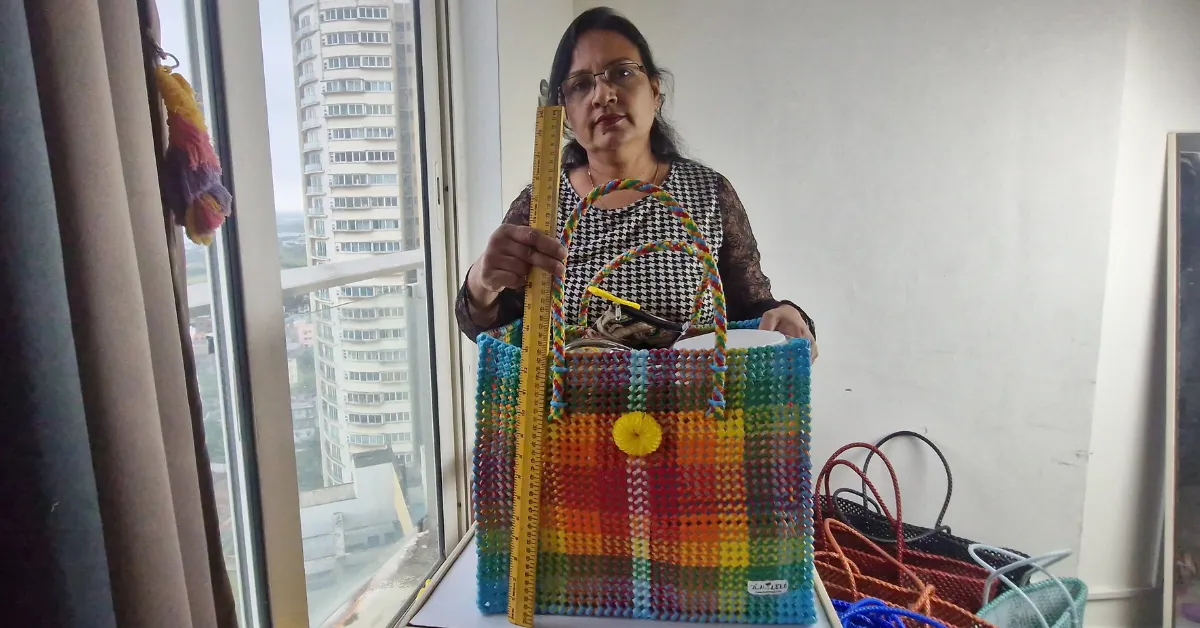
At Thalir LEED, most baskets are made using low-density polyethylene (LDP) wires, often derived from recycled plastic such as PET bottles. The material is flexible yet strong, allowing for both durability and design variation.
The process, however, remains labour-intensive with even a small basket taking up to three days to complete.
Each basket begins with a tightly constructed base, built using foundational knots that determine its strength.
From there, the structure is developed vertically through interlocking loops, with careful attention to tension. Too loose, and the basket loses shape; too tight, and the material becomes difficult to manage.
/filters:format(webp)/english-betterindia/media/media_files/2026/04/29/5-2026-04-29-19-36-37.png)
Different knotting techniques are used at each stage, from basic cross-weaves to tighter locking knots that reinforce durability. Handles are braided separately and attached with additional support, while edges are sealed to maintain structure.
“It’s not just about weaving,” an artisan, who wishes to remain anonymous, explains. “It’s about how you hold it, how tight you pull, how evenly you build.”
While many designs draw from traditional Madras-style patterns, the products themselves have evolved significantly over time.
Adapting to a new market
What began as simple baskets has now expanded into a diverse range of products tailored to contemporary needs.
Today, the women create handbags with zippers and inner linings, office-friendly totes, and customised baskets with internal and external pockets. Sizes range from compact, everyday-use pieces to large, multi-purpose storage baskets.
/filters:format(webp)/english-betterindia/media/media_files/2026/04/29/6-2026-04-29-19-42-18.png)
This shift has been driven in part by demand from the very ecosystem in which these women work.
“Women from the IT offices here have started buying from them,” Siraj says. “They want something functional, but also unique.”
Customisation has become a key feature. Customers can request specific sizes, handle styles, compartments, and finishes, allowing the craft to remain relevant in a rapidly changing market.
Each basket carries a nametag of the woman who made it
What sets these baskets apart, however, is not just their design or durability, but the recognition built into each piece. Every basket, priced between Rs ₹500 and Rs ₹3,000, carries a tag with the name of the woman who made it, a small but deliberate act that ensures the artisan is not invisible in the transaction.
In some cases, customers can even choose to interact directly with the women through the organisation, speaking to the person behind the product.
“I never thought that sitting in Chennai, my name would travel beyond the seven seas to leave a lasting impression among people,” said Poongothai, the chief artist at Thali LEED.
/filters:format(webp)/english-betterindia/media/media_files/2026/04/29/avantika-featured-image-template-11-2026-04-29-19-38-21.png)
For Siraj, this was never meant to become just another product. The person behind it had to matter.
In a market where handmade items often lose any trace of who made them, this small shift changes how the work is seen. It brings the focus back to the women — not just the baskets, but the lives behind them — and restores a sense of recognition that is usually missing.
For Siraj, this was never meant to become just another product. The person behind it had to matter.
In a market where handmade items often lose any trace of who made them, this small shift changes how the work is seen.
It brings the focus back to the women — not just the baskets, but the lives behind them — and restores a sense of recognition that is usually missing.
From Perungudi to global homes
Over time, Thalir LEED has also found a steady international audience.
European customers, in particular, have shown a preference for larger baskets, often ordered in sets of three for seasonal use.
These are used for grocery shopping, storage, and outdoor activities like picnics, especially during the summer months when extended holidays are common.
“They look for durability,” Siraj explains. “Something that will last years.”
Some customers return regularly, drawn by both the quality of the products and the story behind them.
There have also been significant domestic orders, including bulk purchases from cities like Delhi, providing periodic boosts to the women’s earnings.
Income and independence
/filters:format(webp)/english-betterindia/media/media_files/2026/04/29/7-2026-04-29-19-39-15.png)
The income from basket weaving is not fixed. It depends on orders, which fluctuate throughout the year.
But during peak periods, women can earn between Rs ₹10,000 and Rs ₹20,000 a month, a meaningful supplement to their primary income. For many, this makes a tangible difference.
For Poongothai, a single mother without family support, the earnings mean something more personal. “This is my money, and it brings me joy to know I can use it the way I need to without seeking approval,” she says.
In some cases, women prefer to receive payments in cash, an intentional strategy
to retain control over their earnings within complex household dynamics.
This is because access to money isn’t always straightforward. Even when women earn, they may not have full say over how that money is used.
Cash gives them a way to hold on to a portion of it, to meet everyday needs or make small decisions independently.
While the income may not fully support a family, it provides something equally important: financial agency.
‘I stopped feeling alone’: A community beyond work
Yet, the most enduring impact of the initiative lies beyond income.
As the women sit together, hands moving steadily through loops of wire, conversations begin to flow just as naturally.
What starts as small talk often opens into something deeper: stories of strained relationships, financial pressures, loneliness, and how they’ve found ways to get through difficult days
In the act of weaving, a different kind of space takes shape. “It becomes a place where they can share things they cannot say elsewhere,” Siraj says. “They realise they are not alone.”
Over time, these informal gatherings have evolved into support systems, held together by shared experience and understanding. In a context where access to formal mental health support remains limited, this collective becomes its own form of release.
/filters:format(webp)/english-betterindia/media/media_files/2026/04/29/3-2026-04-29-19-40-14.png)
For Janani, who moved to Chennai after marriage and found herself navigating an unfamiliar city in isolation, the shift was deeply personal.
“I didn’t know anyone when I came here. I was lonely and mostly wasted my time doing nothing and waiting for my husband to return home post work. But this opportunity and craft gave me a sense of creativity and community, and I stopped feeling alone.”
For Selvi, a 60-year-old artist, the community has helped revive a spirit she lost after her children moved away for work and her husband passed away following a prolonged illness. “I did not know what to do with myself, and if not for this craft, I wouldn’t have had the will to go on,” she says.
Choosing depth over scale
Efforts to expand the initiative beyond Perungudi have faced challenges, particularly in maintaining quality and consistency.
“We tried bringing in artisans from other areas,” Siraj says. “But the standards didn’t match, and many couldn’t commit.” Rather than scaling rapidly, the team chose to focus on strengthening the existing network.
Since its inception in 2020, Thalir LEED has engaged over 100 women, with around 30 to 40 actively involved at any given time. The model remains flexible, women can join, leave, and return based on their needs.
A continuing story
If The New LEED laid the foundation, building skills and fostering community, Siraj’s intervention created a pathway for those skills to translate into income. Together, the effort reflects a model rooted in collaboration rather than ownership. “I didn’t set out to build a business,” she says. “I only wanted to make sure that, unlike me, no woman felt trapped because she had no options.”
/filters:format(webp)/english-betterindia/media/media_files/2026/04/29/4-2026-04-29-19-41-16.png)
By evening, the day’s work begins to stack up, finished baskets lined along the walls, each one slightly different from the next. They will travel far from this room, into homes across cities, sometimes across countries. But what they carry cannot be measured in utility alone.
They carry hours of labour, quiet conversations, and the weight of small but significant shifts, a little more income, control and confidence. And for the women who make them, that is often enough to keep weaving.
You can explore and support their work here: Thalir LEED — each purchase directly contributes to the women who make these baskets.
Disclaimer : This story is auto aggregated by a computer programme and has not been created or edited by DOWNTHENEWS. Publisher: thebetterindia.com