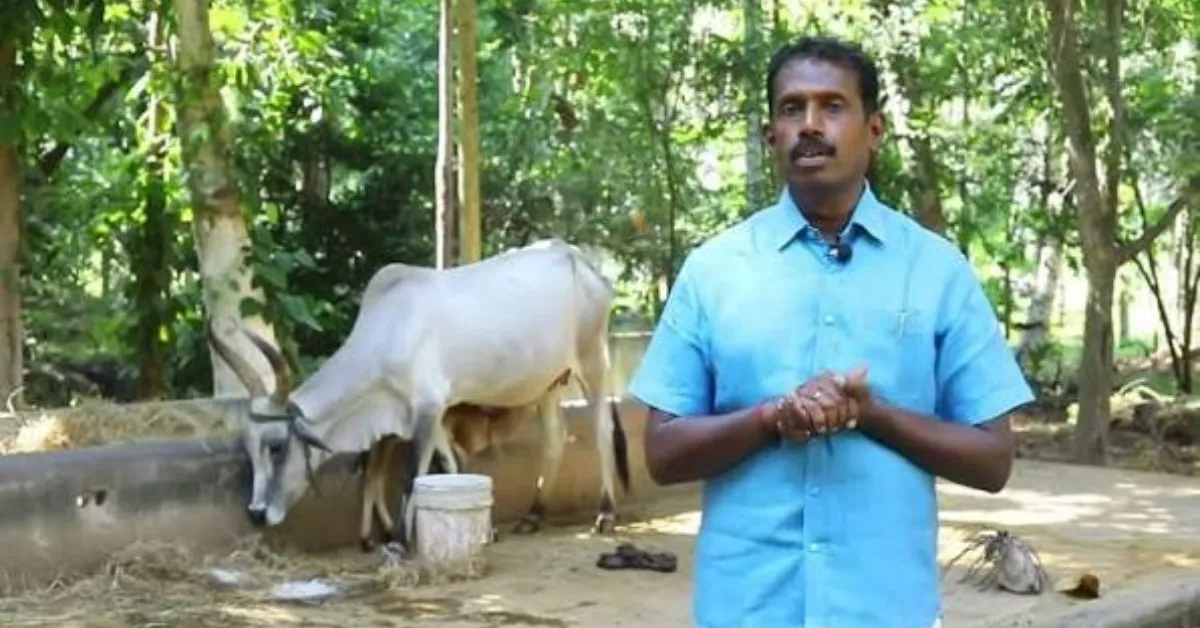
Walk through Valluvan’s farm in Pollachi, Tamil Nadu, and it does not look like a typical coconut plantation.
Banana plants grow beneath tall coconut palms. Pepper vines climb upwards, while turmeric, elephant yam, and curry leaves thrive closer to the ground. Nutmeg trees stand alongside dozens of other species, creating layers of crops that share the same piece of land.
What looks like a dense patchwork of plants is actually a carefully planned farming system.
Over the past 17 years, this approach has helped Valluvan increase his annual income to Rs 2.5–3 lakh per acre, improve soil health, reduce water use, and withstand some of the harshest dry spells the region has experienced.
The 58-year-old farmer’s work has also earned him recognition as a UN FAO Soil Farmer Hero.
More than a coconut farm
Like many farmers in Pollachi, a region known for coconut cultivation, Valluvan once depended largely on coconuts for his income.
But the economics were not working in his favour.
Each coconut tree cost him around Rs 500 a year to maintain, while generating only about Rs 300 in returns.
He was effectively losing Rs 200 on every tree.
“I was losing money on every coconut tree I owned. I knew I had to find a solution,” he told the media.
In 2009, he decided to rethink the way his farm worked.
Instead of treating coconuts as the sole source of income, he began creating a layered farming system where different crops could share space, water, and nutrients.
His aim was not just to increase production but also to reduce risk.
Over time, he introduced crops that occupied different layers of the farm. Beneath the coconut canopy came nutmeg, pepper, seven varieties of banana, turmeric, elephant yam, and curry leaves. He also planted dozens of tree species that added shade, biomass, and ecological balance.
Today, more than 14 crops grow on the farm.
Each crop serves a different purpose. Some provide income throughout the year, while others help improve soil fertility, retain moisture, or make better use of sunlight and space.
Together, they create a farm that functions more like a natural ecosystem than a monocrop plantation.
The numbers behind the transformation
The results became visible both in the soil and in Valluvan’s earnings.
When he began the transition, the farm generated around Rs 30,000 per acre annually.
Over the years, that figure steadily increased.
Today, the farm earns between Rs 2.5 lakh and Rs 3 lakh per acre every year.
Soil health improved as well. Soil organic carbon — a key indicator of soil fertility — increased from 0.5 percent in the first year to 1.56 percent by the seventh year.
For Valluvan, the connection is simple. Healthier soil holds more moisture, supports stronger plant growth, and reduces dependence on external inputs. Better soil, in turn, helps produce better yields.
Farming with water in mind
Water conservation is another key part of the model.
A thick layer of mulch covers the soil, helping reduce evaporation and protect the topsoil. Rainwater harvesting pits capture and store rainfall when it arrives, while layers of vegetation keep the ground shaded and cool.
Together, these measures have significantly reduced the farm’s water needs.
/filters:format(webp)/english-betterindia/media/media_files/2026/06/16/tamil-nadu-farmer-2-2026-06-16-16-39-53.png)
Today, the farm uses only one-tenth of the water it once required.
Valluvan believes irrigation requirements could reduce even further as soil health continues to improve.
When the system was put to the test
The true value of the model became evident during the severe drought of 2017.
Groundwater levels dropped beyond 1,000 feet, and the region received little to no rainfall for nearly two years.
Many farmers struggled to keep their coconut plantations alive.
Valluvan’s farm, however, continued to retain moisture because of its mulch cover, tree canopy, and rainwater harvesting structures.
The farm survived not because of a single crop, but because healthier soil, better water management, and crop diversity were working together.
A model rooted in diversity
By replacing a single-income system with a diverse, multi-crop farm, Valluvan has built a model that improves soil health, conserves water, and spreads risk across multiple harvests.
Today, bananas, pepper, turmeric, nutmeg, and many other crops do more than share space beneath coconut trees.
Together, they demonstrate how farming can become more productive, resilient, and resource-efficient through diversity.
Sources:
‘World Environment Day: Save Soil-Cauvery Calling Farmer’s Income Rises From Rs 30,000 To Rs 3 Lakh Per Acre With Tree-based Agriculture’: by Dharmendra Bajpai, Published on 6 June, 2026
‘Un-Honoured Tn Farmer Turned Coconut Losses Into Profits With Multi-Crop, Tree Based Farming’: by Press Trust Of India, Published on 29 May 2026
Disclaimer : This story is auto aggregated by a computer programme and has not been created or edited by DOWNTHENEWS. Publisher: thebetterindia.com