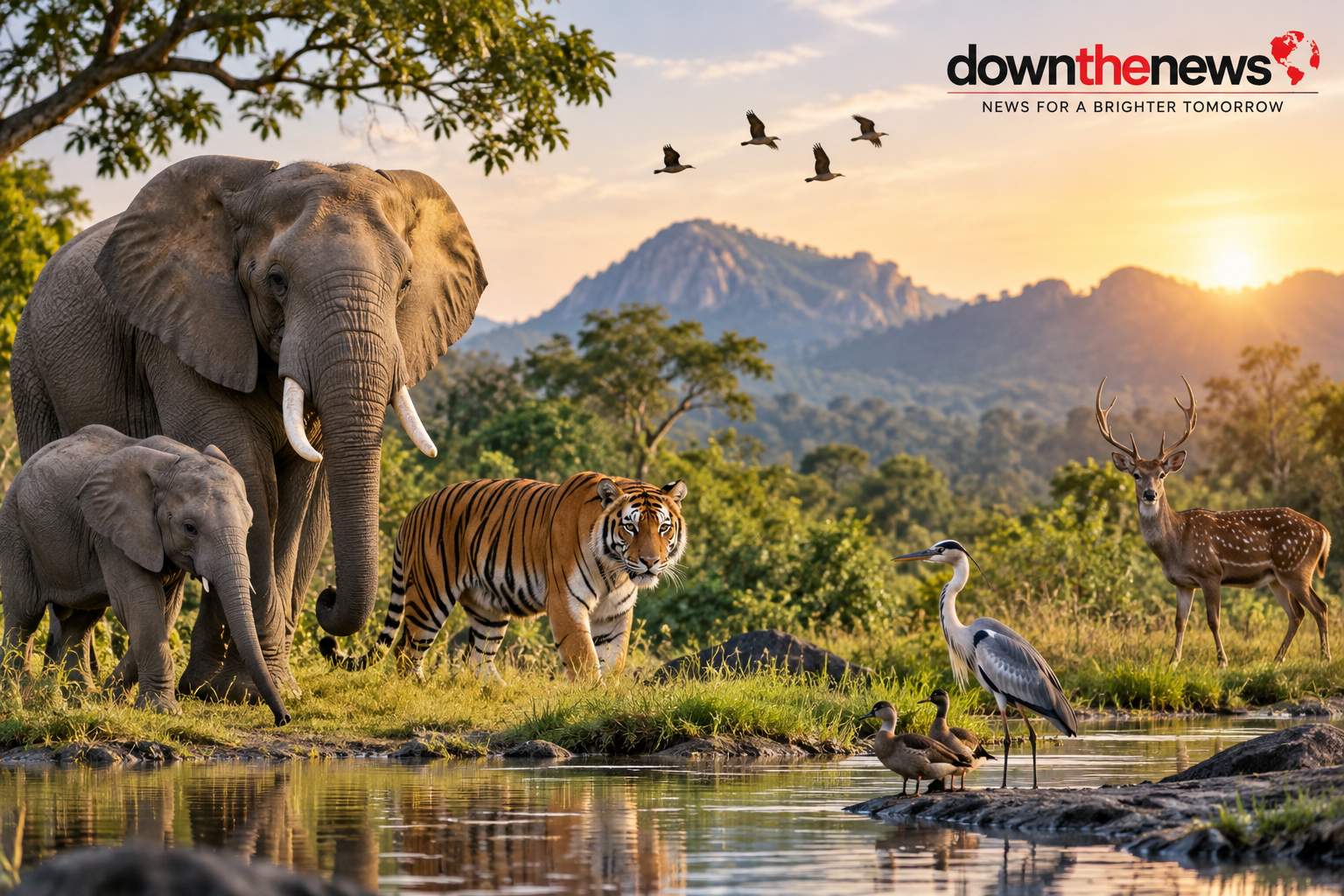
🐅 Top 20 Animal & Wildlife News Stories
Thursday, October 15, 2026 | India & World
Today’s wildlife roundup brings together important developments in animal conservation, endangered species protection, wildlife rescues, human-animal conflict and biodiversity research. The list includes reports published today and significant developments from the past several days.
🇮🇳 India Wildlife News
1. Asiatic Lions Return to Gujarat’s Barda Sanctuary After 144 Years
In a significant conservation development, 17 Asiatic lions are now living in Gujarat’s Barda Wildlife Sanctuary, where the species had been absent for approximately 144 years. A new study published in PLOS One examines the sanctuary’s suitability as an additional habitat for the endangered big cats.
Researchers found that wild pigs account for approximately 55% of the lions’ recorded diet, while domestic cattle account for around 17%. Establishing another viable lion population could help reduce dependence on Gir, the species’ principal remaining natural stronghold. Long-term success will depend on habitat protection, prey availability and reducing conflict with surrounding communities.
2. Tiger Sighting Prompts Safety Advisory in Arunachal Pradesh
Authorities in Arunachal Pradesh’s Lower Dibang Valley district issued a public safety advisory following the sighting of a full-grown Royal Bengal tiger near Tiwarigaon on October 14.
Forest officials have deployed a team to monitor the animal’s movements and assess the situation. Residents, tourists and commuters using the Roing–Anini road have been advised to exercise extreme caution, particularly between kilometres 19 and 23.
Officials have also urged people to avoid unnecessary stops, forest excursions and travel by two-wheelers along the affected stretch during high-risk hours. The advisory highlights the challenges of managing encounters between large carnivores and communities living near forest habitats.
3. Bear That Evolved to Hunt Ants Draws Scientific Attention
A new wildlife report from India is examining the unusual evolutionary adaptations of a bear that specialises in feeding on ants and other insects.
The research highlights the specialised feeding behaviour and physical adaptations that allow certain bear species to exploit food sources that other large mammals may overlook. Such studies help scientists understand how animals adapt to their environments and why protecting habitats is essential for maintaining ecological diversity.
4. Five Baby Orangutans Rescued From Forest in Odisha
Five young orangutans discovered in a forest in Odisha’s Balasore district have drawn international attention to suspected wildlife trafficking.
The animals were found in the Udayapur-Talsari forest area on September 8 and were subsequently rescued by forest officials. They were initially examined and provided with food before being transferred to Nandankanan Zoo for care and observation.
Orangutans are native to the Indonesian islands of Borneo and Sumatra, making their presence in an Indian forest highly unusual. Authorities suspect that the animals may have been abandoned following a failed smuggling attempt, although this has not been conclusively established.
The case has raised questions about illegal wildlife transport, the welfare of trafficked animals and the difficulties of returning rescued primates to their native habitats.
5. Nameri Tiger Reserve Receives International Conservation Recognition
Assam’s Nameri Tiger Reserve has received approval under the Conservation Assured | Tiger Standards programme, a global framework for assessing the management and protection of tiger habitats.
The recognition means all four tiger reserves in Assam—Kaziranga, Manas, Orang and Nameri—have achieved this status.
The assessment framework examines several aspects of conservation, including wildlife protection, habitat management, community participation, tourism management and tiger population monitoring.
The recognition highlights the importance of sustained management rather than relying solely on tiger numbers to measure conservation success.
6. Ganges River Dolphins May Synchronise Activity With Tides and Moonlight
Researchers are examining whether Ganges river dolphins adjust their activity patterns in response to time, tides and lunar cycles.
The findings could improve understanding of how these endangered freshwater mammals navigate rivers, locate prey and respond to changing environmental conditions.
The Ganges river dolphin faces continuing pressure from river pollution, fishing-net entanglement, habitat fragmentation and changes in water flow. Better knowledge of its behaviour could help conservationists design more effective monitoring and protection programmes.
7. Wildlife Officials Face Renewed Human-Tiger Conflict Concerns
The latest tiger sighting in Arunachal Pradesh comes amid broader concerns about encounters between people and large carnivores outside established protected areas.
When tigers move through forest corridors, agricultural land and settlements, authorities must balance public safety with the need to avoid unnecessary harm to wildlife.
Forest departments increasingly rely on rapid-response teams, public warnings and monitoring to manage such incidents. Experts also stress the importance of protecting corridors that allow animals to move between habitats without entering densely populated areas.
8. Human-Lion Conflict Raises Concern in Gujarat’s Gir Landscape
A 31-year-old man died in an incident involving a wild animal suspected to have been a lioness in Gujarat’s Gir Somnath district on October 14.
Forest officials have initiated action to capture the animal while investigating the circumstances surrounding the death.
The incident highlights the challenges of living alongside Asiatic lions in a landscape where settlements, farms and wildlife habitats overlap. Conservationists say public awareness, timely reporting of animal movements and appropriate management measures are essential to reducing risks to both people and wildlife.
🌍 World Animal & Wildlife News
9. Indonesia Returns 20 Green Sea Turtles to the Ocean After Smuggling Raid
Indonesian authorities released 20 protected green sea turtles into the ocean near Serangan Island in Bali on October 13 after rescuing them from a suspected smuggling operation.
Marine police had discovered 22 turtles aboard an apparently abandoned boat following information from local residents. The suspected smugglers had escaped before officers arrived.
The rescued turtles underwent health checks at a conservation centre before being transported to the shoreline for release. Two animals remained under treatment because of health problems.
Green sea turtles are protected under Indonesian conservation laws, but illegal capture and trafficking continue to threaten them. The rescue demonstrates how local communities and enforcement agencies can work together to protect marine wildlife.
10. Eight Endangered Orangutans Relocated After Borneo Wildfires
Indonesian authorities and conservation organisations have relocated eight critically endangered orangutans after wildfires damaged their forest habitat in Borneo.
The rescued group included three mother-and-child pairs and two adolescent males. The animals were moved to the Batu Nyambu protected forest after undergoing health checks.
The relocation involved transportation by road, boat and foot through difficult terrain. Conservationists hope the new location will provide suitable conditions for the animals to resume living in a natural environment.
Indonesia has experienced severe wildfires this year, with fires threatening forests that support orangutans and numerous other species. Habitat destruction, deforestation and poaching already place significant pressure on these great apes.
11. Sumatran Rhino Pregnancies Offer Hope for a Critically Endangered Species
Two rare pregnancies at an Indonesian sanctuary have raised hopes for the survival of the Sumatran rhinoceros, one of the world’s most threatened large mammals.
The species has been reduced to a very small number of animals in the wild, making every successful birth potentially important for its future.
However, conservationists face a difficult challenge: the population is so small and fragmented that inbreeding and limited genetic diversity remain serious concerns.
Protecting remaining habitat, improving breeding success and maintaining genetic diversity will be crucial to ensuring that the pregnancies contribute to a sustainable recovery rather than providing only a temporary boost.
12. Thailand Seizes Ivory Shipment From Zambia, Plans DNA Investigation
Thai authorities have seized an ivory shipment originating from Zambia and are preparing to investigate its genetic origins.
DNA analysis can help wildlife investigators determine where confiscated ivory originated and identify potential connections between trafficking networks and elephant populations.
The technique is increasingly important in combating illegal wildlife trade because physical seizures alone may not reveal the full route or source of the products.
The investigation also underscores the need for cooperation between countries that serve as sources, transit points and destinations for trafficked wildlife products.
13. Cambodia Faces Renewed Scrutiny Over Monkey Trade
Cambodia’s handling of its monkey trade is under renewed scrutiny following reports that regulators have not fully addressed concerns raised about the industry.
International wildlife investigators have repeatedly examined the trade in macaques and other primates because animals may be captured from the wild, transported through complex supply chains or incorrectly classified as captive-bred.
The issue has implications for animal welfare, biodiversity protection and the reliability of international wildlife-trade controls.
Stronger traceability, independent inspections and effective enforcement are considered important steps toward ensuring that legal commercial activity does not provide cover for the illegal capture of wild animals.
14. Illegal Wildlife Trade in Laos Exploits Chinese Social Media
A new investigation has highlighted how Chinese-language social media platforms are being used to promote illegal wildlife trade in Laos.
Online listings and digital networks can connect buyers with sellers offering wild animals and wildlife products, making trafficking more difficult to detect through conventional border inspections alone.
The trade threatens vulnerable species and can also create animal-welfare and disease risks when animals are transported or kept in poor conditions.
Conservation advocates are calling for stronger digital monitoring, cooperation between law-enforcement agencies and more effective action against online sellers involved in illegal wildlife commerce.
15. Amazon Wildlife Trade Routes Revealed by New Research
Researchers have uncovered further details about the routes and patterns involved in the illegal and poorly regulated trade in Amazon wildlife.
The trade can involve fish, turtles and other species collected from local environments and sold through supply chains that reach distant markets.
Animals may command low prices near their places of origin but become considerably more valuable when sold elsewhere. This creates financial incentives that can place pressure on wild populations.
Improving enforcement requires understanding not only where animals are captured but also how they move through intermediaries, transport networks and commercial markets.
16. Human-Elephant Conflict Reaches Critical Levels in Sri Lanka
Sri Lanka is facing a serious human-elephant conflict as expanding settlements, agricultural activity and forest loss push elephants closer to villages.
A Reuters report published this week describes communities around Galgamuwa in the country’s northwest using electric fencing, local warning systems and coordinated responses to reduce encounters.
Since 2019, Sri Lanka has recorded averages of approximately 138 human deaths and 402 elephant deaths annually from these conflicts. Elephant deaths reached a reported record of 488 in 2023.
Around 70% of the country’s estimated 7,451 wild elephants live outside protected areas, increasing the difficulty of managing interactions between wildlife and people.
Conservationists argue that protecting forests, restoring habitat and designing effective wildlife corridors are essential for reducing casualties over the long term.
17. Malaysia’s Dolphins Face Pressure From Coastal Development
Marine conservation researchers are examining the threats facing dolphins in Malaysian waters, including the Indo-Pacific humpback dolphin.
Coastal construction, boat traffic, fishing activity and entanglement in nets can disrupt the animals’ feeding and movement patterns.
Researchers are also using underwater sound recordings to understand how dolphins communicate and use their habitats. Such acoustic monitoring may help scientists detect changes in animal activity even when the dolphins are difficult to observe directly.
The findings could help guide marine conservation measures in areas where development and wildlife habitats overlap.
18. Rare Sea Star Goes Viral as Scientists Discover 57 Deep-Sea Species
A colourful orange sea star attracted widespread online attention because of its resemblance to the animated character Patrick Star.
However, the more significant scientific development is a discovery involving an Argentine deep-sea canyon, where researchers identified 57 new species.
Deep-sea ecosystems remain among the least understood environments on Earth. New discoveries can reveal previously unknown relationships between species and help scientists assess biodiversity in places that are difficult and expensive to study.
The research also reinforces the importance of understanding deep-sea habitats before industrial activities potentially disturb them.
19. Sri Lanka’s Spectacled Cobra Reveals a Two-Million-Year Genetic History
A genetic study has identified a distinct evolutionary lineage among spectacled cobras in Sri Lanka.
The findings suggest that the island’s cobras have followed a separate evolutionary path for approximately two million years, raising important questions about how geographic isolation shapes biodiversity.
Such research can improve understanding of species classification and help conservationists identify populations that may require specific protection or management.
It also demonstrates why genetic studies are important for wildlife conservation: animals that appear similar may represent distinct evolutionary lineages with different histories and ecological characteristics.
20. Cape Town Plans Capture and Relocation of Baboon Troops
Authorities in Cape Town, South Africa, are pursuing a plan to capture and relocate groups of chacma baboons that regularly move through areas occupied by people.
The animals’ presence in residential and recreational spaces has created challenges involving food access, public safety and the protection of wildlife.
The proposed intervention has renewed debate about how cities should manage animals that live near people, particularly when human development has reduced or fragmented natural habitat.
Wildlife specialists generally stress that long-term solutions should combine responsible waste management, restrictions on feeding wild animals, habitat protection and humane management measures. Relocation programmes must also account for the animals’ social structures and the ecological suitability of their destination.
🌿 Five Major Wildlife Trends to Watch
1. Habitat protection: Forest fires and land-use changes continue to threaten orangutans, elephants and other wildlife.
2. Human-animal coexistence: Tiger and lion sightings in India and elephant conflicts in Sri Lanka demonstrate the need for safer shared landscapes.
3. Wildlife trafficking: The rescue of sea turtles in Bali and investigations into international primate and ivory trades highlight continuing enforcement challenges.
4. Species recovery: The return of Asiatic lions to Barda and the Sumatran rhino breeding developments offer cautious reasons for optimism.
5. Science-led conservation: Genetic research, acoustic monitoring and ecological studies are helping researchers understand species and improve protection strategie