Elenore Hughes, Mauricio savarese and Anna-Catherine Brigidia
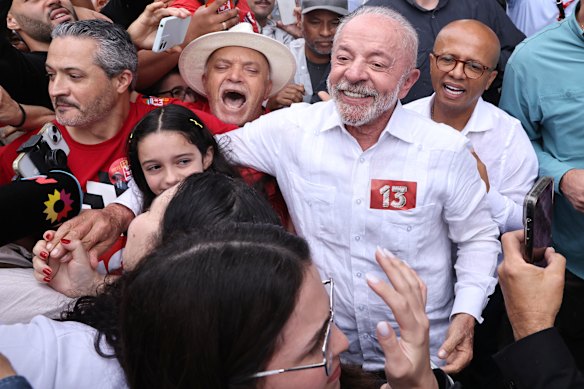
Rio de Janeiro: Brazil’s President Luiz Inácio Lula da Silva, a vocal critic of President Donald Trump, has been re-elected in a result that provides relief to critics of widening US influence in Latin America.
With 100 per cent of the vote counted, Brazil’s electoral court announced that the soon-to-be 81-year-old Lula had a lead of nearly 4.4 million votes – 51.8 per cent of the total vote – over opponent Flávio Bolsonaro. The announcement capped an evening of chaos at polling places across Brazil, following a last-minute decision to extend voting by two hours. That decision by a Supreme Court justice may trigger legal action by Bolsonaro.
His triumph bucks a trend in Latin America where increasing numbers of right-of-centre presidential candidates allied with Trump have been winning. Lula’s victory leaves Mexico and Brazil, Latin America’s two most populous nations, with left-of-centre leaders. It also positions Latin America’s largest economy, with a GDP of $2.6 trillion a year, to remain independent of the US, despite the pressure of increased tariffs imposed by Trump.
In Rio de Janeiro, cars beeped their horns and a woman dressed in red – the colour of Lula supporters – shouted “You lost! Cry harder!” to four men in yellow and green, sipping beers, Bolsonaro’s signature colours. A huge roar echoed in the street as the result was confirmed.
Rodrigo Valentim, a 51-year-old businessman and supporter of Bolsonaro, said that another Lula government would harm the economy. He pointed to financial markets’ positive reaction to the result of the first round, when Bolsonaro bested Lula.
“I don’t understand how people can vote for Lula,” he said. “The country is collapsing.”
Bolsonaro had yet to respond to Lula’s apparent victory, which, if confirmed by electoral authorities, will give him his non-consecutive fourth term as president. The next term begins on January 5, 2027.
The electoral court’s announcement ended an evening of confusion at polling places after Brazilian Supreme Court Justice Cristiano Zanin ruled three minutes before the scheduled end of voting to keep polls open for two more hours, following requests by both candidates. Lula’s request came after issues with buses that provide transportation to polls in São Paulo and Salvador, two cities that tend to favour the incumbent. Bolsonaro’s request was due to heavy rains in Brazil’s south, where he is favoured.
In Brasilia, volunteers who oversaw the vote count at a school debated whether they needed to stay after the announcement to extend voting, but most left 15 to 20 minutes after polls closed, and they had given count information to electoral authorities. At a polling station in Rio de Janeiro, the voting machines had already been switched off minutes after polls were set to close and couldn’t be turned back on.
The decision delayed tallying the votes by two hours. It was unclear how many polling stations stayed open after the scheduled closing time.
Bolsonaro ally Nikolas Ferreira noted that Zanin, who made the decision, is Lula’s former lawyer.
Bolsonaro bested Lula by more than 2.2 million votes in the first round of the election earlier this month. Sunday night’s apparent victory by Lula marked the first time since Brazil’s military dictatorship ended in 1985 that the second-highest vote-getter in the first-round elections won the presidency.
Lula faced a tough re-election battle because of concerns about the cost of living and security. Bolsonaro made a tough-on-crime approach the cornerstone of his campaign and pledged to bring down food costs while Lula, trying to lure undecided voters, has invested in costly incentives.
Both have been hit by corruption suspicions involving family members and allies, with Bolsonaro implicated in a sprawling scandal rocking Brazil. Lula previously spent more than a year in prison on corruption convictions that were eventually annulled.
This will most likely be the last victory of the veteran leader’s political career. Lula began his political career in the 1970s as a union leader. He then helped found the Workers’ Party, which he represented as a presidential candidate three times until he finally won it in 2002. He was re-elected four years later and was succeeded by one of his cabinet ministers, Dilma Rousseff, in 2010. She was re-elected in 2014.
Rousseff was impeached for accounting manoeuvring in 2016 amid a sprawling corruption probe, which also ensnared Lula. He tried to run for president again in 2018 but was jailed in March after being convicted.
Lula was released from prison after 580 days and saw Brazil’s Supreme Court annul his sentence after police found messages that showed the judge who convicted him was biased. He quickly became one of former president Jair Bolsonaro’s biggest critics and narrowly beat him in 2022.
Since he lost the first round, Lula reorganised his campaign, appealed to young voters, put millions of Brazilians on the streets to defend democratic values and his legacy, raised fears of another Bolsonaro administration and boosted several government initiatives.
He joins Trump and Nicaragua’s President Daniel Ortega – all aged 80 – as the oldest presidents in the Americas.
AP
From our partners
Disclaimer : This story is auto aggregated by a computer programme and has not been created or edited by DOWNTHENEWS. Publisher: www.smh.com.au