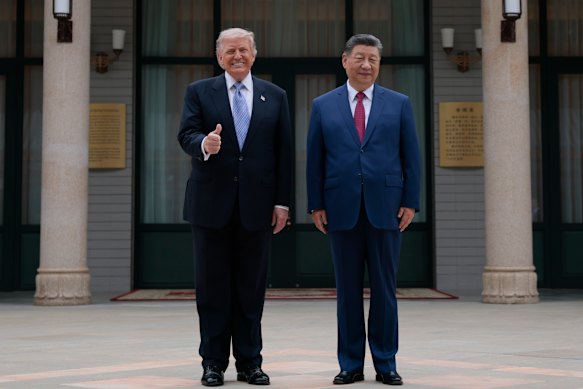
At last week’s summit, Donald Trump and Xi Jinping agreed to create boards of trade and investment. Does that signal a truce in their trade war?
From what they’ve disclosed, the answer is no. What’s known of the agreement is limited and vague, but it appears that their Board of Trade will cover only a modest proportion of the trade between the US and China, with ambitions for the Board of Investment even less developed.
While Trump hailed the summit as producing “fantastic trade deals, great for both countries,” it more broadly was a non-event, more photo-op than a restructuring of the trade relationship.
Trump didn’t get the help he sought from China in dragging the US out of the quagmire its assault on Iran has created, and China didn’t get the extension of last October’s trade truce that it wanted.
What they did agree on was that China would buy some soybeans from the US, whose farmers have been decimated by China’s switch of suppliers to Brazil. Soybean futures fell after the deal for China to buy $US17 billion ($24 billion) of soybeans a year was announced, suggesting either that the volumes disappointed or that farmers don’t believe it will deliver.
China also agreed to buy some Boeing planes although, at 200, it’s considerably less than the 500-plane order anticipated.
China, in return, said it would relax its controls on exports of rare earths, which it had successfully weaponised last year to force Trump to back away from his threats of 145 per cent tariffs on its exports.
While Trump hailed the summit as producing ‘fantastic trade deals, great for both countries,’ it more broadly was a non-event, more photo-op than a restructuring of the trade relationship.
That means that the Board of Trade and the Board of Investment are the only obvious structural outcomes from the summit – the deals on soybeans, planes and rare earths can, as recent history has demonstrated, be abandoned the moment there are any fresh tensions within the two nations.
Trump was forced to bail out farmers in his first term after China responded to his initial tariffs by boycotting US agricultural products. He had to do so again last year with a $US12 billion aid package after China completely halted soybean purchases in response to last year’s tariffs.
China has also failed to live up to its past commitments to buy US products, soybeans in particular.
What will the boards of trade and investment actually do?
US Trade Representative Jamieson Greer has said the Board of Trade would see tariffs reduced by both countries on $US30 billion or more of their trade in “non-critical goods.”
Trump said after the summit that tariffs hadn’t been discussed, although China’s state media said the countries would work to expand two-way trade via a “reciprocal tariff reduction framework.”
If we take Greer’s understanding at face value, what’s envisaged is the removal of tariffs on low-value goods and commodities that neither side sees as important to their national security or economic plans.
“We are going to have conversations with the Chinese about stuff we should be selling them – ag (agriculture), and Boeing, and medical devices – and the kinds of things we want to be getting from them, whether it’s consumer goods, or low tech or other inputs that we don’t have here,” he said.
But at $US30 billion, the amounts involved aren’t material to either economy.
Last year, even with Trump’s trade war on the rest of the world and China in particular, China exported $US308 billion of goods to the US (down from about $US525 billion in 2024), while US exports to China totalled about $US106 billion ($US98 billion in 2024).
Trump’s tariffs have reduced China’s direct exports to the US, but China’s trade surpluses with the rest of the world have still exploded.
The surplus was more than $US1 trillion last year and is on track to be above that again this year, with its exports being redirected to third countries – and probably subsequently on-shipped to the US, whose trade deficit was essentially unchanged last year at just over $US900 billion.
Perhaps more important than the impact the Board of Trade might have on the countries’ bilateral trade is that it could introduce more stability to their trade – at least they will have a forum for ongoing discussion – and offers the prospect that the truce in the trade war agreed in South Korea last October might remain in place, even if informally.
It’s not the first time that the US and China have established bodies to coordinate their trade relationship.
In 2006, George W. Bush’s administration helped create the Strategic Economic Dialogue with China, which the Obama administration evolved into the Strategic and Economic Dialogue as a mechanism for pushing structural changes to China’s economy and economic and trade strategies.
Those forums promoted free trade, with Obama’s version also expanding to security issues, climate change and human rights.
Trump, naturally, ditched that mechanism in his first term and launched his tariff war on China, which he then widened in his second term, last year, to his trade war on the entire world.
Trump has always over-estimated the leverage that tariffs can provide over China.
In 2018, when he first announced tariffs on China, he sent a trade delegation with a list of demands for changes to China’s economic policies, including the ending of forced technology transfers and the theft of intellectual property, the elimination of industry subsidies and expanded market access for US financial services and goods. China didn’t blink and changed nothing of any consequence.
Trump’s new Board of Trade is essentially an admission that neither dialogue nor tariffs are going to change China, its state-directed and subsidised industry policies or its mercantilist economic strategy.
Instead, the US and China will seek to manage a limited volume of their non-strategic elements of the two-way trade while keeping the bulk of their economies protected from each other.
Pragmatically, they will do the kind of product-level deals exemplified by the agreement on soybean and aircraft purchases, while leaving their trade barriers (and the effective tariff rate of nearly 32 per cent the US has on Chinese imports) largely intact.
The downside of the type of managed trade being contemplated is that it generally leads to inefficient deployment of national capital (not something that would concern the Chinese), undermines national competitiveness, leads to higher prices for the products protected (and more inflationary pressures) and creates distortions of trade that hurt domestic companies and consumers as well as other trading partners.
As for the Board of Investment, it is not clear that either side knows what that will do. The US already has an entity, the Committee on Foreign Investment into the United States, that screens foreign investment proposals, and China is notoriously selective about the foreign direct investment it allows.
Both countries are, in the Trump and Xi eras, extremely protective of their domestic industries, including those that are in non-sensitive sectors. There are no great expectations of any meaningful increase in cross-border investment, even if the Board of Investment is established.
That sums up the outcome of the summit — a bit of tinkering around the edges of the trade relationship, but nothing of substance agreed.
The Business Briefing newsletter delivers major stories, exclusive coverage and expert opinion. Sign up to get it every weekday morning.
 Stephen Bartholomeusz is one of Australia’s most respected business journalists. He was most recently co-founder and associate editor of the Business Spectator website and an associate editor and senior columnist at The Australian.Connect via email.
From our partners
Disclaimer : This story is auto aggregated by a computer programme and has not been created or edited by DOWNTHENEWS. Publisher: www.smh.com.au