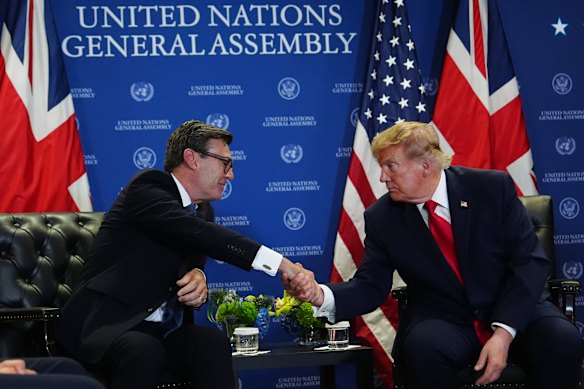
Nicholas Kristof rightly praises the UN’s aid efforts, but ignores its ultimate failure (“The UN is terrible – but right now, we need it desperately,” September 28). Formed after World War II to prevent global conflict, the UN’s core mission was crippled from the start by giving veto power to five nations. Today, it remains toothless against modern warfare. Nothing illustrates this futility better than Donald Trump using the UN forum to effectively declare war on Iran. We still need unified humanitarian systems but as a peacekeeper, the UN is an anachronism. It’s time for a global rethink on stopping war – one shaped by humanity, not politicians. Chris Rivers, Port Macquarie
In the past week, the leaders of the United States and Israel used speeches at the United Nations to do exactly what the world organisation was created to avoid; they glorified the destruction of their enemies and threatened to go even further if their demands weren’t met. President Donald Trump’s contempt for the UN is well known. Under his leadership, the wealthiest country in the world refuses to pay its dues and he intends to replace it with his own “Peace Board”, which would be a puppet of his twisted view of world government. When Trump’s presidency thankfully comes to an end, we must wonder whether sanity will return to US foreign policy, or if he will be replaced by one of his disciples. Ian Adair, Hunters Hill
Nicholas Kristof reminds us that despite the United Nations being reduced to a crumbling pillar of the geopolitical order that was created after World War II, it is needed now more than ever before. On January 24, 1946, just five months after the atomic bombings of Hiroshima and Nagasaki, the first resolution adopted by the UN General Assembly was dedicated to the peaceful use of atomic energy and the elimination of weapons of mass destruction. With the temperature of the fireball created at Hiroshima reaching 7700C, this resolution was meant to shine a light on humanity’s darkest hour. But today’s nuclear arms race between the US, China and Russia places us all equally at the mercy of this newfound means of mass incineration. So if the UN is to have any relevance, it too must again remind us that such enslavement to the power of the atom is no match to the moral power inherent in human dignity. Rev Vincent Zankin, Rivett (ACT)
Power couple
Whatever your view on Australia’s energy policy and the way our electricity grid is changing, you have to admire what was achieved at Hornsdale (“Two billionaires, one online bet and a turning point for Australian energy”, September 27). A world-first grid-scale battery was built and operational in just 63 days. This goes well beyond energy. Australia has become used to major infrastructure projects taking years because of planning rules, environmental approvals and procurement processes. Hornsdale showed that when there is a clear goal, the money is available and governments and business are prepared to move quickly, things can happen much faster. We should be asking why the same approach cannot be used in other areas such as water, transport, telecommunications and urban development. Too often we seem to accept that big projects must be slow and expensive. Hornsdale showed that they don’t have to be. If governments and business can work together with a sense of urgency, Australia can get important infrastructure built much faster. This is not about policy or ideology – it’s about a can-do attitude and getting on with the job. John Kempler, Rose Bay
It’s an impressive story, how we were the first country in the world to install a 100 megawatt big battery, back in 2017. But what’s happened since is even more impressive. Australia now has the third-highest level of battery storage in the world, behind only China and the United States. And we have the highest level of home battery storage – more than 12 gigawatts at last count. When you consider the figure was only 3.6GW a little over a year ago, the transformation is truly impressive. The challenge now is to keep this going so we transition our grid from near total dependence on fossil fuels to near 100 per cent renewable energy. Then we really will have something to boast about. Ken Enderby, Concord

Rather than blaming the 2016 storm that tore down 20 transmission towers, Josh Frydenberg and Barnaby Joyce falsely blamed over-reliance on renewables in South Australia for the statewide blackouts. With global warming we can expect many more such weather events. The Coalition and One Nation continue to aggressively fight renewables to this day, which just proves they are still unfit for office. Tony Simons, Balmain
Brexit barriers
I am an Australian and a European citizen, resident in Rome for more than 40 years. Britain may seek to re-enter the European Union, but the people of Europe will not welcome a return of the perfidious Albion to Brussels (“As three countries move to quit UK, a Brexit reversal might be its only hope”, September 28). It may work as an “associate”, which is basically a modified free trade agreement, but many Europeans think that a re-entry of the UK should be on the same terms as the entry of recent new members, which among other requirements would include the adoption of the Euro. The decision, if it comes, will depend on those few European countries that will refer the matter to the people by a referendum. It will not be easy. Alan Randell, Rome (Italy)
I really don’t know what George Brandis expects from UK Prime Minister Andy Burnham by way of fixing the economic mess caused by Brexit. With all the past-glory revelling and Rule Britannia types such as Nigel Farage still in abundance, healing the UK’s self-inflicted wounds will be neither simple nor quick. And taking cheap shots at an ideological foe “just 10 weeks into the job” is typical of the attitude of some that will likely stymie any attempts to fix the problems. Brandis should aim his darts at those who caused the mess in the first place and acknowledge that you can’t just shout “clean-up in aisle four” and expect it to magically happen. Adrian Connelly, Springwood
RBA off target
Shane Wright’s article on the dilemma faced by the RBA governor Michele Bullock makes for dispiriting reading (“Bullock’s reign as RBA governor has been defined by uncertainty”, September 28). As many correspondents have pointed out, the RBA has been left with just one arrow in its quiver, leaving it like William Tell with just one critical strike. Unfortunately, its recent strikes have been ineffective, so why does it think another will be any better? The trouble with this lack of options means that, among others, young people striving to pay off their homes are cruelly targeted, as was Tell’s son. It is manifestly unfair, especially when many aspiring homeowners were seduced by the government into taking mortgages for 95 per cent of their home’s value but who now find because of the RBA’s policies that they are in a position of negative equity. It is wrong and the government and the RBA must find another means of controlling inflation without harming the innocents. Lance Dover, Pretty Beach
It seems wrong to curb inflation by only reducing the spending power of homebuyers through higher interest rates. The government could be fairer and more proactive by temporarily increasing taxpayers’ contribution to their superannuation as a form of deferred income. Conversely, during recessions these extra superannuation contributions could be returned to stimulate demand. John Woodward, Ashfield
Great brain robbery
Peter Hartcher is right to say we can’t afford to miss the AI wave, but he misses a critical point (“Why Australia simply cannot afford to miss this AI wave”, September 28). The “ore” in the AI economy isn’t data centres, it’s the vast volume of human-created content that has been harvested by the world’s largest technology companies without permission or payment to its creators. Globally, more than 145 copyright lawsuits are currently under way because AI companies have refused to negotiate licensing arrangements. Their goal is clear: change the law, minimise payment for content and set a global precedent. We keep hearing that copyright is the great obstacle to AI development, yet these same companies have no difficulty navigating and paying for every other essential input: land, power, water, chips and lobbying. The irony is striking. Earlier this year, both Anthropic and OpenAI accused Chinese AI firms of industrial-scale intellectual property theft. We understand their concern, but copyright is not the problem. The problem is that AI platforms have shown no interest in seeking permission and paying for the content that makes their systems valuable. Human creativity is not a peripheral input to AI. It’s the foundation. Australia should embrace the AI wave, but we must insist on permission and payment for creators. Helen Lear, Ultimo
Medicare fading fast
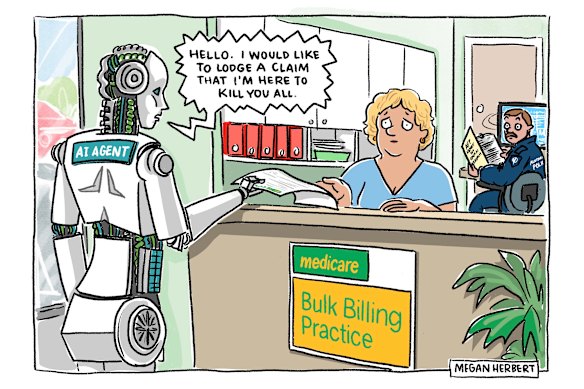
Badiucao’s cartoon of a Medicare card being eaten away by worms sums up today’s situation brilliantly (Letters, September 28). The disappearance of hospital specialist outpatient clinics with years-long wait lists; the long public surgical wait lists that drive people to the private system; the unaffordable private specialist fees that make essential medical management simply unavailable; the inadequate rebates that price many GPs out of patients’ reach – all these make me wonder how much of Medicare is really left. Dr Jennifer Briggs, Kilaben Bay
Care in crisis
Mental health problems are on the rise and the facilities are ill-equipped to cope (“Alarm as courts send mentally ill to EDs”, September 28). Patients fortunate enough to make it into the system are generally well cared for, especially if they are recipients of the NDIS. Those receiving proper care are now outnumbered by those denied the support needed. The Richmond Report was followed by the Mental Health Act of 1983, which resulted in the deinstitutionalisation of mentally ill people, despite the concerns of health professionals at the time. The promised community infrastructure was never fully funded or adequately built to meet the needs. Since then, successive governments have failed to address the parlous state of mental health care. Consequently, hospitals and the families of these patients are overwhelmed by the burden of providing the support required. It seems to be another case of government cost-saving without due consideration of the consequences. Graham Lum, North Rocks
Unsung ICAC heroes
Bevan Shields has done a stellar job with his awards for the current ICAC Operation Rosny hearings and its key figures (“Biggest idiot, grubbiest behaviour, best phone tap: The Operation Rosny Awards”, September 27). There does, however, seem to be one group of unsung heroes that has gone unmentioned: the diligent professional investigators and commission staff. They have clearly assembled a vast catalogue of documents and text messages, and listened to hundreds of hours of phone calls. Piecing together the apparent web of lies and deceit is no small task. While technology and AI have surely made these tasks easier, there’s no denying that the good public servants of NSW have worked hard for us, the people of NSW. Cathryn Callaghan, Croydon
So long, bogong
For a few days recently I was lucky enough to play host to some energised migrating bogong moths (“Sydney swarmed by bogong moths”, September 27). These amazing creatures, an endangered species, use nocturnal navigation by means of Earth’s magnetic field, and visual markers like stars to reach the cooler Australian Alps, journeys of up to 1000 kilometres. They stay there for summer before returning via the same route to their breeding grounds. In 2017, populations crashed by 95 per cent owing to prolonged drought, climate change and unsustainable agricultural practices. The moths provide critical food to endangered mountain pygmy possums and other species across the entire alpine ecosystem. We owe it to these moths to look after them as they go about their annual journey. Please don’t spray or kill them, just let them go on their way. Judy Hungerford, Narraweena
Supercharge our servos
Tony Lewis makes a good point about the difficulties involved in using EV charging stations (Letters, September 26). On any long drive in my petrol car I have no worries about where I may be able to fill up. Often, the petrol stations are built right next to the highway, with large parking lots and multiple food and amenity options. I really don’t understand why these big servos are not used as primary locations to install multiple EV charging stations. They already exist, are well signposted, and would be perfect for customers to soothe range anxiety over a bite to eat and a cup of coffee while their EV is charging. Pankaj Rao, Merewether
The tattoo trap
One significant current “lifestyle creep” discretionary spending item that Cherie Gilmour omitted is tattoos (“Beware lifestyle creep turning little luxuries into staples”, September 28). I remember a time when tattoos were something of a rarity, only to be seen on small numbers of ex-servicemen (mainly sailors), ex-prisoners with prison tatts, bikies and Pacific Islanders. One source tells me that tattooing has grown into a $484 million industry with a growth rate of 5 per cent; that 30 per cent of Australians have at least one tattoo; that the average lifetime spend on tattoos ranges between $2000 and $6000, and that heavily inked people can spend up to $30,000. Apart for Pacific Islanders getting tattoos for cultural reasons, anyone considering one should think of the saving to be made by not having any, while also sparing yourself the cost of having them removed. John Payne, Kelso
- To submit a letter to the Sydney Morning Herald, email letters@smh.com.au. Click here for tips on how to submit letters.
- The Opinion newsletter is a weekly wrap of views that will challenge, champion and inform. Sign up here.
Disclaimer : This story is auto aggregated by a computer programme and has not been created or edited by DOWNTHENEWS. Publisher: www.smh.com.au