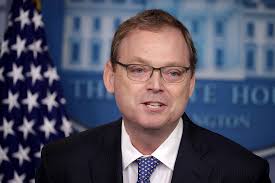
National Harbor: The United States expects to witness higher economic growth, repeating the 1990s dot-com boom, following the reforms introduced by the Trump administration under its America First policy, a senior US economic official said.
Speaking at the 2026 SelectUSA Investment Summit, Kevin Hassett, director of the White House National Economic Council, said, “If you can remember when the dot-com revolution really got going in the 90s, we had growth rates in the 5s and in the 6s, and we’re poised to see that again.”
The United States — the world’s largest economy — had seen its highest economic growth in the last 30 years between 1997 and 2000, when the GDP grew by four per cent to five per cent. The country beat this growth rate only in 2021 with 5.95 per cent growth because of the post-Covid rebound.
Explaining his optimism about the higher economic growth in his country, Hassett said the United States is importing capital goods in large numbers, which is going to bring back jobs to the country.
“The number one driver for GDP growth was a very healthy number in capital spending. The only thing that was a negative in the data was that all of the things that we’re importing are capital goods… If you look at the quality of imports, the US is now buying machines instead of carnival stuffed animals from China. That means that this economy’s growth is going to be something that significantly outperforms what we’ve seen in the first term of President Trump,” said Hassett, who served at the US Federal Reserve in the 1990s under Governor Alan Greenspan.
Referring to a new study on artificial intelligence, the economist said, “Artificial Intelligence is making everybody do their job more productively. And it’s not costing jobs right now. In fact, initial claims for unemployment insurance in the US are the lowest they’ve been since the 1960s, so nobody’s losing their job. Everybody’s thriving.”
Explaining his growth outlook for his country further, he said, “AI is creating a productivity boom that’s increasing productivity by between 2.5 per cent and 3.5 per cent. What that means is that the US economy is going to grow 2.5 to 3.5 per cent, [even] if we don’t invest more, if we don’t hire more workers, and if we get no growth out of capital spending or labour. But our estimate is that capital is going to give us 1.5 to 2%, and labour is going to give us maybe 0.5 per cent to 1 per cent.”
Disclaimer : This story is auto aggregated by a computer programme and has not been created or edited by DOWNTHENEWS. Publisher: deccanchronicle.com