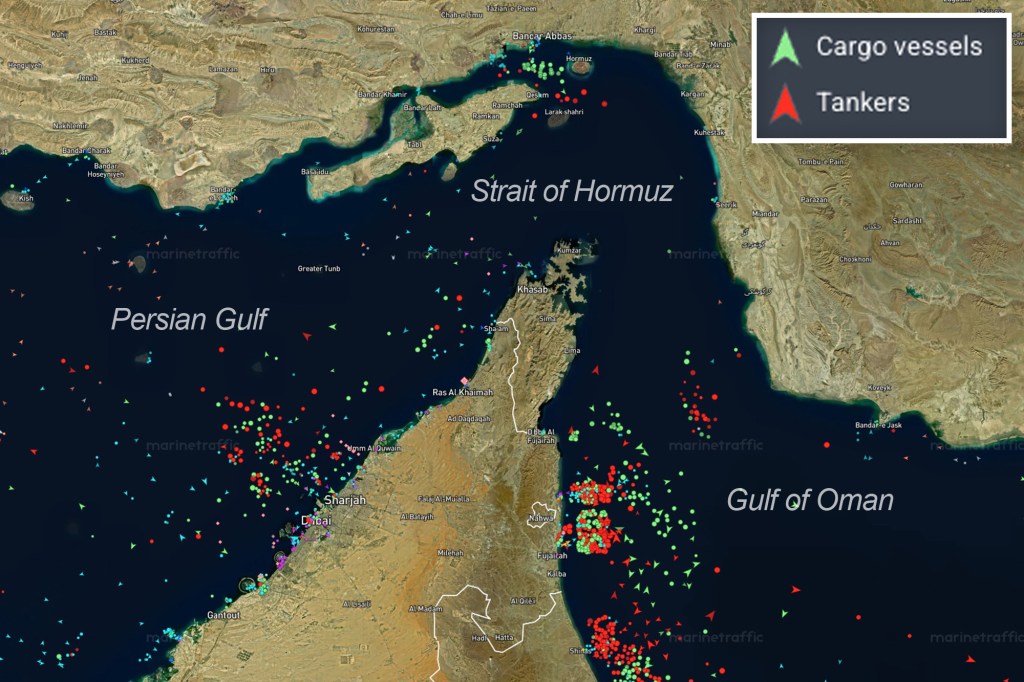
A dozen commodity vessels transited the Strait of Hormuz on the weekend, down from 35 the prior weekend, shipping data showed on Monday, as tension in the Gulf persisted with the US and Iran in stalemate.
Visible traffic through the strait, the conduit for a fifth of the world’s oil and liquefied natural gas before the war, has dwindled to a trickle.
However, Middle Eastern producers continue to export oil on tankers travelling with their transponders off.
Among trackable ships, four vessels — two tankers carrying refined oil products and two empty carriers for bulk goods and gas — exited the strait on Sunday, while another two small-sized oil tankers entered the Gulf, provisional data from analytics firm Kpler showed.
On Saturday, five vessels left the Gulf carrying agricultural products, liquefied petroleum gas and fertilizer while an empty very large gas carrier entered, the data showed.
Before the US-Israeli war with Iran started on February 28, the strait typically handled about 125 large, commercial vessels per day, including tankers, gas carriers, bulkers and container vessels.
SAUDI CRUDE EXPORTS RISING
The attacks by the Houthis on Saudi Aramco’s East-West pipeline have prompted the state energy firm to increase exports through the Strait of Hormuz this month and next after halting some shipments via Yanbu.

That enabled exports from the OPEC kingpin to recover to over 4 million barrels per day (bpd) so far in September after slumping to 2.4 million bpd in August, the lowest since at least 2013, according to provisional data from Kpler.
A total of 13 tankers, mostly very large crude carriers carrying 34 million barrels of crude, exited the strait in the week of September 13, Kpler data showed.
Saudi Arabia accounted for half of the exports, while 35% of the volume came from Iraq.
“Middle East oil flows remain surprisingly strong despite the disruption to Saudi Arabia’s East-West pipeline,” JPMorgan analysts said in a note on September 18, adding that the total oil flows averaged 17.1 million bpd in the past 10 days, just 6.1 million bpd below the 2025 average.
“The most notable pivot has come from Saudi Arabia,” the analysts said, as satellite data indicated Saudi oil moving through the Strait of Hormuz averaged 2.9 million bpd over the past six days, up from just 700,000 bpd in August.
Disclaimer : This story is auto aggregated by a computer programme and has not been created or edited by DOWNTHENEWS. Publisher: nypost.com