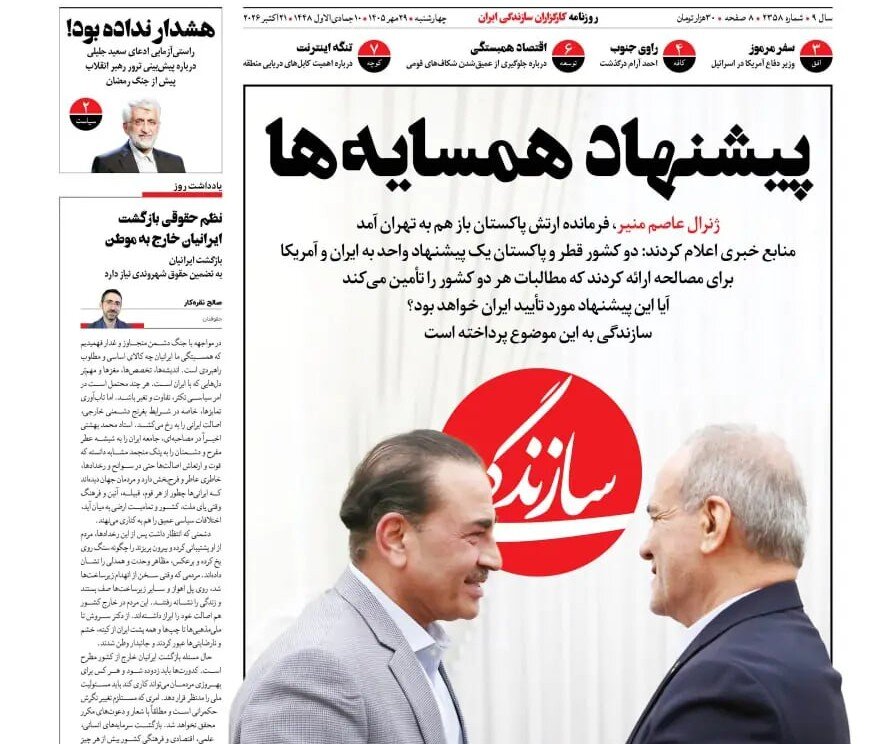
Sazandegi examined the distinction between a preemptive strike during an active military confrontation and military action undertaken during a relative pause in hostilities. Quoting Mohammad Atrianfar, a member of the central council of the Servants of Construction Party (Sazandegi), the article stated that a preemptive attack may be considered within the logic of military operations during an active conflict.
However, this differs fundamentally from situations in which both sides are observing a temporary ceasefire or experiencing a relative suspension of hostilities. In such circumstances, launching a preemptive attack would not necessarily resolve existing issues and could instead intensify tensions and broaden the scope of conflict. The path out of the current situation lies in a combination of defensive vigilance, restraint from provocative actions, and preserving diplomatic channels. The primary goal should be preventing the crisis from escalating and creating conditions for a lasting reduction in tensions.
Etemad: The West at an impasse
Etemad analyzed the visit of Russian Foreign Minister Sergey Lavrov to Tehran. His trip has fueled renewed speculation regarding Iran-US negotiations aimed at reviving the Islamabad understanding, a topic frequently discussed in Iran s political sphere. According to Mashaallah Shamsolvaezin, the United States bears the greatest responsibility for undermining the agreement because it approached the issue with the expectation of Iran s surrender. At the same time, Iran has succeeded in establishing a new balance against Washington and its allies through both military and diplomatic means. This balance has increased Western concerns about extending the conflict and opening new fronts, particularly in areas such as Bab al-Mandab. Shamsolvaezin believes that three major challenges, namely the Strait of Hormuz, the nuclear issue, and Bab al-Mandab, have pushed Washington toward negotiations that may accommodate some Iranian demands. However, he contends that the United States is attempting to downplay Iran s strategic advantages, even though those advantages have grown significantly stronger than they were before the war.
Donya-e-Eqtesad: Diplomatic players in Tehran
From Sergey Lavrov s visit to the arrival of Asim Munir, the simultaneous diplomatic activity involving Pakistan, Oman, Qatar, and Russia, along with indirect Chinese support, signals an intensive effort to break the deadlock in Iran-US negotiations ahead of two crucial elections involving the Knesset and the US Congress. While this sequence of events does not by itself prove the existence of a coordinated agreement between Moscow and Islamabad, it carries considerable political significance at a time when talks between Tehran and Washington face deep mistrust and disagreements over the Strait of Hormuz, sanctions, and the nuclear file. The common message of these diplomatic exchanges is clear: the channel for diplomacy remains open, and various actors are seeking a way to halt the cycle of escalating tensions before it develops into another round of military confrontation.
Arman-e-Melli: Iran-US tensions at an unprecedented level
In an article, Arman-e-Melli highlighted the complexity of the Iran-US dispute, arguing that the confrontation, shaped by joint US and Israeli attacks on Iran, possesses a level of complexity unlike previous crises. A review of conflicts involving Afghanistan, Libya, Iraq, Syria, and even border disputes over the past decade reveals that none had as many dimensions and layers as the current tensions between Iran and the United States. Part of this complexity stems from Iran s strategic geography and Tehran s geopolitical leverage against Washington and its allies. Another factor is the central role of energy, combined with the connection of these issues to broader regional developments, including the wars in Yemen and Lebanon. Given these circumstances, it is natural that new mediators, including actors from outside the region, continue to become involved. The result is a deeply interconnected conflict environment in which not only Pakistan, Qatar, Oman, Turkey, and China have become active, but Russia has also intensified its engagement.
Kayhan: Hormuz, where the oil price is still decided
Kayhan explained how Iran has used the Strait of Hormuz as leverage to increase economic pressure on the United States. The Strait of Hormuz remains at the center of the regional crisis, providing Iran with a significant geopolitical and economic advantage. In addition to possessing vast oil and gas reserves, Iran is situated alongside one of the world s most critical energy corridors. With oil prices remaining above $100 per barrel and strategic reserves under unprecedented strain, the United States is experiencing the costs of its confrontational policies through historically high interest rates and persistent inflation. Under these conditions, markets are closely monitoring not only military and diplomatic developments but also statements by Iranian officials regarding the security of the Strait of Hormuz, oil exports, and future tensions. Reassuring messages can reduce part of the oil market s risk premium, whereas signs of growing uncertainty can have the opposite effect. The newspaper argued that Iranian officials should carefully consider the market impact of their economic and diplomatic statements.
Disclaimer : This story is auto aggregated by a computer programme and has not been created or edited by DOWNTHENEWS. Publisher: tehrantimes.com