
Nir Kaissar
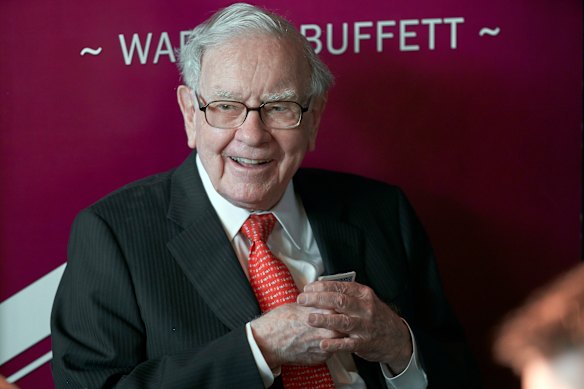
Warren Buffett shared his usual wisdoms about patience, diligence, prudence and kindness in a CNBC interview the morning of Berkshire Hathaway’s annual meeting last weekend, the first in many decades that the oracle did not lead. But the sign that hung above him spoke loudest.
It read “The Legacy Continues.” That legacy is Buffett’s track record of doubling the return of the S&P 500 Index over six decades, a singular achievement that makes him the greatest investor of all time and turned Berkshire into a powerhouse with a market cap of around $US1 trillion ($1.4 trillion). The continuity is a wish that Greg Abel, who took over for Buffett this year and presided over Berkshire’s annual meeting for the first time, will be able to replicate Buffett’s success.
Stock pickers only have so many levers in their quest to beat the market. Buffett’s use of value, quality and leverage are well known, but he made good use of two others: size and concentration. In Berkshire’s early days, Buffett managed a relatively modest sum, which allowed him to buy smaller, overlooked companies. That size advantage gradually disappeared as word of Buffett’s investment prowess spread and money poured in. What remained was Buffett’s willingness to bet the company’s stock portfolio on a handful of companies. Even now, nearly 70 per cent of Berkshire’s stocks reside in six businesses.
Very few stock pickers have the gumption to hold such a concentrated portfolio. Abel pledged in his first annual letter that “this concentrated approach will continue.” He also noted, though, that Berkshire has “meaningful positions in a small number of other companies,” leaving open the possibility that those investments may also become “core holdings.” So, we shall see about that concentration.
Either way, Abel’s bigger challenge is size. Buffett often laments that more money means fewer places to invest. When Berkshire was worth a few billion in 1987, it could arguably still hunt smaller targets. By the early 2000s, the company was worth many times that, limiting Buffett’s ability to deploy capital. Perhaps it’s no surprise, then, that Berkshire underperformed the S&P 500 Index by 0.7 percentage point a year from 2003 to 2025, including dividends, a 23-year drought and counting.
The start of that period also coincided with the market’s recovery from the dotcom crash. In the lead up to the internet bubble in the late 1990s, Buffett famously passed on technology stocks, saying he didn’t understand them. That appeared to be a cunning and prophetic move when Berkshire mostly sidestepped the tech-led crash in the early 2000s.
Two decades later, however, it’s clear that betting on technology was the better move. In fact, the tech behemoths have been among the best performers and would have given a boost to stock pickers such as Buffett who are limited to the biggest companies. Buffett has acknowledged as much.
Berkshire now risks making the same mistake with artificial intelligence. “I understand fewer of the businesses as a percentage of the whole than I did 10 years ago,” Buffett conceded to CNBC’s Becky Quick. “I have not learned new industries for some years.”
Charting a new course will be tricky for Abel, at least initially. If he adds exposure to AI, he erodes concentration; if he swaps Berkshire’s old economy investments, such as Bank of America, Coca-Cola and Chevron, for trendy AI names, it will feel like a sharp pivot from Buffett, an impression Berkshire seems eager to avoid.
But Abel will need to find more growth if he wants to rekindle the old Buffett magic. Since 1988, the first year for which Berkshire data is electronically available, the company’s stock returned nearly 16 per cent a year through 2025, more than 4 percentage points a year better than the S&P 500. About 90 per cent of that return came from Berkshire’s revenue growth. Valuation and margin expansion contributed little and dividends none.
While visibility into Berkshire’s private holdings is limited, the prospects for revenue growth for its publicly traded companies look lacklustre. The six companies that make up most of its stock portfolio – Apple, Chevron, Bank of America, Coca-Cola, American Express and Moody’s – are expected to grow sales by an average of 5 per cent a year over the next four years, according to estimates compiled by Bloomberg.
Meanwhile, the tech giants Berkshire has little or no exposure to are poised for much greater growth. Analysts expect dotcom-era darlings Microsoft, Amazon.com and Alphabet to grow sales by an average of 15 per cent a year. Two companies powering AI, Broadcom and Advanced Micro Devices, are each expected to grow revenue by 29 per cent a year. Given those companies’ hefty weight in the S&P 500, it won’t be easy for Berkshire to outpace the market without them.
The thing about concentration — and the reason most stock pickers avoid it — is that there’s a lot riding on a few names. Abel’s stock portfolio, like Buffett’s, is likely to be judged against the S&P 500. As things stand, Abel is betting in large part that financials, energy and a soda business can keep up with technology. A bold wager, indeed.
Bloomberg
The Market Recap newsletter is a wrap of the day’s trading. Get it each weekday afternoon.
From our partners
Disclaimer : This story is auto aggregated by a computer programme and has not been created or edited by DOWNTHENEWS. Publisher: www.smh.com.au


