
Updated ,first published
Indian Prime Minister Narendra Modi’s Melbourne visit had a few elements: business, diplomatic, and sporting. And then there was Thursday night’s genre-busting community/cultural/rock star/political extravaganza at Marvel Stadium.
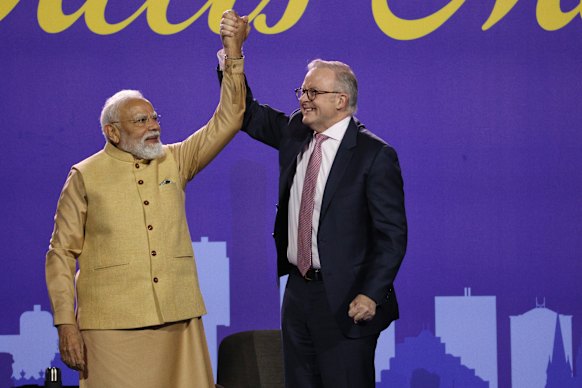
Thousands waved their mobile phone lights aloft as Modi took to a purple garlanded stage in the middle of the stadium, accompanied by Prime Minister Anthony Albanese and Victorian Premier Jacinta Allan, who both experienced a level of cheering and a lack of booing neither was used to.
In a speech punctuated by frequent bursts of applause, Modi declared that just as sugar sweetens milk, Indians integrate and sweeten societies globally.
“Just as when sugar is added to milk it makes it sweeter,” he said.
“Just as we Indians infuse the world,” he continued to a crowd estimated at 20,000.
“The milk comes from Australia, however the tea is made the Indian way.
“I am the tea vendor – the chai wallah,” said to huge applause.
Albanese said he had first visited India in 1991 as a backpacker, while Allan said that she was on a 600-day streak of practising yoga since visiting as premier in 2024.
Modi has now visited Australia three times, the first in 2014.
“This completes the hat trick,” he said. “This demonstrates the heights Indian-Australia relations have reached.”
Not even the Docklands stadium could contain the size or exuberance of “Modi Meets Melbourne”, with Cranbourne’s 50-strong Janagar Jana Dhol Pathak drumming group outside gate 2 delivering an eardrum-shattering serenade as the audience arrived.
“This is a very important event for us,” drumming leader Satish Gaikwad said. “Australia and India coming together. That’s the unity we want to show the world.”
The sound of the massive dhol drums, carried over the shoulder, and the smaller tasha drums completely eclipsed the 30-odd protesters who were sporting a feeble PA system and “Modi Go Home” and “Stop Indian Invasion” posters.
This group was largely unnoticed by the 20,000 Indians streaming along the concourse into the stadium, in what could be seen as a metaphor of geopolitical realities between Australia (population 27 million) and India (population 1.47 billion).
Rachita Savant from Wyndham Vale said she had mixed opinions about the protesters.
“I think they don’t have enough information about what they’re speaking,” she said.
“I understand their emotions. But honestly, the groups that are coming here today, they’re not all harmful to Australia. These are people who have some calibre to be here. They’re not here living off Centrelink.”
“Especially the Indians,” said her friend Gayatri Gangapurkar of Truganina.
“Australia is a diverse culture,” Gangapurkar added. “Australia accepts diversity and India is the same. Because it is one India, but there are different cultures, different languages living together. It’s quite similar.”
Thirty years ago, the Indian diaspora in Australia numbered 50,000, said Pawan Luthra, chief executive of the Indian Link media group. When the next census is released, it is expected to show the figure has grown to 1.3 million, he said.
The Indian diaspora has already eclipsed the British as the largest foreign-born group here.
“A lot of them transition from permanent resident to citizen over time,” Luthra said. “A lot of them want to fully participate in Australia – except when there is a cricket match on.”
As for Modi: “I value him as a strong economic manager, but there are a lot of things that should have been done better.”
As demonstrated by his embrace of Albanese on Thursday, Modi is a world leader who knows the power of a good selfie. He is only the second Indian prime minister in history to win a third consecutive term, after Jawaharlal Nehru. (Indira Gandhi won a non-consecutive four terms.)
Similarly to Nehru, who had his jacket, Modi’s sense of style means his name has been leant to the Modi kurta, a fitted half or full-sleeve top with a mandarin collar he is often seen wearing.
But some are highly critical of him. Hindus for Human Rights Australia said it had serious concerns about “democracy and human rights, custodial deaths, press freedoms, collapsing educational systems, the right to protest and civil liberties, environmental protections, women’s safety, and the persecution of minorities in India”.
Both countries are helping each other, said Dr Jagwinder Virk, chair of the India-Australia Strategic Alliance.
“Relationships are building up,” he said, pointing to critical minerals, trade and the Indian Premier League.
“Most Australian players spend three to four months in India. They have a second home in India now,” he said. “Glenn Maxwell is married to an Indian woman. That is a good thing.”
Start the day with a summary of the day’s most important and interesting stories, analysis and insights. Sign up for our Morning Edition newsletter.
 Stephen Brook is a special correspondent for The Age and CBD columnist for The Age and The Sydney Morning Herald. He was previously deputy editor of The Sunday Age. He is a former media editor of The Australian and spent six years in London working for The Guardian.Connect via X or email.
From our partners
Disclaimer : This story is auto aggregated by a computer programme and has not been created or edited by DOWNTHENEWS. Publisher: www.smh.com.au