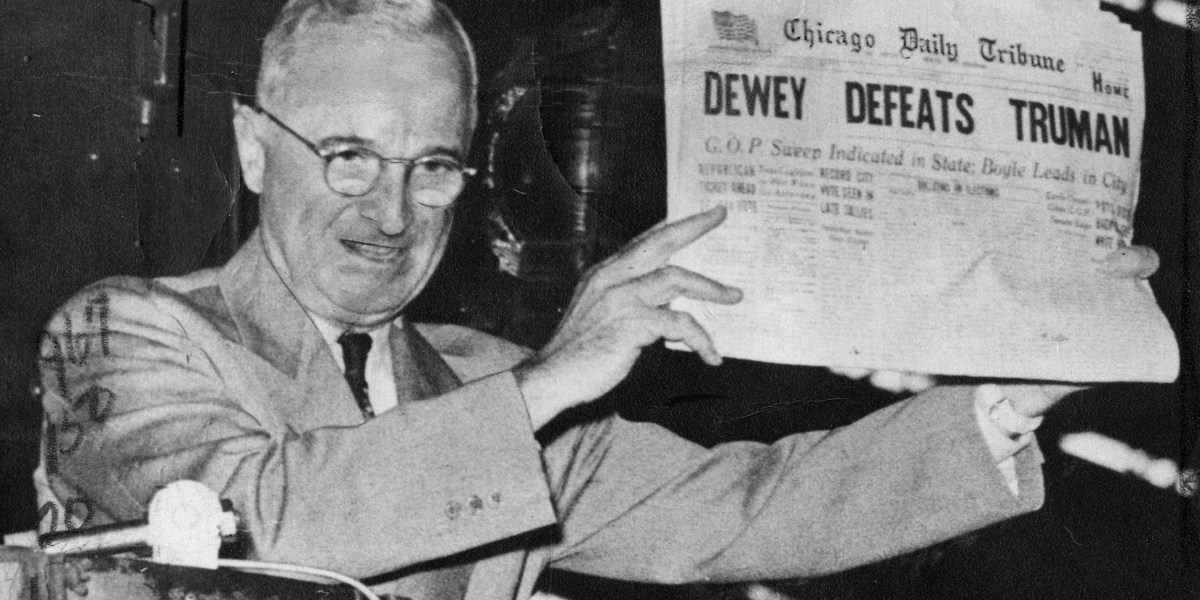
One of the most iconic images in 20th-century American political history shows a beaming President Harry Truman holding up a copy of the Chicago Daily Tribune emblazoned with the headline “DEWEY DEFEATS TRUMAN.”
In fact, Truman had just resoundingly defeated his Republican challenger, New York Gov. Thomas Dewey, winning 303 electoral votes to Dewey’s 189. The Tribune had gone to press before the race was called, but its editors can be given a measure of grace: just about every major poll put Dewey ahead.
That includes the one this magazine published. Elmo Roper’s final survey for Fortune gave Dewey 44% to Truman’s 31%, and the editors wrote, “So decisive are the figures given here this month,” that no further detailed reports were planned, according to historian David Greenberg’s account in Politico.
Seventy-eight years later, as Americans vote in the 2026 midterms, the major forecasters point to a strong night for Democrats. For companies and investors that plan around which party controls Congress, the question is how much weight those forecasts can bear. History says less than their precision suggests: presidential polls have underestimated Donald Trump in three straight elections, and the people who answer pollsters are a shrinking, skewed slice of the electorate.
A long record of confident misses
The 1948 miss was not close. Gallup and Crossley both gave Dewey about a five-point edge in their final polls, FiveThirtyEight found, and Roper stopped polling weeks before Election Day. Newsweek asked 50 political writers to pick the winner; all 50 chose Dewey. Afterward, George Gallup offered a blunt verdict: “We were wrong,” the Deseret News recounted.
Polls that seemed staid and reliable have since proved flagrantly inaccurate. In 1960, Roper’s election-eve poll had Richard Nixon edging out John F. Kennedy by two points, Time reported. Kennedy won, clinching 303 electoral votes to Nixon’s 219, though his popular-vote margin was razor thin.
A generation later, most polls saw the 1980 race between Republican Ronald Reagan and President Jimmy Carter as harrowingly close; Gallup’s final survey had Reagan up just three points, according to Gallup. Reagan won 489 electoral votes and carried 44 states. Carter took 49 electoral votes, six states, and the District of Columbia.
Hillary Clinton was favored to beat Trump in 2016 but lost 304 electoral votes to 227, even as she won the popular vote. In 2020, polls correctly pointed to a Joe Biden win, but Trump ran well ahead of them; Biden won 306 electoral votes to 232, a striking parallel to 2016. The American Association for Public Opinion Research later found that 2020’s national polling error was the highest in 40 years.
The error shrank in 2024, but surveys still underestimated Trump for a third straight presidential race, 538 found. As historian W. Joseph Campbell wrote for Fortune that year, election polls have kept their popular appeal despite a checkered record.
What the 2026 forecasts show
If the major forecasts hold, Democrats will take the House and have a real shot at the Senate. As of Election Day, the Cook Political Report rated 204 House seats Solid or Likely Democratic and 178 Solid or Likely Republican, with 18 leaning Democratic, 17 leaning Republican, and 18 toss-ups, according to Newsweek’s tally.
An NBC News poll conducted Oct. 28–30 found 52% of registered voters preferred Democratic control of Congress, versus 45% for Republican control.
The 270toWin consensus forecast, which aggregates several forecasters, leans Democratic in 220 House seats and Republican in 196, with 19 toss-ups. Its Senate map is less settled: Iowa, Kansas, Maine, Ohio, and Texas sit in the toss-up column, and Democrats need a net gain of four seats to flip a chamber Republicans hold 53–47.
Why the misses lean one way
We won’t know how accurate this year’s polls were until the votes are counted. Polling has never been an exact science, and even as text-based surveys and AI-driven modeling have become commonplace, the raw material pollsters depend on keeps getting harder to collect.
The biggest reason is falling response rates. In generations past, pollsters called voters on landlines, and people almost always answered. Now it’s easy to screen calls or ignore texts. Pew Research Center’s telephone response rate fell from 36% in 1997 to 6% in 2018, NBC News reported.
Those who do respond often don’t represent the electorate. Andreas Philippou, a professor emeritus of probability and statistics at Greece’s University of Patras, has traced several major polling failures to nonresponse.
In the U.S., the problem has a partisan tilt. AAPOR’s review of the 2016 polls found that better-educated Americans were significantly more likely to answer surveys than voters without degrees, who lean Republican.
Most pollsters now weight their samples by education. Yet AAPOR concluded that the 2020 miss wasn’t caused by a failure to do so, leaving the industry to chase a harder-to-measure gap between the people who answer and the people who don’t.
Midterms have been kinder to pollsters. In 2022, the RealClearPolitics generic-ballot average showed Republicans ahead by 2.5 points; they won the national House vote by 2.8.
That makes tonight a clean test. If Republicans outrun their polling in the toss-up House districts and the five Senate races the consensus can’t call, the nonresponse problem will have surfaced in a year without Trump on the ballot. If the results land near the averages, as they did in 2022, pollsters will have their strongest case yet that they’ve learned the lessons of 1948.
Disclaimer : This story is auto aggregated by a computer programme and has not been created or edited by DOWNTHENEWS. Publisher: fortune.com