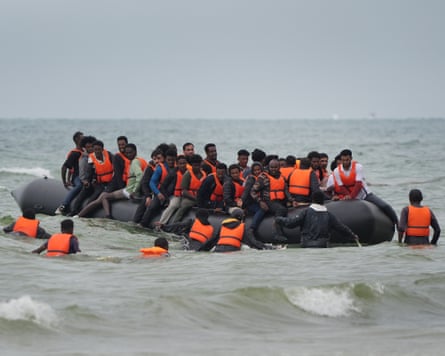
Good morning. You’d be forgiven for missing it. Earlier this month, the government quietly scrapped its “one in, one out” deal with France. The partnership was supposed to eliminate small boat crossings by deterring asylum seekers from making the treacherous journey across the world’s busiest shipping channel.
The deal, which lasted just 423 days, was beset with problems, had a negligible impact, and now joins a long list of policies that have tried and failed to address highly visible, often tragic small boat crossings. This morning, the Home Office announced that it would be doubling the number of riot police along the French coast in lieu of the deal.
Although small boat arrivals have actually decreased over the last year, the far right continues to weaponise these crossings. In its annual threat briefing yesterday, the head of MI5 warned that extremists with anti-immigration opinions are increasingly considering carrying out terrorist attacks.
Today’s newsletter speaks to specialist reporter Diane Taylor and Daniel Trilling, author of If We Tolerate This, to situate the deal’s collapse within the wider context of policies that have exacerbated the sense of disorder they’re supposed to resolve – and asks what comes next. That’s after the headlines.
Five big stories
-
UK news | Extremists holding anti-immigration opinions are becoming increasingly likely to consider carrying out terrorist attacks against immigration centres and asylum hotels, the head of MI5 has warned.
-
UK politics | Nigel Farage has denied that a Reform UK government would authorise lethal force against small boat crossings in the Channel.
-
Ukraine | Andy Burnham will host Volodymyr Zelenskyy at Downing Street on Wednesday as the UK seeks to further underline its support for the Ukrainian president, in contrast to his difficulties with Donald Trump.
-
US politics | Kimberly Guilfoyle is stepping down as US ambassador to Greece after weeks of reports that she sought payment from a Trump donor in exchange for access to administration officials.
-
Pope Leo XIV | Pope Leo has lung cancer, the Vatican said late on Tuesday. Leo, 71, underwent an operation and had the lower lobe of his right lung removed, with tests confirming a diagnosis of lung adenocarcinoma, the Vatican said.
In depth: ‘I’ve never seen as much suffering caused to refugees by government policy’
The one in, one out policy that was announced in a joint press conference between Keir Starmer and Emmanuel Macron in July last year was supposed to render small boat crossings pointless. A person arriving in a small boat to the UK could be forcibly returned to France in exchange for another person who would be brought legally to the UK. “In effect,” Diane Taylor wrote in a moving piece about the scheme in September, asylum seekers were “used as reluctant human shields to protect our borders from others in the same predicament.”
The scheme was always limited in scale; of the 40,000 people who arrived in small boats while it was active, just 1,500 – roughly 4% – were returned to France. A report by British Future, a thinktank that championed the policy, recognised that it would have to be expanded twenty-fold to close down routes as a viable way to claim asylum. But it’s doubtful that, even at this far larger scale, it would have ever been effective. Diane reported in August that nearly 50 asylum seekers deported under the scheme returned to the UK a second time, and an unknown number arrived undetected.
The government would have liked the scheme to continue, and its official explanation was that it was scrapped because it couldn’t be effectively scaled up. But it seems likely that political concerns in France also played a role. “At a time when immigration is going to be a major issue in the French presidential election, France doesn’t want to be seen to be taking in more unwanted people from the UK,” Rajeev Syal, the Guardian’s home affairs editor, tells me.
The other side of one in, one out
The deal was partially founded on a recognition of the need for safer routes to claim asylum in Britain. Starmer acknowledged when announcing it that “it is right that we offer a haven to those in most dire need”. But this flicker of humanitarianism was outweighed by the scheme’s arbitrary cruelty. Nearly 100 children were misidentified as adults and wrongly detained under the scheme, while some asylum seekers deported back to France were beaten by people smugglers. “I’ve been writing about asylum seekers for 25 years and I’ve never seen as much suffering caused to refugees by a UK government policy,” says Diane.
It was also accompanied by the government’s fortification of security measures along the French border. To some extent, these security measures help to explain the drop in small boat crossings this year, together with an overall reduction in arrivals of asylum seekers to Europe. But they have also encouraged people to make even more unsafe crossings. The increased police presence in northern France has led to more trips in larger “mega-dinghies”, which became a subject of panicked headlines this summer, as smugglers attempt to transport more people in single crossings.
Increased security has also encouraged people to take longer routes across the channel, sailing from Normandy and Belgium rather than Calais. Earlier this summer, far-right protests spread to Portsmouth, where people arriving on small boats had sailed from Normandy. “In effect, while the security measures seem on the surface to be working, they also contribute to boat journeys becoming far more dangerous, again adding to the sense of spectacle,” Daniel Trilling tells me.
Why are so many people still crossing in small boats?
The right frames small boat crossings as a failure to control immigration. Crucially, though, they’re a manifestation of ever-more draconian attempts to crack down on people trying to claim asylum in the UK. Before people crossed the channel in dinghies, they hid in lorries, or took flights to the UK using false passports. “When I first started reporting in Calais in 2014, it was still possible for refugees to stow themselves away on lorries without paying smugglers for access,” Daniel recalls. “But the more security that was placed around ports, the harder that became, and the more refugees had to rely on smugglers who could get access to secure lorry parks.”
In 2020, when the pandemic temporarily grounded traffic between Calais and Britain, small boat crossings spiked dramatically. By the following year, these crossings had more than doubled. “There used to be really, really small numbers of boats arriving in Britain, and nobody paid attention to them,” Diane says. “And obviously, you didn’t get far-right influencers live-streaming arrivals at border control in Heathrow, or standing on the hard shoulder of the M25 waiting to film asylum seekers for their YouTube.”
What happens next
Part of the calculation behind the government’s latest decision to double the number of riot police in northern France is that, now the deal has ended, it has limited time in which to strengthen its partnership with the French government. If Marine Le Pen is elected in April next year, it’s plausible that her government could refuse to take any asylum seekers from Britain, further politicising the issue and causing a rise in crossings that would play into the hands of the far right here.
Yet the decision is also yet another manifestation of the tendency to treat migration as a security issue rather than a reflection of an increasingly unstable world. No matter the increase in security or threats of deportation, people will keep trying to claim asylum. “As long as we have wars, instability and persecution, people will be displaced, and we need to work out ways to respond to that, rather than pretending that a policy tweak here or extra security measure there will simply make it disappear,” Daniel says. “At some point, you have to make a political argument for why asylum isn’t just an act of generosity, but a necessary response to the world as it is.”
What else we’ve been enjoying
-
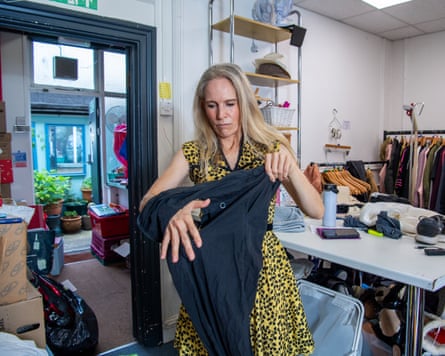
This illuminating read explains how charity shops are facing a crisis as they compete with secondhand resale sites such as Vinted, a problem with unexpected consequences. Crucially, she outlines how we can all donate better. Craille Maguire Gillies, newsletters team
-
Reading Morwenna Ferrier’s pest I’ll never forget made me reconsider the humble pigeon – which she describes as having encountered with such awe, aged 11. Poppy Noor, newsletters team
-
Whatever side of the “will AI destroy society” debate you stand, read Leyland Cecco’s conversation with AI computer scientist turned sceptic Geoffrey Hinton: uncertainty, Hinton argues, is not a reason for complacency. Craille
-
I loved our gallery of French photographer Jean-Pierre Laffont’s work – he spent two decades capturing protests, clashes and countercultural gatherings in America, and the images to come out are stunning and empowering. Poppy
-
When species of birds decline, passing on the skill of singing becomes harder, even affecting their ability to breed. Rebecca Ratcliffe has this fascinating and warming look at how scientists are helping birds remember lost songs. Craille
Sport

Football | Pablo Barrios struck after 53 seconds and Leny Yoro was shown red as Atlético Madrid added to Manchester United’s woes with a 2-0 victory.
Athletics | Ruth Chepngetich’s failed doping test, five months after she obliterated the record in 2024, left the sport deeply uneasy but powerless to act.
Formula One | Formula One has confirmed Rwanda will join the calendar, with the first race set for the early 2030s. It will mark the first time F1 has raced in Africa since 1993.
The front pages
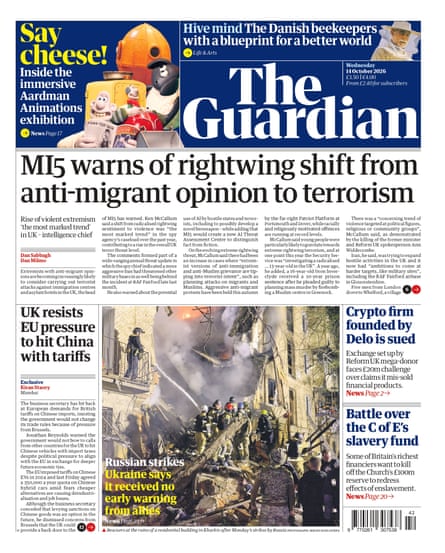
“M15 warns of rightwing shift from anti-migrant opinion to terrorism,” is the splash on the Guardian on Wednesday. “M15 chief: Russia did not sway Brexit vote,” says the Telegraph. “Putin’s Russia is biggest threat to Britain, M15 chief confirms,” says the i. “M15 chief: UK must not ‘play into hands’ of Putin,” has the Express, while the Mirror runs with: “Red Alert.”
“Tax fears eased in Burnham’s ‘pro-business’ pitch to bosses,” is the lead story over at the FT. “Online tax crackdown to boost the high street,” says the Times. “4 out of 5 new jobs went to foreigners in the past decade,” has the Daily Mail, while the Metro goes with “Toxic water spills surge.” Finally, the Star with: “Tiger’s victim a child actor.”
The Latest
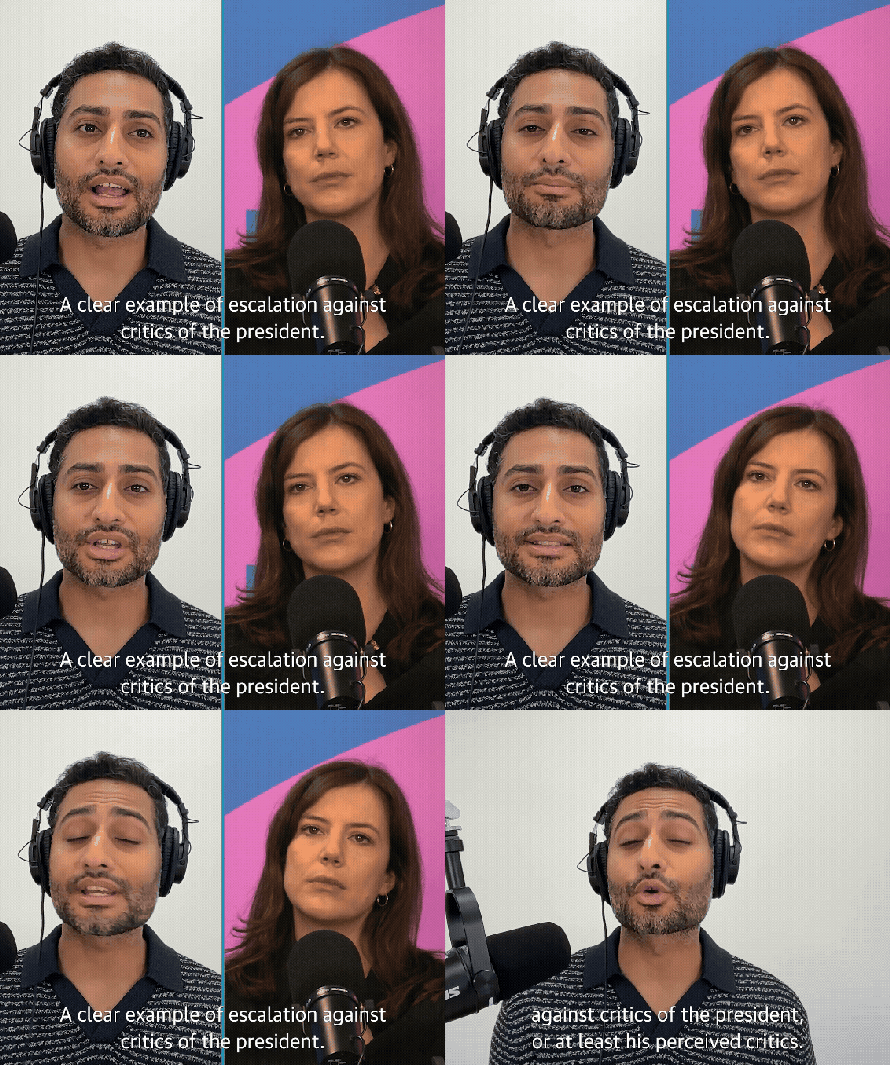
‘I will not be silenced’: Trump critic Ilhan Omar defiant after home raided
Democrats have described a raid on the home of Congresswoman Ilhan Omar as “deeply disturbing” and a “rogue abuse of power” by the Trump administration. The Democratic representative for Minnesota has long been a target of highly personal attacks by Donald Trump, who claims he was not involved in ordering the raid. Lucy Hough speaks to Guardian US political reporter Shrai Popat – watch on YouTube.
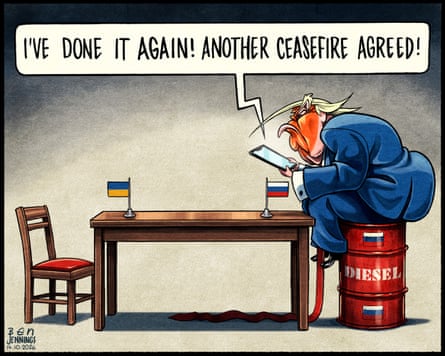
Cartoon of the day | Ben Jennings
The Upside
A bit of good news to remind you that the world’s not all bad
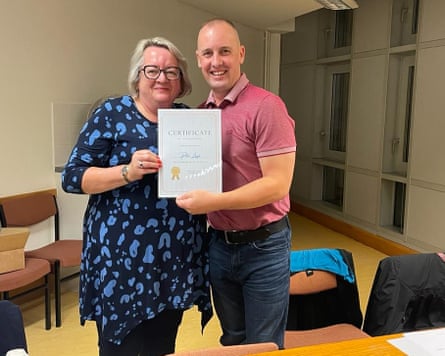
Peter Lloyd spent most of his life unable to read or write, despite repeated attempts to learn. He struggled in school, left with no qualifications, and developed coping strategies that enabled him to work successfully as a lorry driver. During the Covid lockdowns, he found that it had become an overwhelming issue, particularly when he could not help home-school his son.
Encouraged by his wife, he contacted the charity Read Easy and began lessons with a volunteer tutor. Over three years, he learned to read and now Lloyd serves as a Read Easy ambassador.
Lloyd says: “I think it’s important to encourage others in my situation to seek help, especially men who might be too ashamed. I have three books on the go at the moment – I can’t believe how beautiful reading is!”
Sign up here for a weekly roundup of The Upside, sent to you every Sunday
Bored at work?
And finally, the Guardian’s puzzles are here to keep you entertained throughout the day. Until tomorrow.
Disclaimer : This story is auto aggregated by a computer programme and has not been created or edited by DOWNTHENEWS. Publisher: theguardian.com