
Summer is right around the corner. We’re headed out on adventures and bringing our stuff with us. Here are all the tech and tips that WIRED Reviews recommends for your travels.
In 2015, I ran the Marathon Des Sables. You know, that race across the Sahara where people wear funny flappy sun hats and gaiters, and carry everything they need to survive (except a tent) on their backs. A week spent battling the giant dunes and the blistering, dried up rocky river beds taught me an important lesson: It’s possible to pack your life into a 10-lb pack and run big distances. It’s also a lot of fun.
Since then, I’ve embarked on many running adventures, including a 100-mile lap of Italy’s Lake Garda and the 184 mile length of the River Thames. In 2022, I became the first person to run Europe’s Danube river from sea to source, 1,830 miles across eight countries in 67 days, always carrying my own kit. I’ve spent a lot of time “kit pratting”, or obsessing over my ideal gear. I’ve worked out what’s essential (less than you might think), what’s superfluous, and what I can trust.
For my most recent excursion, I took on the Via Degli Day, an 80 mile trail run across the Italian Apennines from Florence to Bologna (though most people hike from Bologna to Florence). On day one I ran around 24 miles, 26 miles on day two and 30 on day three, somewhere between 5-8 hours each day. Here’s some of the essentials I packed to get me from Point A to Point B.
The Running Shoes
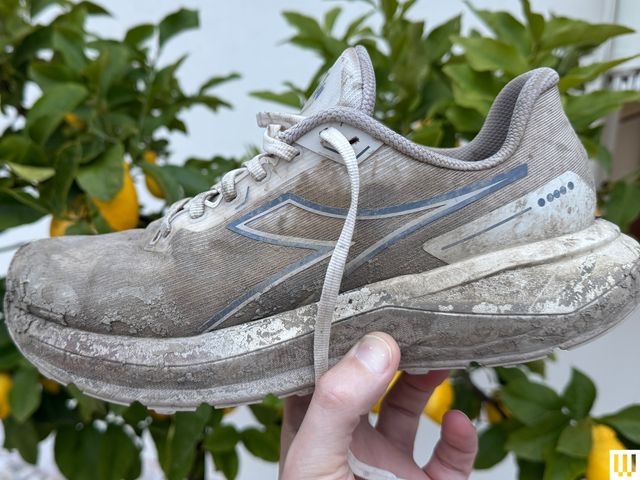
The Diadora Nucleo 2 GR ($170) is one of the new wave of gravel running shoes that’s made to handle everything from road to light off-road trails. I encountered a lot of both on this run, along with more challenging trail sections. The big wedge of softish cushioning, shallower lugs, and wider base worked well on the harder-packed, clear and runnable terrain while the really nice roomy toe box was excellent for blister-free comfort.
The Nucleo 2 GR is a bit heavy and struggled for precision, agility and stability on the more rock-strewn technical descents. But the grip worked surprisingly well (outside of some very muddy sections). Crucially, it’s a protective shoe with a generous fit that’s also easy to lace back on when it’s time to forage for dinner once you’re done running. That’s important when you’re only taking one pair of running shoes.
The Running Watch

Confession time: As a running gear tester, I had three sports watches on the go. The Garmin Forerunner 570, the Forerunner 970, and the Fenix 8 Pro 51 mm AMOLED. Of these, the Fenix 8 Pro stood out as the top performer. It’s expensive, but it’s the ultimate tool for multi-day adventures where you need multiple days of GPS staying power, reliable mapping and best-in-class routing, all on a big, easy-to-scan screen.
If you’re running far off grid, the Fenix 8 Pro also offers back-up satellite safety tools like SOS Emergency, off-network messaging, and live tracking, though you’ll need an inReach satellite subscription to unlock some of those. I was pleasantly surprised by the Forerunner 970 which just about lasted the three days. It lacks the safety tools and the routing wasn’t quite as on point as the Fenix 8 Pro, but for shorter runs of where you have access to charging, it’s a decent option.
Running Headphones


You can’t underestimate the morale boost from meaningful music or a well-timed chat with family (my Phone a Friend lifeline). So I always pack workout headphones. The Shokz OpenRun Pro 2 ($140) bone conduction headphones, or open ear styles like the Shokz OpenDots ($160), are good for staying connected with the world around. But I often opt for headphones that also cater for the time in transit, or the flights and trains to get to the trails when I’m not running.
This time, I took the Samsung Buds4 Pro. Samsung’s answer to the Apple AirPods Pro 3 combines high quality sound, with a light and comfy fit, good noise cancellation, excellent call quality and enough battery life for a day’s grafting. I can’t carry multiple USB plugs and cables, so the strategic charging of phone, camera, watch, and other tech is always a bit of a dance when I get access to power. The Buds4Pro’s rapid charge—1 hour of playback from a quick 10-minute charge in the case—means I can juice up enough for a day in a short period of time.
They’re also protected against dust and will survive sweat and being dropped in mountain puddles. The case is also pocket-friendly.
The Bag

After running shoes, your backpack is arguably the most mission-critical piece of kit. If it breaks 18 miles from civilization you’re in trouble. It’s also a problem if it rubs, bounces irritatingly or carries the weight awkwardly. The Silva Strive 23 ($93) ticks most of the boxes with a strong, durable harness, and straps that won’t wear through under duress like bungee cord straps. Double adjustable chest and sternum straps, a waist belt and side cinch pulls, make it easy to lock the pack in place for a reliable comfortable fit. The shoulder straps are wide enough to avoid cutting in and it was brilliantly bounce-free even on the steep downs.
The 23-liter main compartment has an expandable, extra 3 L roll top that happily swallowed everything I needed for three days of running and a three day trip directly after. That included a lightweight change of clothes, small safety kit, and essential toiletries. There’s pretty good up front storage, too, with two waist belt pockets for fuel, charging packs, headlamp, and any other gear you might need within reach on the move. I used two 750ml hard flasks in the harness bottle holsters. Soft flasks wouldn’t stay put and I find hard bottles better for mixing post-run recovery drinks and general hydration when I’m not on the trail.
I try to pack as light as possible. I’ll cut my toothbrush in half, decant sunscreen into the lightest bottles I can find. I’ll only take a few pairs of socks. I wear the same kit daily. The most I’ve gone without washing it was seven days. After that it gets crusty and the chafe risk rises. I take only one set of clothes for post-run chilling, and only the essential chargers, safety, and first aid kit.

My clothing is designed to handle chafing. When you’re moving for up to 8 hours a day, chafing is your enemy. Unfortunately, it’s all too easy to inflict friction burns on yourself and once something starts to gnaw you raw, it doesn’t tend to stop. I start out with the 2Toms Sportshield ($14) anti-chafe roll-on. I first used it at the Marathon Des Sables and it’s been my go-to ever since. For long runs, city marathons and longer adventures, I’ve not found a better way to prevent chafing.
It’s compact, easy to apply, and you can use it on nipples, thighs, underarms, feet, particularly the hard-to-reach nooks and crannies. It covers easily and one application lasts all day. It’s relatively mess-free to apply, washes off easily and doesn’t leave greasy spots on clothes like Vaseline can, which is handy when you might be wearing the same running tee for seven days straight between washes.
The longer you get into a days’ running, the less likely you are to stop and retrieve that vital piece of kit that’s stuffed deep in the main compartment of the pack. So having lots of accessible stash space is a smart move. Janji’s Trail Half Tights ($94) have six stretchy thigh pockets that can transport an impressive array of essentials. At one point during my Italian trek, I had my phone, three snack bars, a large charging pack, an Insta360 X2, and a headlamp all crammed in there.

In the Sahara we had to carry a minimum of 2,000 calories per day for six days. That included gels, carb drinks or energy bars, and freeze-dried expedition food. If I’m running through towns and villages, I’ll eat from shops and cafes and top up my pack supplies as I go. In my bag, I carry Precision Fuel & Hydration PF30 chews ($11). Each compact pack has 30 g of carbs and the neutral or mint and lemon chews are easy to eat, relatively tasty, plus they take up little space and they survive being squashed pretty well. I also took some Veloforte Amaro chews ($3) for a treat.
I also packed a tube of Precision Fuel & Hydration’s 1500 electrolyte tabs. The tube can slide down the side of your front-holstered water bottle, the tabs are easy to add to your flasks, and the light flavor is great for before, during and after a long day on the trails.
No matter what you do to avoid them, blisters are an inevitable risk. When the angry bumps rise, a simple foot care kit is your best friend. I always carry a clean hypodermic needle (to gently puncture the blister), a handful of alcohol wipes (to clean the area and the needle), along with iodine patches ($7), gauze, and physio foot tape, which you can use to prevent toe-on-toe aggression and keep open sores free from infection.
I’ve listened to enough Real Survival Stories to know bad stuff happens when you least expect it. So I carry some insurance. A small emergency kit is non-negotiable. I also keep a small selection of calorie dense food for emergencies, along with a whistle, a compass, and a small signaling mirror.
For Post Run
For my post-run attire, I pack one long sleeve base layer which I can also reach for if the weather gets bad during the run, a spare lightweight tee, a pair of brief-lined shorts (so I don’t need multiple pairs of boxers), and some hiking pants (as thin and light as possible). I’ll also stuff in some arm sleeves, a couple of Buffs ($32), and a cap, all of which can double up as warm gear should I come unstuck on the trials.
-Offwhite-Background-SOURCE-Ibex.jpg)


Disclaimer : This story is auto aggregated by a computer programme and has not been created or edited by DOWNTHENEWS. Publisher: wired.com



