
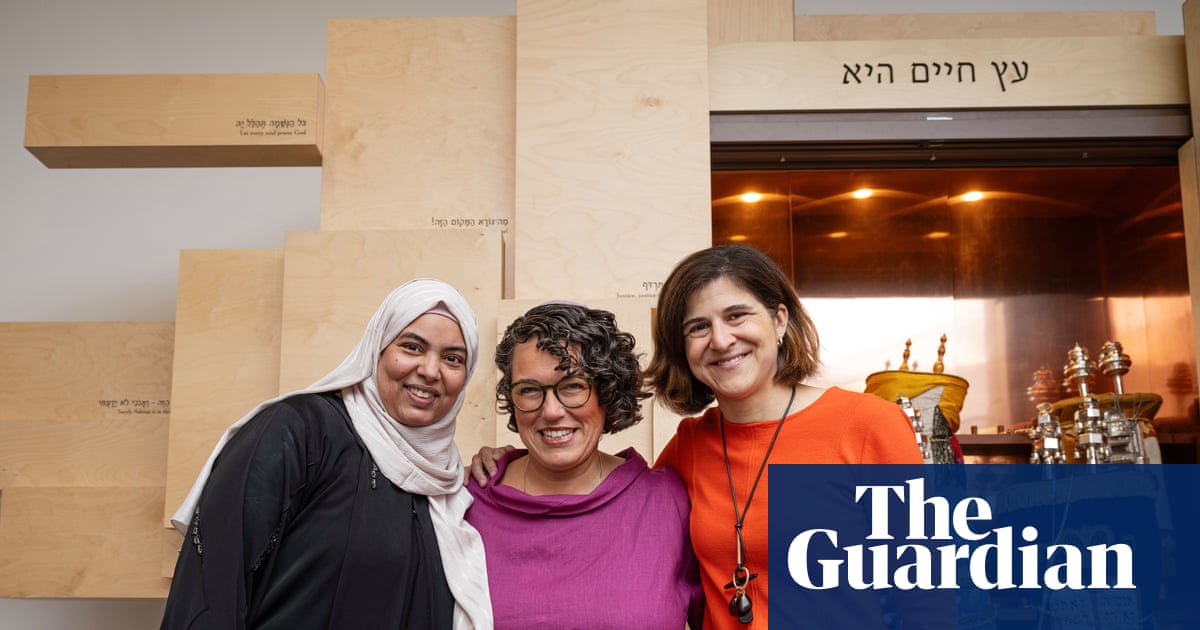
“How good and how wonderful it is when friends sit together,” reads a quote from the Psalms painted high on the wall inside Finchley Reform Synagogue (FRS). For the congregation gathering in a cheerful hubbub before its Shabbat service on Friday evening, that felt like an especially apt sentiment.
Three days after the synagogue was the victim of an attempted firebombing, hundreds of members made an extra effort to get together in determined if slightly nervy solidarity, joined by guests including local politicians, other faith leaders, police officers – and one particularly special group of neighbours.
These were the members of the Somali Bravanese community, many of whom arrived in the area as refugees, and whose own centre was destroyed in an arson attack 13 years ago. On that occasion, realising their Muslim neighbours would be without anywhere to pray as Ramadan approached, FRS offered them the use of the synagogue for evening prayers for the duration of the holy month – an arrangement that lasted for four years until their new centre was ready.
“We became a family,” said Asmaa Mohamed Ali, the director of the Somali Bravanese Welfare Association (SBWA), shortly after wrapping FRS’s Cantor Zöe Jacobs in an enormous bearhug. “We got to know the similarities that we have.”
This week, it was the turn of the Somali and Bravanese neighbours to return the favour. “As soon as my community heard this, they said, ‘They helped us a lot. They were there for us during our difficulties. Now it’s our turn. What can we do?’” said Mohamed Ali.
And so, as members of the Jewish congregation crammed into the foyer before the service, a group of children from SBWA nibbled on buns while showing off homemade signs marking the bond between the two groups. Other SBWA members had brought large numbers of donuts to share after the service.
It marked a heartening end to an otherwise deeply dispiriting week at the synagogue, after bottles containing a liquid thought to be petrol were thrown at the building early on Wednesday morning. A man and a woman have been arrested in connection with the incident, which is being treated as an antisemitic hate crime.
That attack comes after the fire bombing last month of four ambulances owned by a Jewish charity in nearby Golders Green, an attack that was claimed by a group with links to Iran. Sarah Sackman MP, in whose constituency the attacks occurred, said there was “fear and genuine anxiety” among the Jewish community, “but I also believe there is a strong show of resilience”.
She called the close partnership between the synagogue and Muslim community centre a “quiet, radical act of solidarity and allyship”. “FRS is not just a place of worship, they host a nursery, homeless shelter, refugee drop-in, educational and community activities. It is a place that embodies the best of community and which reaches outwards. British Jews do not want to live behind higher and higher walls.”
The buzzing warmth inside the standing room only service, where toddlers whirled in party dresses and families smiled and swayed together during the many songs, was in contrast to the mood outside. Everyone present would have passed through the high gates ringing the synagogue, patrolled by volunteers, security guards and, on Friday, extra police. Visitors may have been expressly welcomed, but they had to check their names against a list and show photo ID.
“When we built this building four years ago, I remember really strongly saying, why are we having a fence around our building? That’s not our message, we want to be an open building,” said Jacobs. “Now, honestly, that feels a bit naive and I guess I’m glad I didn’t win that one.”
Antisemitic incidents in the UK are significantly more frequent than before the Hamas attacks on Israel in October 2023 and Israel’s war in Gaza, according to research by the Community Security Trust (CST), which provides security and support to Jewish communities in the UK.
It identified 3,700 incidents in 2025, the deadliest of which was the October knife attack on the Heaton Parksynagogue in Manchester, in which two people were killed and three seriously injured – the first fatal antisemitic incident in the UK since CST records began in 1984. That terror attack, in itself, became the precursor for a sharp rise in antisemitic incidents, the charity found.
Dave Rich, CST’s head of policy, said:“There’s a huge amount of policing going into protecting the Jewish community at the moment, which is both very welcome and a sign of how seriously they take the threat.
“Amidst it all, I think it is very typical of the Jewish community that Finchley Reform Synagogue are determined to carry on being open and welcoming. That balance between the severe nature of the threat and the determination to carry on is the hardest thing to maintain, I think.”
FRS’s Rabbi Deborah Blausten, told those in attendance: “When dark forces come knocking at our doors it hurts. It really hurts”. However, she stressed, the synagogue “is a place of welcome … Whatever life throws at us, we do not walk alone.”
On Sunday, the congregation was told some from the synagogue would be joining with worshippers at the local Anglican church, to which others were invited. “The timing could not be any better”.
On leaving, the congregation were instructed not to linger once outside the gates and past the security guards. “Please do all your socialising inside.”
Disclaimer : This story is auto aggregated by a computer programme and has not been created or edited by DOWNTHENEWS. Publisher: theguardian.com



