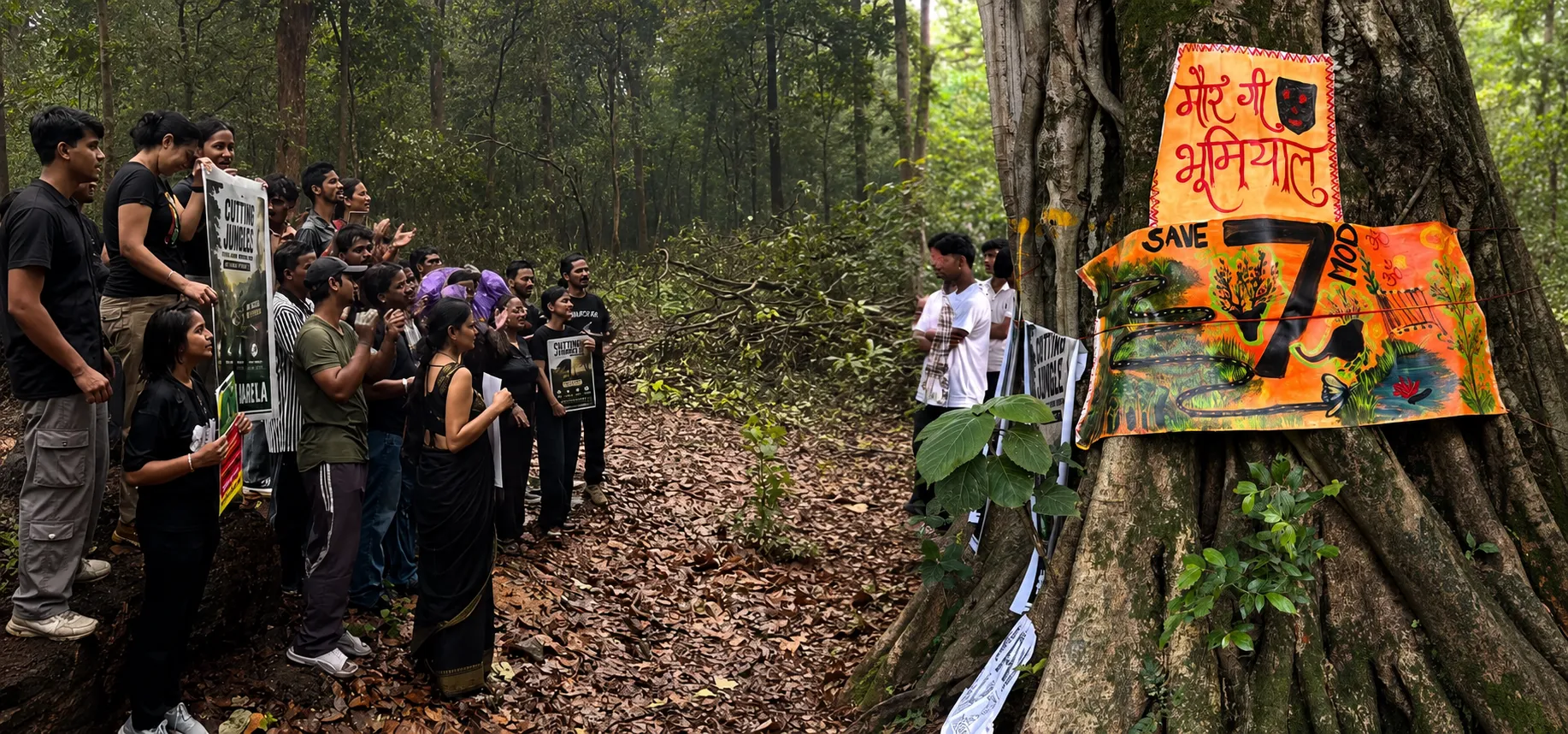
Saat Mod, or “seven bends”, is a short, shaded stretch of National Highway 7 between Bhaniyawala and Rishikesh in Dehradun district.
For years it was little more than a bend in the road to most travellers, a place where Sal trees lean over the tarmac, and elephants occasionally amble across between forest patches.
In July 2026, this quiet stretch became the site of one of Uttarakhand’s most remarkable displays of citizen action in recent memory.
The Bhaniyawala-Jolly Grant-Rishikesh stretch was being widened from two lanes to four or six, a project meant to ease growing traffic to Jolly Grant Airport and along the Char Dham Yatra route. But the widening meant thousands of mature Sal trees, some over a century old, standing in its path.
The stretch also falls within a recognised elephant corridor connecting to the Rajaji Tiger Reserve, a link that allows wildlife to move safely across the wider landscape.
Rather than watch the trees disappear, residents of Dehradun decided to show up. Every single day.
A movement rooted in memory
What unfolded at Saat Mod was not a single dramatic gesture but a sustained, creative campaign that drew on decades of local tradition. Students, retired officials, environmentalists and everyday residents began gathering at the site, and their methods were as striking as their persistence.
Many protesters hugged the trees earmarked for felling, a direct echo of the Chipko movement of the 1970s, when villagers in these same Himalayan foothills wrapped their arms around trunks to physically stop loggers.
That movement began in Uttarakhand and became one of India’s most iconic examples of grassroots environmentalism. Its return to the same hills, five decades later, was not lost on anyone at Saat Mod.
Alongside the tree-hugging, protesters revived another local custom: tying sacred threads around the trunks of trees, a gesture traditionally used to mark a tree as protected, almost like a pledge of guardianship. Each thread became a small, personal commitment, a way of saying this tree matters, long before any formal outcome was decided.
The most inventive moment came on 16 July, the date of Harela, Uttarakhand’s annual festival celebrating greenery, agriculture and the arrival of the monsoon.
Instead of the usual festivities, protesters observed what they called Kala Harela, or “black Harela”, dressing entirely in black to mark their mourning for trees being felled even as the festival meant to honour nature was being celebrated elsewhere.
Together, these acts turned a roadside protest into something closer to a cultural performance, one that used memory, ritual and symbolism as effectively as any placard or petition.
What the numbers show
Environmental researcher Anoop Nautiyal shared data pointing out that Uttarakhand had diverted more than 46,000 hectares of forest land for development since 2000, with nearly half of that concentrated in Dehradun district alone.
/filters:format(webp)/english-betterindia/media/media_files/2026/07/24/3-2026-07-24-16-34-18.png)
For many at Saat Mod, this context was part of why they felt compelled to act, not simply about one stretch of highway, but about what collective vigilance could still achieve for the hills they called home.
Plans for the highway itself included measures designed with conservation in mind: a proposed 3.5-kilometre elephant underpass, wildlife crossings, culverts and compensatory afforestation across 40 hectares, developed with input from WWF-India and the Wildlife Institute of India. These details mattered to protesters too.
Their questions were less about opposing progress and more about ensuring every gentler alternative had genuinely been explored first.
What citizens achieved by simply not leaving
After days of sustained, peaceful presence at Saat Mod, tree felling was paused and fresh consultations were opened with residents, experts and other stakeholders. For a protest built almost entirely on showing up, standing still and tying a thread, that pause was a meaningful marker.
The story of Saat Mod is not yet finished, and the trees already felled cannot simply grow back. But what happened here offers something worth holding onto: a reminder that ordinary people, using nothing more than presence, memory and a sense of shared purpose, can still shape decisions that once felt entirely out of their hands.
The Chipko movement began in these same hills fifty years ago and went on to influence forest policy across the country. At Saat Mod, a new generation picked up the same instinct, tying it to old rituals and new symbolism, and proved that collective, peaceful action still has the power to make people pause and listen.
Images courtesy: Instagram/@thebetterindia
Sources
‘Dehradun Protest at Saat Mod as NHAI Plans to Fell 4,369 Trees for Highway Expansion‘: by Down To Earth staff, Published July 2026
‘Uttarakhand CM Dhami halts tree-felling on Dehradun’s “Saat Mod” amid public outcry‘: by IANS for The Hans India, Published on 18 July 2026
‘Dhami halts tree felling for Rishikesh-Bhaniyawala 4-lane project after prolonged protests‘: by PTI for The Federal, Published on 18 July 2026
Disclaimer : This story is auto aggregated by a computer programme and has not been created or edited by DOWNTHENEWS. Publisher: thebetterindia.com