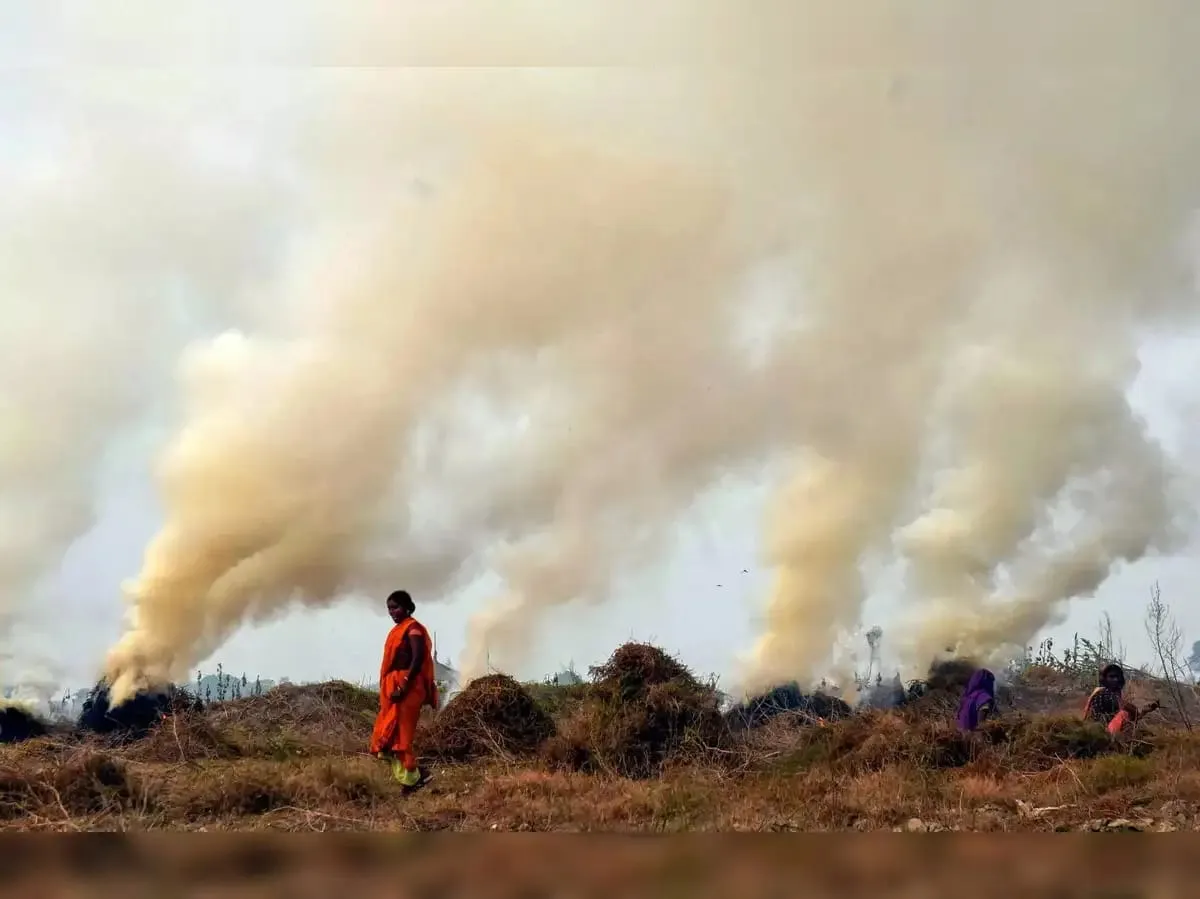
At first, 16-year-old Sk Reezaal Arafat thought someone near his home in Medinipur, West Bengal, was burning rubbish. For the past two winters, he had been noticing tiny particles of ash floating in the air and settling around his house.
He had grown up hearing about Delhi’s ‘gas chamber’ winters and the smoke caused by farmers burning leftover crop waste in Punjab and Haryana. But he had never expected to come across the same problem so close to home.
When he began looking into where the ash was coming from, he discovered that farmers in his own district were setting fire to the stalks left behind after harvesting their crops.
It bothered him. Why were farmers still burning their crop waste when the smoke was affecting people living nearby? And what would it take to stop it?
As Reezaal would soon discover, the answer was far from simple.
Why farmers were burning their fields
The first thing Reezaal learnt was how much it could cost farmers to avoid burning.
Clearing just one bigha of farmland by hand could cost around Rs 600, while burning the leftover stalks cost almost nothing. And with another crop to plant, farmers often had very little time to get their fields ready.
Unpredictable weather was making things harder. Machines had made harvesting faster, but many farmers still didn’t have access to the equipment needed to clear the waste left behind. Other options, such as products that help the stalks break down naturally, could take time to arrive and even longer to work.
For a farmer worried about the cost of clearing a field and getting the next crop planted on time, burning was often the easiest way out.
But Reezaal noticed another problem. By the time someone spotted a fire, reported it and the authorities could respond, the damage had already been done. The smoke had spread, and families living nearby were left breathing it in.
He began to wonder why everyone was trying to deal with the fires after they had started.
What if farmers could get the help they needed before they reached for a match?
How SATARK looks for warning signs before a fire
That question led to SATARK, a climate-tech initiative Reezaal started in December 2025. Today, he leads a team made up mostly of student volunteers aged 15 to 18, with a network of over 30 ‘Student Guardians’ helping connect the initiative with farmers. He began building it while still in school, juggling field visits, coding and research calls alongside his board exam preparation.
SATARK aims to identify where crop waste is likely to be burned and help authorities reach farmers with alternatives before they resort to setting their fields on fire.
But Reezaal first had to understand why existing systems were missing some of these fires.
Satellites can spot fires from space, but they don’t always catch everything. Some pass over an area only at fixed times, so fires that burn for a short while or happen late at night can go unnoticed. Sometimes, the images also lack enough detail to show exactly what’s happening in a particular field.
“If we can’t find the hotspot properly, then we cannot find the solution too,” he says.
As he studied these gaps, Reezaal realised that simply detecting more fires wouldn’t solve the problem.
“We were missing a lot of fires,” he says. “I didn’t want to just make a detection system that records more burning. We needed to track who is burning, where they are burning, and why they are burning — because only then can you design a response that actually helps.”
/english-betterindia/media/post_attachments/eae8e0c0-db2.png)
With guidance from mentors, he began developing a system that combines satellite information with data collected directly from villages and farming areas.
So how does SATARK work?
The system has two main parts. The first is a network of small, low-cost Internet of Things (IoT) devices, called ‘sentry nodes’, that collect information about local weather conditions, including wind direction, air pressure and moisture.
The second is a prediction model Reezaal calls ‘smart burning windows’. It uses satellite images, information about crops and weather conditions to identify fields that are nearing harvest and assess whether burning at a particular time could worsen pollution nearby.
To do this, the system uses something called NDVI, a way of measuring how green the crops are. By tracking fields as they change from green to harvest-ready brown, SATARK can identify places where farmers may soon need to clear leftover crop waste.
/filters:format(webp)/english-betterindia/media/media_files/2026/10/12/crop-burning-2026-10-12-18-43-27.jpg)
The sentry nodes add another layer of information. Using local weather readings, the team can estimate where smoke might travel if a fire starts, whether it would disperse or drift towards nearby homes and public spaces.
Together, these tools help SATARK answer two questions: where is crop waste likely to be burned, and when can someone step in to help?
And if help cannot reach a farmer in time, the ‘smart burning windows’ model also attempts to identify when burning might cause less environmental damage.
From a school project to a village-level pilot
But identifying the risk is only one part of what Reezaal wants SATARK to do. The larger goal, he says, is not to punish farmers after a fire has already happened, but to send alerts and support early enough for authorities to step in with decomposers, machinery or other interventions.
“I always thought technology should not be something that brings convenience to us while discarding nature at the same time,” he says. “I think of it as a biosystem between technology and nature. I approach it with the question: how can we optimise natural systems instead of working against them?”
That thinking has also shaped how SATARK works with communities. Guided in part by Dr Daniel Aldrich, whose work focuses on resilience and disaster governance, the team began looking not only at who was burning, but also at who was managing not to burn despite facing similar constraints.
“At first, we were only looking for who was burning,” Reezaal says. “But he suggested that we should also look for the people who are not burning — the positive deviants. That changed a lot for us.”
/filters:format(webp)/english-betterindia/media/media_files/2026/10/12/crop-burning-2026-10-12-18-28-12.png)
The shift helped SATARK move away from seeing farmers simply as violators and towards understanding the local practices that were already reducing dependence on fire.
Other mentors helped strengthen different parts of the project: Dr Ruth DeFries of Columbia University advised on land use and remote sensing; Dr Adway Mitra of IIT Kharagpur supported the AI and geospatial modelling work.
Dr BK Mohan of IIT Bombay contributed to the geoinformatics and remote sensing side, while Dr Arun PV of IIIT Sri City worked closely on SATARK’s technical architecture and research.
For a project still in its early stages, SATARK has already begun moving beyond one school campus. Reezaal studies at Siddha Sashi Sripati Vidyabhaban, one of several schools now linked to the initiative, alongside Harasankar Garkilla High School, Raghunathbari High School, Uttar Jianda High School and Gopalnagar B.L. Vidyapith.
Together, they form the base of a student network that can gather field observations, support awareness efforts and act as a bridge between farming communities and public systems.
The initiative is also beginning to receive support from local authorities. SATARK has received pilot backing from officials, including the Block Development Officer in Kolaghat, and has entered a second phase of field authorisation.
/filters:format(webp)/english-betterindia/media/media_files/2026/10/12/crop-burning-2026-10-12-18-44-41.jpeg)
Its work has also led to a 34-farmer ground-truth socio-economic dataset published on Harvard Dataverse, peer-reviewed research outputs, and an OSHWA open-source hardware certification for its environmental monitoring stack.
Still, Reezaal is careful not to present SATARK as a finished answer.
“I wouldn’t say the most important thing is that we built an AI model,” he says. “The most important part is how we interact with farmers and what we learn from them.”
‘First, we sit with farmers & listen’
By June 2026, SATARK had directly worked with 37 farming families across eight villages, while its wider community reach has spread further through local networks. But on the ground, the team says the work begins not with technology, but with trust.
“We don’t start with questions,” says Sanket Kuila, one of SATARK’s field team members.
/filters:format(webp)/english-betterindia/media/media_files/2026/10/12/crop-burning-2026-10-12-18-46-11.jpg)
“A lot of farmers are tired of outsiders showing up, asking things, and then disappearing. So we sit with them first, understand what pressure they’re under that season, and only then talk about the problem.”
That approach has shaped how SATARK is trying to build credibility in villages where farmers have long relied on inherited knowledge, but are now dealing with increasingly unpredictable weather and tighter timelines.
“Earlier, in our fathers’ time, there was a rough sense of when the rain would come, when storms would come, when the sun would hold,” says farmer Kartik Chandra Hazra.
“Now everything seems mixed up. Nothing is as predictable as it used to be. So, what they’re doing gives us a reason to look more closely at the data they share with us.”
Instead of lecturing farmers about pollution, the team tries to offer something immediately useful in return for their time: soil reports, fertiliser guidance, and evidence on how repeated burning may be affecting topsoil health.
In one comparison, SATARK found that a farmer who had repeatedly burned crop residue over the years had lower levels of soil organic matter and nutrients, as well as a lower crop yield, than farmers who had not.
That evidence has also helped the team navigate long-held beliefs around burning.
“A widely held belief is that ash acts as a fertiliser,” Reezaal says. “It’s not entirely wrong in the short term, but it destroys the microbial layer and the long-term nutritional value of the soil.”
/filters:format(webp)/english-betterindia/media/media_files/2026/10/12/crop-burning-2026-10-12-18-53-48.jpg)
Instead of arguing, the team is comparing burnt and unburnt plots so that the data can make the case. For farmers like Kartik Pradhan, what mattered was not just the explanation, but the effort to make the system understandable.
“Just seeing those devices, we wouldn’t know what they do,” he says. “But they sat with us, showed it live, and then gave us a report on how much fertiliser the soil actually needs. Everything was explained properly.”
When farmers want to stop burning, who helps them?
The team has also documented nine ways farmers are already managing paddy straw without burning — from feeding it to cattle and using it to boil paddy, to mixing it back into the soil. That, Reezaal says, has been one of SATARK’s biggest lessons: solutions often already exist within communities, but need support, coordination and timely alternatives to become viable at scale.
As farmer Sanjib Sanki points out, the problem is not always a lack of alternatives, but a lack of reliable access. “Straw can be sold or reused, but you don’t always know who to call, when the season changes and buyers disappear,” he adds.
That is also the challenge SATARK is trying to solve next: not just detecting fires, but making sure support reaches farmers before they run out of time.
“The satellite and the sensors are the easy part,” Reezaal says. “The hard part is making sure that when a farmer decides not to burn, there’s actually something waiting for them on the other end.”
/filters:format(webp)/english-betterindia/media/media_files/2026/10/12/crop-burning-2026-10-12-18-55-29.jpg)
In Bengal’s villages, SATARK is learning that crop burning is shaped by timing, cost and access, as well as awareness.
By listening first, grounding its model in field realities, and treating farmers as collaborators rather than culprits, this student-led team is trying to make alternatives to stubble burning practical and worth adopting before the smoke rises.
All images courtesy of SK Reezal
Disclaimer : This story is auto aggregated by a computer programme and has not been created or edited by DOWNTHENEWS. Publisher: thebetterindia.com