
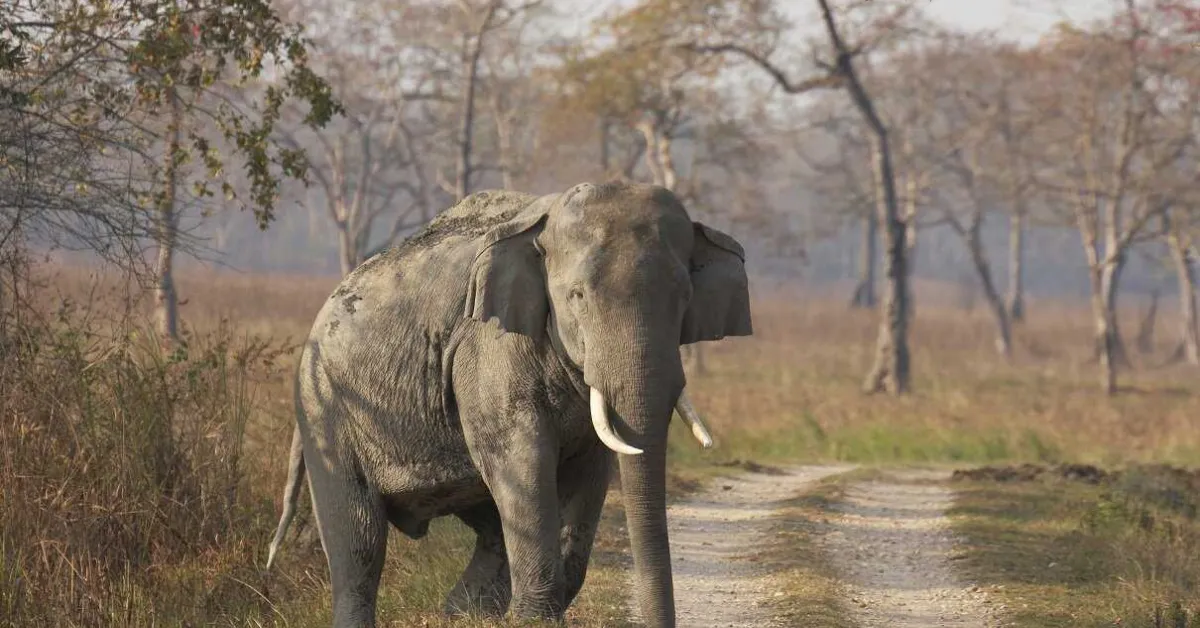
For a farmer, a field of paddy or sugarcane is months of work standing in one place. If elephants enter and damage the crop, a season’s income can disappear with it.
For an elephant moving through the Terai, the same field looks very different. Paddy, maize and sugarcane are all food, and they offer plenty of energy in a relatively small area.
This overlap between what a farmer depends on and what an elephant wants to eat lies at the centre of a difficult question: how do you protect livelihoods in a landscape elephants continue to use?
Fences are one answer. In parts of Uttar Pradesh’s Terai Elephant Reserve, farmers and conservationists are also trying something else.
They are looking at what grows inside the field.
The crop drawing attention is turmeric, which elephants are less attracted to than paddy, maize or sugarcane. Farmers are being encouraged to grow it alongside, or in place of some of, the crops that are more vulnerable to elephant damage.
The idea makes sense only if it works for the farmer too. Turmeric has to grow well, cost less to cultivate and find a market that pays enough to make the shift worthwhile.
That is where this experiment begins.
Why are elephants choosing farms over forests?
The Terai Elephant Reserve was notified in December 2022 and covers more than 3,000 sq km across the Dudhwa-Pilibhit landscape. It includes forest areas associated with Dudhwa, Pilibhit, Katarniaghat and Kishanpur. Government sources put Uttar Pradesh’s elephant population at about 232.
The reserve also borders Nepal, and elephants move across the international boundary. Their route, however, does not run through one continuous stretch of forest. Farms form part of this landscape too.
For an elephant, many of the crops growing there are familiar kinds of food.
“Sugarcane is a species of grass. Paddy, wheat and maize are grasses too. So, from an elephant’s perspective, they are all food,” explains Dr Aritra Kshettry, National Lead-Elephant Conservation at WWF-India.
Cultivated crops have another advantage. They pack a considerable amount of energy into one place.
“Nutritionally, these crops have been selectively bred by humans for thousands of years to maximise carbohydrates, which means they are a rich source of energy,” says Kshettry.
In a forest, getting the same amount of energy takes much longer.
“To get the same amount of energy, elephants would have to forage for up to 12 to 14 hours a day in the forest, feeding on bits of grass and trees,” he explains. “They can get the same energy in a couple of hours by feeding on paddy, sugarcane or maize.”
Seen from the elephant’s side, a cultivated field can therefore be difficult to pass up.
“From an energy point of view, it makes more sense for elephants to feed on crops,” says Kshettry. “But croplands also have costs.”
Those costs include people, roads, electricity infrastructure and other hazards. An easy source of food can also bring elephants into situations that are dangerous for both the animals and the people living around them.
The challenge has become more pressing as elephant movement in this part of the Terai has changed.
When seasonal visitors began staying year-round
According to Kshettry, elephants were once seasonal visitors to the landscape. In 1991, that pattern began to shift.
“1991 was the first year Dudhwa had elephants throughout the year. There were about 45 elephants,” he says.
Over time, elephants began spending longer periods on the Indian side and expanding their range.
“In the lived memory of people in this landscape, elephants are a fairly recent entry, unlike tigers and leopards, which have always been there,” says Kshettry.
That matters to the people farming here. Elephant presence through more of the year means that the animals and agricultural fields cross paths more often.
WWF-India profiled elephant-related crop loss alongside other challenges faced by farmers across the Terai Elephant Reserve. Katarniaghat Wildlife Sanctuary emerged as a particular hotspot, with elephants present almost every year.
The farming calendar adds another layer to the problem. Some farmers grow sugarcane throughout the year. Others grow two crops, such as wheat followed by maize, or wheat and paddy.
As one crop is harvested, another may be growing. For elephants moving through the area, food can therefore be available across different seasons.
It was while looking at these patterns that an existing crop began to stand out.
What was different about the turmeric?
Some farmers in Katarniaghat were already growing turmeric. Elephants did not appear to be drawn to it in the same way they were to paddy, maize or sugarcane.
For farmers dealing with repeated crop damage, that difference opened up an interesting possibility.
“So our supposition was: what if we could increase the revenue from turmeric by adopting better agronomic practices and more climate-resilient, high-yielding varieties?” says Kshettry.
Farmers would not have to abandon food crops altogether. If turmeric could bring in enough money, income from it could help absorb losses when elephants damaged other crops.
“The increased revenue these farmers get from turmeric will help offset the losses they inevitably face with food crops,” he explains.
The programme began with around 10 progressive farmers. WWF-India’s agriculture team then worked with about 70 farmers on improving the way turmeric was cultivated. The focus was practical: increase yields, use less water and reduce input costs.
“That has been our initial intervention for the last two years: introducing better agronomic practices for turmeric to get a higher yield,” says Kshettry.
Around 100 farmers have since been trained in improved turmeric cultivation, according to WWF-India. The organisation says yields increased by 85% in one year.
A heartwarming sight of Asian Elephant calves enjoying a hearty mudbath under the vigil eyes of mum, aunts,& other in Dudhwa N.P. The calves imitate every action of their elders unconcerned about any danger. It helps them cool off & get rid of ticks.@DudhwaTR@rameshpandeyifspic.twitter.com/Vlu2Jltz61
— Sanjay Kumar IAS (@skumarias02) September 15, 2026
A larger harvest, however, brings its own practical concern. Farmers still need somewhere to sell it.
A good crop is no use if nobody buys it
A field of turmeric that elephants leave alone is useful only if the farmer can make a reasonable income from it.
If production rises without reliable buyers, farmers are left with a different problem. So the work has begun moving beyond cultivation and into what happens after the turmeric leaves the field.
“The yield has to go somewhere. So currently, we are building the value chain through farmer producer organisations, which will aggregate the farmers’ produce and sell the turmeric to a procurer,” says Kshettry.
Farmer producer organisations can bring together produce from several farmers and connect them with larger buyers.
One buyer is being developed around organic production. Farmers would need to follow organic practices for several years before their turmeric could qualify for organic certification and command a premium.
Another buyer is expected to work with the farmer producer organisations on processing and packaging.
These steps matter because a farmer’s earnings depend on what happens after harvest too. Drying, processing and packaging can influence how much value eventually comes back to the person who grew the crop.
According to WWF-India, the Forest Department has committed funds towards a turmeric processing and drying unit in the region.
The success of crop diversification will ultimately depend on this full chain. Farmers need a crop elephants are less likely to damage, but they also need that crop to make economic sense.
That raises another question farmers living with elephants often face. Why go through the trouble of changing crops when a fence could simply keep the animals outside?
So, why not just put up fences?
Fencing can help in certain places, particularly where a dense human settlement meets an area used by wildlife and there is a clear boundary that needs protection.
Kshettry’s concern is what happens when fences are placed within a larger landscape of forests and farms through which elephants already move.
“Fencing, I think, has been abused in India,” he says.
“If you put fences in a mosaic of forests and farms, you restrict wildlife movement and divert it elsewhere.”
The effect can be easy to miss when looking at a single farm. An elephant stopped by one fence still has to find another way through.
“If you put up a fence around your farm and it lies along a corridor or on flat land, you may expose your neighbour’s farm to these elephants,” says Kshettry. “So there are spillover effects.”
Protecting one plot can therefore push the problem towards another.
That is why the work in Katarniaghat extends beyond turmeric fields. If elephants will continue to move through this landscape, people also need ways to know when they are nearby and respond before an encounter becomes dangerous.
An early warning can make a difference
The programme has supported 150 Gaj Mitra (elephant-friend) volunteers working across 20 teams. Around 1,600 community members and other stakeholders have also received training in managing human-elephant conflict.
Technology has become part of that response. AI-enabled cameras have generated more than 650 automated alerts about elephant presence for communities and Forest Department response teams.
/filters:format(webp)/english-betterindia/media/media_files/2026/10/03/938483-ac2022-2026-10-03-12-04-21.jpg)
An alert cannot stop an elephant from moving, but advance warning gives people and response teams more time to react when one is nearby.
Alongside this community response, ecological monitoring is helping teams understand the animals and the landscape better. More than 50 wild Asian elephants have been individually identified and profiled.
Vegetation surveys across 220 plots have also recorded hundreds of plant species and more than 18,000 field data points.
Each of these pieces addresses a different part of the same problem: what are elephants eating, where are they moving, when are they approaching farms, and what can reduce the losses when people and animals use the same landscape?
The answers will not remain fixed.
“These are very dynamic systems, and what works today might not work tomorrow. What works in one location might not work in another,” says Kshettry.
That uncertainty is also why turmeric is being tested as one part of a wider approach.
How much can one crop change?
There are encouraging signs from Katarniaghat.
Between 2021 and 2025, the area of crops damaged by elephants fell by 86%, according to WWF-India. The number of crop-damage incidents declined by 47% over the same period.
Those figures sit alongside the work on turmeric, early-warning systems, community response and ecological monitoring. No single intervention can take credit for solving a conflict shaped by animal movement, farming choices, rainfall and changing habitat conditions.
For the farmer standing in a field, however, the question remains much simpler.
Can this land continue to provide an income without losing so much of what grows on it to elephants?
Turmeric offers one possibility. If farmers can grow it productively, find reliable buyers and earn enough from it, a crop that elephants largely avoid could make farming in this landscape a little less vulnerable.
The elephants, meanwhile, will continue to move.
The experiment in the Terai starts from that reality and asks what can change around it. Sometimes, that change may begin with something as ordinary as deciding what to plant.
This story is part of a content series by The Better India and WWF-India.
Disclaimer : This story is auto aggregated by a computer programme and has not been created or edited by DOWNTHENEWS. Publisher: thebetterindia.com




