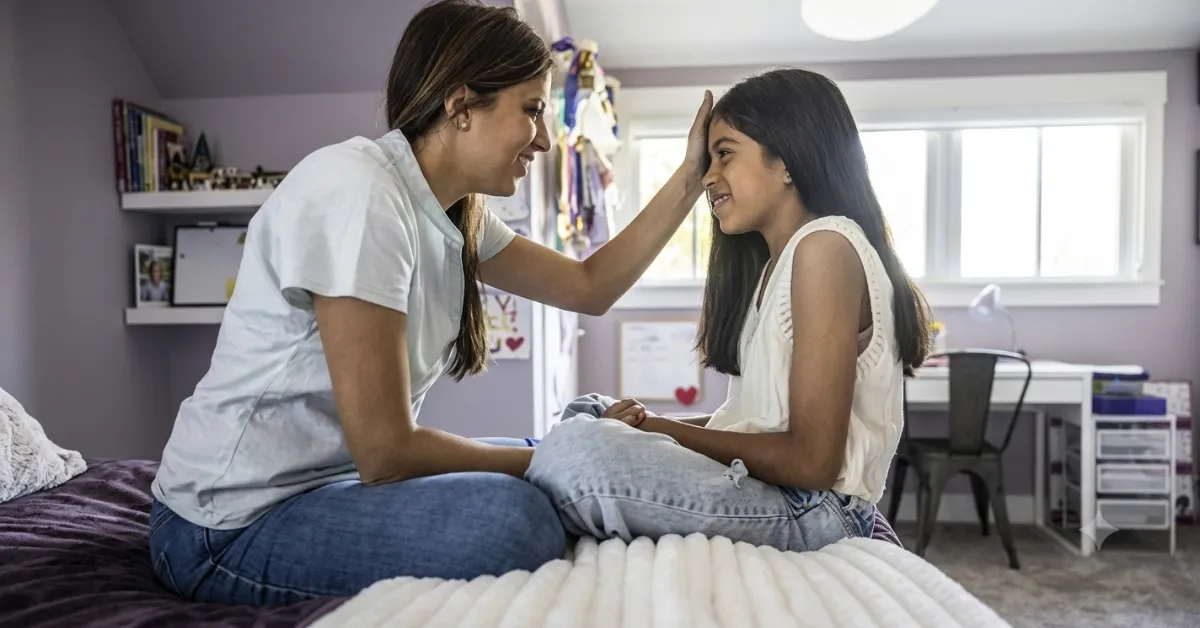
Do you remember your first period?
Maybe it came when you were at school, and you noticed a red stain on your uniform before you even knew what it meant. Maybe you ran to the bathroom, convinced that something was wrong.
Or perhaps your mother had already told you about periods, and when it finally happened, you knew exactly what to do.
For many girls, the first period is a strange mix of confusion, embarrassment and fear. There is blood where there wasn’t any before, a body that suddenly seems unfamiliar, and often one overwhelming question: Am I okay?
Sometimes, the most memorable part isn’t the period itself but how the adults around you reacted.
A calm ‘You’re fine, this is normal’ can make the experience feel ordinary.
A panicked reaction, a warning to hide the stain, or an awkward silence can make a child feel that menstruation is something to be embarrassed about.
And that is precisely why the conversation about periods should begin before the first period arrives.
A child who already knows what menstruation is, why it happens, and what she can do when it starts is far less likely to mistake it for an injury or feel helpless in the moment.
Period education, then, isn’t simply about explaining the menstrual cycle. It is about giving a child enough information and confidence to know that my body is changing and that I know what to do.
Start before the first period
Parents don’t need to sit their child down for one intimidating ‘period talk’. In fact, the conversation can be much easier when it happens gradually.
Dr Neha Abhijit Pawar, Consultant in Gynaecology at Kokilaben Dhirubhai Ambani Hospital, Mumbai, recommends beginning conversations around the age of 8 or 9, using simple, age-appropriate language.
In a conversation with The Better India, Dr Pawar says parents can introduce menstruation naturally while discussing growing up, body changes and hygiene. Signs such as breast development or the appearance of pubic or underarm hair can also become an opportunity to explain that more changes will follow.
The first message is simple: periods are normal. They are not an illness, and period blood does not mean that a child is hurt.
Children should also know that the first few periods may not arrive like clockwork. Some may experience cramps, tiredness, mood changes, or breast tenderness, while others may experience very little discomfort.
The aim isn’t to overwhelm a child with information. It is to make sure that when the moment comes, nothing about it feels completely unfamiliar.
Make a plan for the unexpected
The first period may not happen at home. It could begin in a school bathroom, during a sports class or while a child is out with friends.
A little preparation can therefore go a long way.
Dr Pawar recommends putting together a small period kit with two or three sanitary pads, spare underwear, tissues or wipes and a disposal bag. But she also suggests preparing the child for the social side of the situation.
Identify a teacher, school nurse, counsellor or another trusted adult whom she can approach. Parents can even practise what she might say: ‘I think I have started my period. Can you please help me?’
It may seem like a tiny exercise, but knowing the words to use can remove a lot of anxiety when a child is suddenly faced with a situation she has never experienced before.
When the first period finally comes
If a frightened child approaches her parent and asks, ‘Why am I bleeding?’, the first response does not need to be a biology lesson.
Reassurance comes first. Dr Pawar suggests you can try explaining to your child in this way:
“You are okay. You are not hurt. This is your first period, which means your body is growing and developing normally. The blood is coming from the uterus and is part of a natural process. I am here with you, and we will manage it together.”
Once the child feels safe, parents can explain what is happening in greater detail.
/filters:format(webp)/english-betterindia/media/media_files/2026/09/28/period-health-2026-09-28-18-09-18.png)
Dr Pawar also cautions parents against reactions that may unintentionally create shame. “Telling a child she is too young, calling menstruation dirty, making jokes about stains, or immediately imposing restrictions can create unwanted worry for the child,” she adds.
A child’s first lesson about periods is often not what adults say about menstruation but what their reactions tell her about it.
Help her separate facts from myths
By the time children get their first period, they may already have heard plenty about menstruation from friends, older siblings or social media.
Some of it may be wrong.
Parents can gently correct myths such as the idea that period blood is dirty or toxic, that girls should not bathe or exercise during their periods, or that every menstrual cycle must arrive exactly every 28 days.
“Cycles can vary, particularly initially,” says Dr Pawar. “Bathing and physical activity are generally safe.”
One myth that deserves particular attention is that severe period pain is something every girl has to tolerate.
Mild cramps can often be managed with a warm heating pad or hot-water bottle, hydration, rest and gentle movement or stretching. But severe pain that worsens repeatedly, interferes with school or daily life, or does not respond to usual measures should be discussed with a healthcare professional.
/filters:format(webp)/english-betterindia/media/media_files/2026/09/28/period-health-2026-09-28-18-11-56.png)
Similarly, very heavy bleeding, prolonged bleeding, fainting or significant weakness should not simply be brushed aside as part of getting a period.
Teach her what ‘normal’ can look like
The first few periods may be unpredictable. Bleeding can vary in amount and duration as the menstrual cycle matures.
Rather than making a child anxious about tracking every date perfectly, parents can encourage her to notice patterns — when she bleeds, how long it lasts, and how she feels.
The bigger lesson is that bodies do not always follow a textbook schedule.
And if something feels unusually painful, heavy, or disruptive, she should know that asking for help is not an overreaction.
The conversation should continue after the first period
Perhaps the biggest mistake parents can make is treating period education as a one-time conversation that ends once the first pad is used.
Children will have more questions as they grow: about cramps, discharge, irregular cycles, menstrual products, exercise, school, body image, and eventually reproductive health. They need to know that they can keep asking.
/filters:format(webp)/english-betterindia/media/media_files/2026/09/28/period-health-2026-09-28-18-10-33.png)
Because the goal was never simply to prepare a child for the sight of blood.
It was to prepare her to understand her body without fear, to ask for help without embarrassment, and to grow up knowing that menstruation is not something she needs to hide.
And perhaps, years later, when someone asks her, ‘Do you remember your first period?’, the memory won’t begin with panic or shame.
Maybe she’ll simply remember thinking, I knew what was happening. I knew what to do. And I knew I was okay.
Disclaimer : This story is auto aggregated by a computer programme and has not been created or edited by DOWNTHENEWS. Publisher: thebetterindia.com