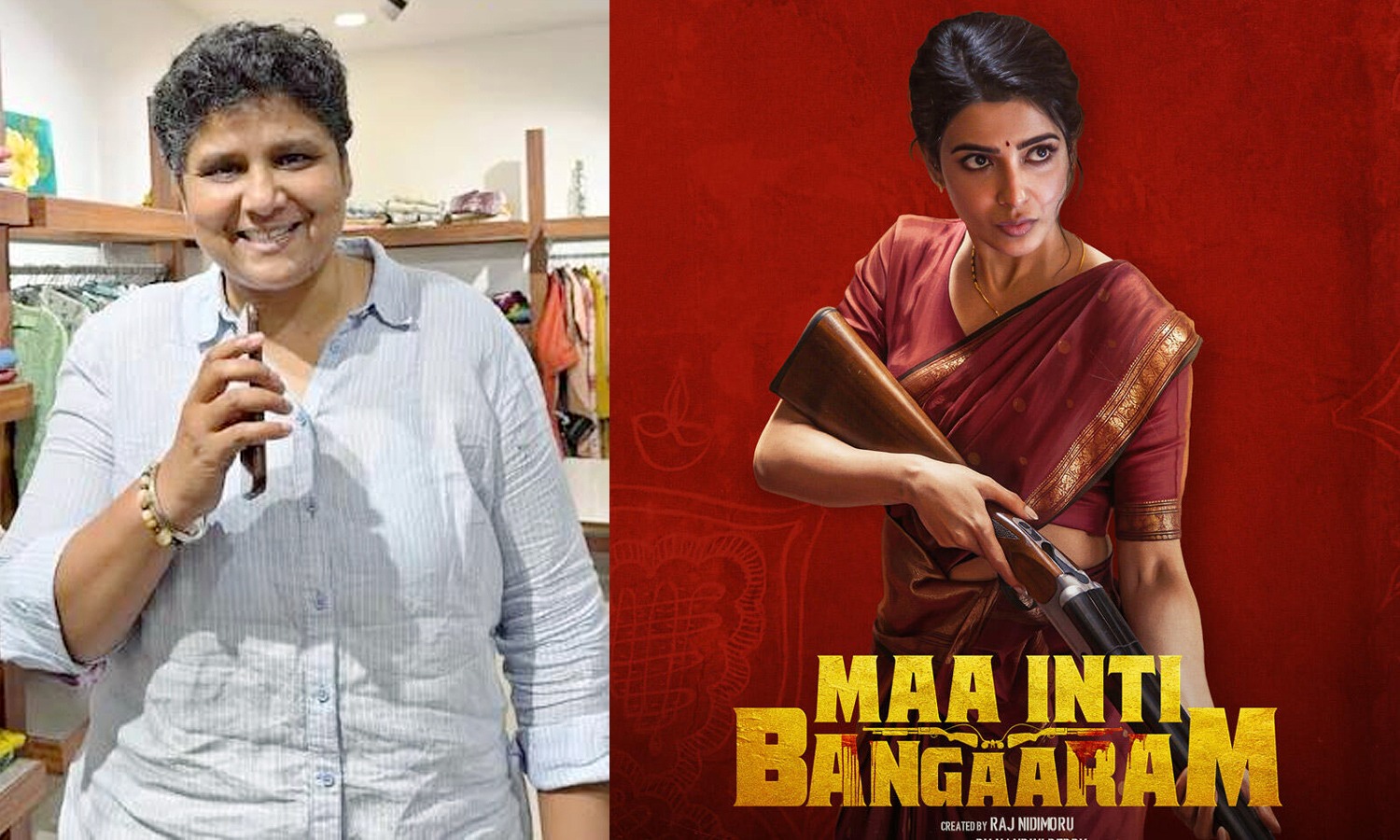
Noted filmmaker Nandini Reddy has finally broken the jinx surrounding women directors in Tollywood with the blockbuster success of Maa Inti Bangaram, which has reportedly collected around Rs 25 crore share worldwide.
“Nandini Reddy has proved that a woman director can deliver an action entertainer on par with any male filmmaker. But Tollywood needs many more such successes before women directors are accepted as a commercial force,” says a leading exhibitor.
He points to the disappointing box-office performance of Padmavathi Malladi’s Gandhi Tatha Chettu and Neeraja Kona’s Telusu Kada, despite the latter featuring an impressive cast comprising Siddhu Jonnalagadda, Raashi Khanna, and Srinidhi Shetty.
“It is a fact that women directors have struggled to strike a chord with Telugu audiences in recent years and need to reinvent themselves. I don’t want to single out anyone, but very few female directors have delivered commercial hits lately,” says producer Lagadapati Sridhar, admitting that these are challenging times for women filmmakers trying to establish themselves in Tollywood.
Although the Telugu film industry has talented women directors such as Sujana Rao (Gamanam), Seshu Sindhu Rao (Choosi Choodangaane), Sowjanya (Varudu Kaavalenu), and Sanjana Reddy (Raju Gadu), most of them have struggled to sustain their careers and move up the ladder with consistent projects.
Offering another perspective, Lagadapati Sridhar believes the industry’s work culture also plays a role. “Many women directors have certain inhibitions when it comes to approaching producers. Unlike their male counterparts, they cannot keep visiting production offices repeatedly in search of opportunities,” he says.
According to him, the industry’s image itself discourages many aspiring women filmmakers .”Until the industry sheds its male-chauvinistic mindset, women directors will continue to face an uphill battle. Some of them have told me that the atmosphere isn’t always conducive for women. Frequent visits to production houses often invite unwanted comments. Coming from conservative and educated families, many women prefer to wait for the right opportunity rather than face unnecessary criticism,” he adds.
He also feels that women filmmakers are often typecast. “They excel at handling emotions, relationships, and family dramas, so they naturally gravitate towards romantic and family-oriented stories. At a time when action films dominate the market, they find it harder to secure projects,” he reasons.
Actor-turned-director Jeevitha Rajasekhar dismisses the notion that women can only make feel-good entertainers. “Women are capable of handling every genre, including action. Talent has nothing to do with gender,” she says. “Direction has traditionally been a male-dominated field, but women are steadily finding their rightful place.”
She believes the industry is gradually becoming more inclusive. “Today, we are seeing more women working as costume designers, assistant directors and even assistant cinematographers. The situation is changing for the better. Some women from well-educated families may still have apprehensions about joining the film industry, but that perception will change as more women take centre stage and succeed.”
Disclaimer : This story is auto aggregated by a computer programme and has not been created or edited by DOWNTHENEWS. Publisher: deccanchronicle.com