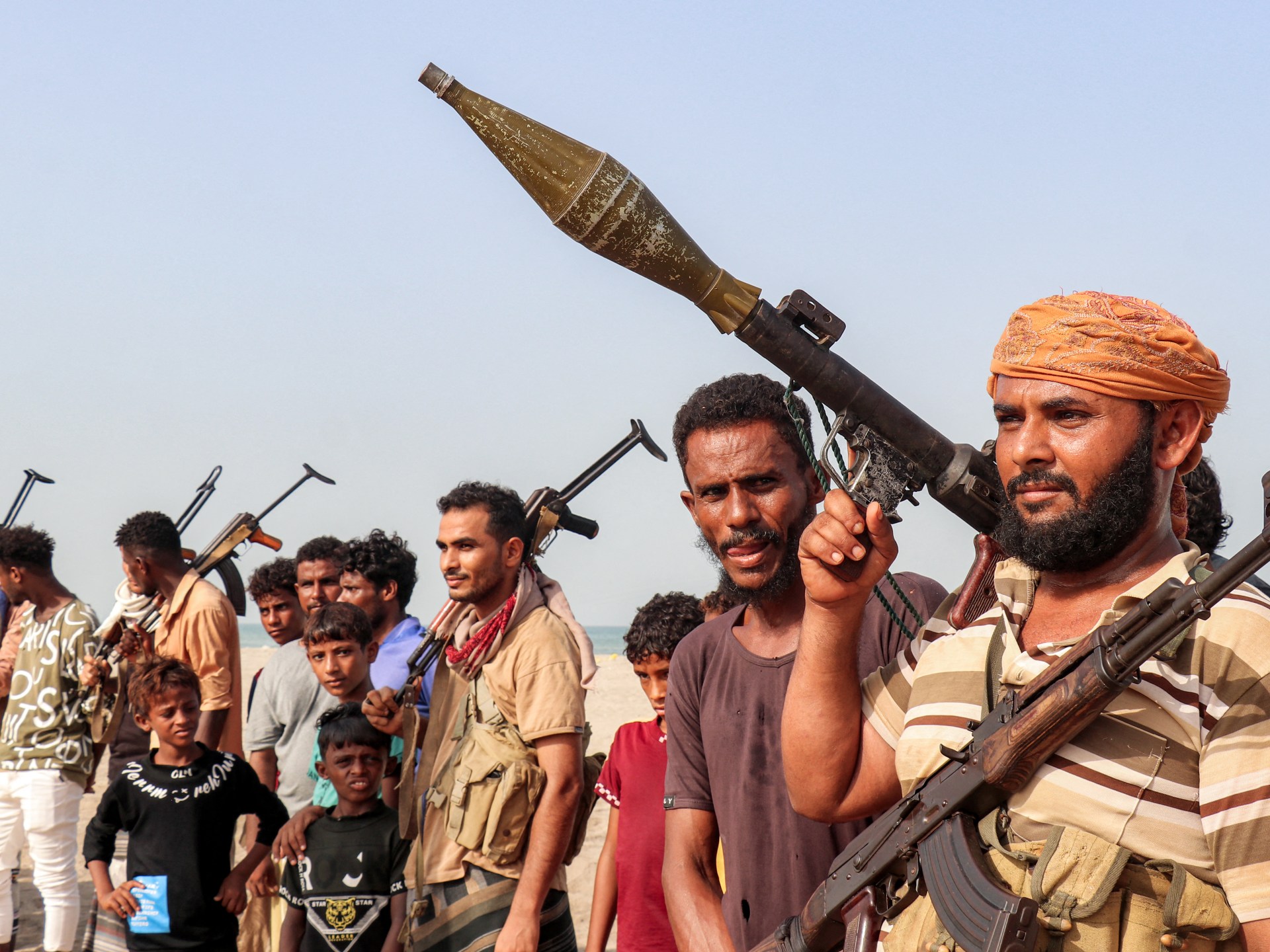
The conflict in Yemen has entered a new chapter with a declaration by the Houthis that they are imposing a maritime siege on all shipping to Saudi Arabia.
The Yemeni rebel group, also known as Ansar Allah (or supporters of God), has attacked a number of Saudi tankers in the Red Sea.
Recommended Stories
list of 3 itemsend of list
This development has placed the Bab al-Mandeb Strait, the strategic waterway that connects the Red Sea to the Gulf of Aden and the wider Indian Ocean, at the heart of the war between the United States and Iran, and amplifies pressure on global trade routes.
The Iranian-backed Houthis, who seized Yemeni capital Sanaa in 2014, have threatened to close the strait, the route through which much of Europe’s energy supplies pass. It is also a key passage for imports to Saudi Arabia.
The Houthis’ decision to announce a maritime blockade cannot be separated from the turmoil created by the ongoing war between Washington and Tehran, which erupted on February 28 when the US and Israel attacked Iran.
Houthis raise stakes for Saudi’s support
On Monday, Yemen’s internationally recognised government claimed responsibility for an air strike on Sanaa airport, saying that it was a measure to prevent an Iranian plane from landing in Yemen’s Houthi-controlled capital. But the Houthis blamed Saudi Arabia for it.
The Houthis responded by firing missiles into Saudi Arabia – a key backer of the Aden-based Yemeni government – and later upped the stakes by announcing a naval blockade on the kingdom.
These developments mark a major escalation in Yemen’s civil war. Saudi Arabia, which has sought in recent years to avoid a new war on its southern borders, is facing a more complex equation with the threat shifting from land to sea, and the targeting of one of the most important alternative routes for its oil exports.
Advertisement
All of this raises the question: will this escalation cause a new confrontation between the Yemeni government and the Houthis? And if so, what does the balance of power look like between the Houthi and government sides after more than a decade of war? Has the balance changed enough to increase the odds of a military resolution to the conflict?
There has been talk of potential escalations in recent years, but this now seems more likely, especially since it intersects with local, regional and international events and the return of the US-Iran war.
The Yemeni government has restructured its military with a single decision-making centre, and regional messages suggest the military option has not been shelved, as was once thought.
So, will retaking Sanaa return to the table as a military objective to be thought of seriously, and what does that mean practically? And how ready are the parties, especially the Yemeni government, for battle?
The structure of government-affiliated forces
The anti-Houthi camp today comprises the National Army as the official framework of the Ministry of Defence, in addition to new formations with independent commands, such as the Giants Brigades, and the Guardians of the Republic forces in al-Makha, or Mocha, in the west.
These different groupings – all on the anti-Houthi side in the conflict – have emerged over the years due to the weakening power of the central government, the growth of independent figures, and the backing of regional countries.
The number of National Army personnel in the field is estimated at about 400,000, according to recent statements by the Defence Ministry. Its organisational structure includes Yemen’s seven military regions, but troop deployment is concentrated in Marib, Taiz and the country’s southern and eastern governorates, as a result of Houthi control over vast parts of the country’s northwest, including Sanaa.
Also backing the army are the Emergency Forces, comprising between 30,000 to 40,000 personnel, and the Homeland Shield Forces, created in 2022 with between 30,000 and 40,000 recruits, and tasked with taking over camps in Hadramout and the southern governorates in December 2025, following the defeat of separatist forces who previously controlled those areas.
Fighting late last year between the Yemeni government and affiliated forces on one side, and United Arab Emirates-backed separatists on the other, has led to changes in Yemen’s south and west.
After the defeat of the 75,000-strong separatist Southern Transitional Council, following a Saudi intervention on the side of the government and the withdrawal of the UAE from Yemen, the group’s organisational cohesion has been impacted. But they have not been disarmed, and remain in many locations in the south, with some elements absorbed – even if nominally – into government structures.
Advertisement
Another formerly-UAE backed force, the Tariq Saleh-led Guardians of the Republic, is estimated to number about 20,000 fighters. They are stationed primarily on the Red Sea coast and are considered among the most heavily armed formations, due to the past Emirati support.
The Giants Brigades are among the most prominent combat formations in the anti-Houthi camp, with an estimated 20,000 fighters and a presence on the Red Sea coast, in Aden, and in some southern areas.
Consequently, the total size of the forces affiliated with the government and the anti-Houthi camp is estimated at more than 500,000 personnel, albeit with a clear disparity in levels of training, discipline and institutional integration.
Quality of armament and military equipment
The types of weapons held by these forces do not differ as significantly as the level of their operation and management. The National Army relies on conventional weapons inherited from the Yemeni army pre-war, including light and medium weapons, armoured vehicles, tanks and field artillery, alongside various communication and transport capabilities.
The Homeland Shield Forces, backed by Saudi Arabia, are considered among the most relatively well-equipped modern formations. They rely on tactical vehicles, light armoured vehicles, and superior communication systems suited for rapid deployment missions and the protection of institutions.
The Emergency Forces rely on light to medium armament focused on urban operations and rapid deployment missions, more akin to a field military force with rapid intervention duties, combining a security character with combat capability.
The Giants Brigades rely on medium and heavy armament, armoured vehicles and fire support units, and they are recognised for their capability to conduct offensive ground operations compared with other forces.
As for the formations affiliated with the Southern Transitional Council, they rely on diverse weaponry, though readiness varies as a result of the organisational changes they have undergone.
In recent years, the majority of government forces have also developed their drone capabilities, both within regular units and some irregular formations. These assets are now used for reconnaissance and surveillance missions, and occasionally for limited tactical support.
Balance of power with the Houthis
Official military records in Sanaa indicate that Houthi-affiliated army units comprise more than 200,000 fighters and can also mobilise tens of thousands of members from their volunteer Popular Committees for rapid intervention and support.
However, these figures, much like the military rosters in the government camp, may not accurately reflect the actual combat strength on the ground due to the inclusion of reserve or inactive names in registries.
Although government-affiliated forces may possess more manpower, the balance of power in Yemen is not determined solely by numbers.
Despite sustaining significant damage to its forces and assets from US and Israeli strikes over the past few years, the Houthi side benefits from a more centralised command structure and possesses experience in managing asymmetric warfare.
Advertisement
This is in addition to possessing missile, drone and maritime threat capabilities that have proven their impact in the Red Sea and the Bab-al-Mandeb Strait. It appears that the military balance in Yemen is more a balance of organisational and war management rather than a balance of weaponry and numbers.
Readiness of government forces for a major battle
Indicators suggest government forces are capable of engaging in defensive battles, holding territory or managing extensive security deployments. However, they face significant challenges should they consider launching a large-scale offensive.
The most prominent of these challenges was the multiplicity of military decision-making centres – before Saudi Arabia assumed control of this decision-making following the UAE’s withdrawal – and the varying levels of training and discipline, compounded by the difficulty of operational coordination.
Geography is also a factor, as the Houthis’ control over the mountainous northwest grants them a defensive advantage, whereas government forces are dispersed across multiple fronts, limiting their ability to mobilise at a decisive point.
The scenario of entering Sanaa
So far, there are no clear public indications that any international power, including the US, has adopted a declared plan to support a large-scale military operation to take Sanaa.
Although Houthi attacks in the Red Sea have elevated the level of international interest in the Yemeni file, the international strategy has been focused on degrading Houthi capabilities related to the sea and smuggling, rather than on a ground offensive. However, reports have emerged from sources within the Yemeni state regarding a possibility of waging a war against the Houthis with US support.
If an operation towards Sanaa is considered, its success would require complex conditions, most notably unifying the government’s military command, providing broad domestic and regional political cover, and ensuring the ability to manage the city after seizing control of it. Some of these conditions may have already been met.
Has Saudi Arabia provided cover to confront the Houthis?
The Yemeni government’s military decision-making is largely tied to Saudi political and military support, and any broad move against the Houthis remains contingent upon Riyadh. But Riyadh has preferred to focus on protecting the kingdom’s southern borders, securing shipping lanes and preventing the expansion of the Houthi threat deep into Saudi territory.
It seems that Saudi strategy has previously leaned towards managing the conflict rather than resolving it, by combining limited military pressure, diplomatic moves and de-escalation tracks to reduce the security and economic costs of the war.
The Saudi position may have shifted recently in light of international and regional events, particularly concerning the security of navigation in the Red Sea. Riyadh may be pushed to re-evaluate its options regarding the Yemeni file, and the one currently on the table may be a military one.
Disclaimer : This story is auto aggregated by a computer programme and has not been created or edited by DOWNTHENEWS. Publisher: aljazeera.com