
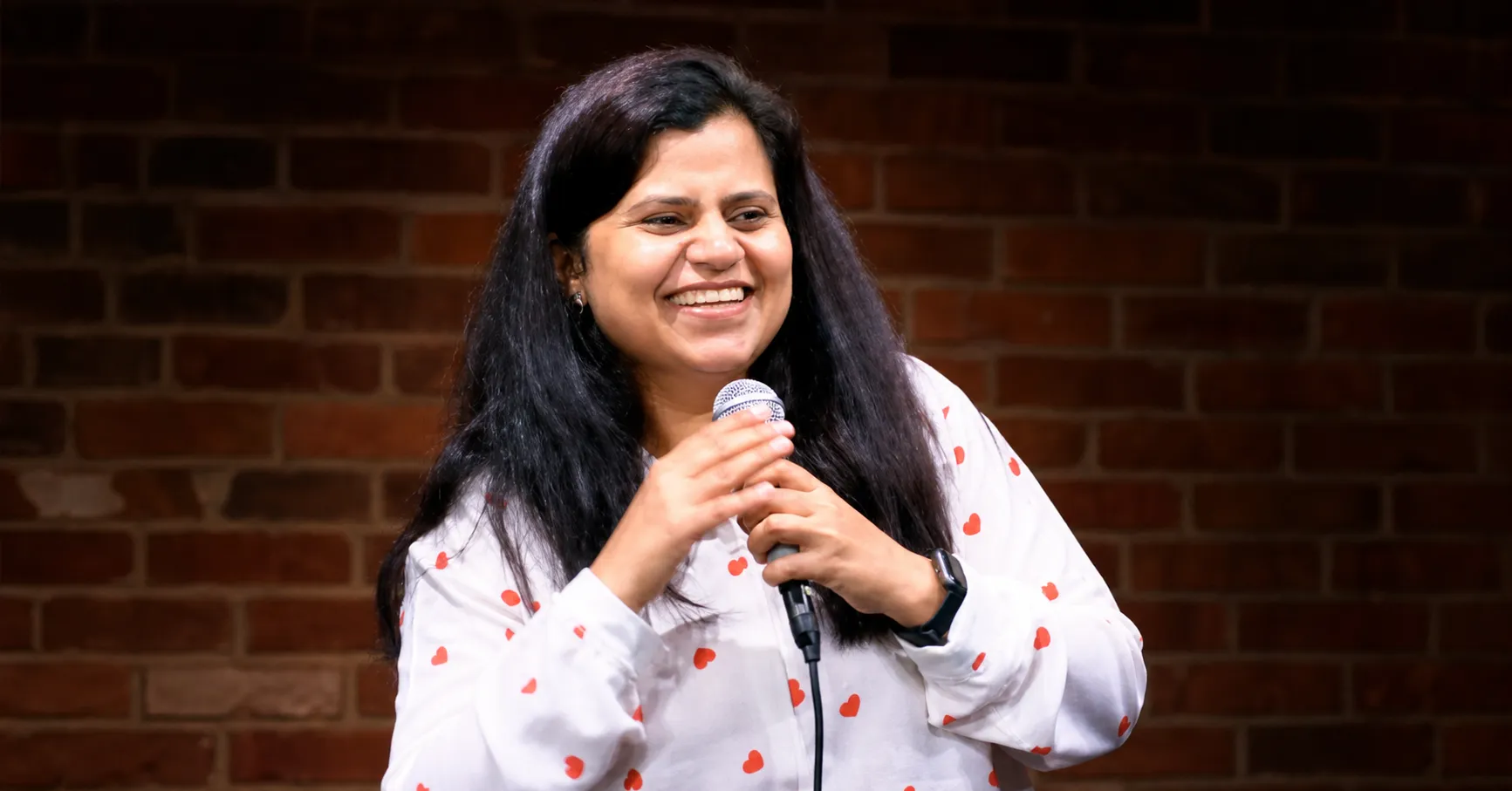
It was a New Year’s Eve house party, somewhere in the years before any of this had a name.
The host kept telling the room that the party hadn’t started, that some other guy was on his way, and only when he arrived would the night come alive. Akhilee Matta listened to this for long enough. When the man walked in, she pounced.
She told him, sweetly, that of course the party couldn’t begin without him; they had all been waiting for the “life of the party” to arrive. She then asked where the zing was that he was supposed to bring. He bowed his head. He said he didn’t know this woman. Everyone else was on the floor. By the end of it, he was no longer the one the room was waiting for — she was.
Her friend Gaurav Sethi — now her husband — was watching. He would marry her years later, and somewhere between the laughter and the moment, something clicked for him. There was a craft sitting inside the woman he would marry, and it had a name.
“She has a knack for being very witty and funny while being spontaneous,” he says, recalling the conversation that ran on quietly in their home for the next four years. “And she can do that without offending another person — instead, while making them laugh. I started telling her, “You have such a natural talent that not everyone is gifted with. So why aren’t you trying it out in the industry?”
But there was no industry yet. Not one Akhilee could see from where she was sitting in Delhi NCR, holding a corporate communications job, climbing the ladder she had set herself on when she had picked Mumbai for her postgraduate course, chiefly because it was not her hometown, Jhansi.
/filters:format(webp)/english-betterindia/media/media_files/2026/05/05/akhilee-1-2026-05-05-18-52-10.jpeg)
You see, Akhilee had been a funny child. She had imitated her teachers at the dinner table, the way they rubbed the board until their feet lifted off the floor. She had given pet names to half the staff room. Her younger brother made her laugh at home; she made everyone else laugh outside it.
But nobody in Jhansi, in those years, said the word “comic” out loud the way you would say engineer or banker. So she had filed it away as a personality trait, the way most funny women do, and gone to Mumbai to learn how to write press releases.
The plus-one years
It took Gaurav until 2019 to find a vocabulary for what he had seen at the party. Stand-up comedy was beginning to surface in India by then. He started taking her to open mics, then to a touring show by a Mumbai comic in Delhi.
She was not impressed with herself.
“This is too polished. I can’t do this,” she remembers thinking. “Premise. Setup. Punch. Premise. Setup. Punch. When you are starting, you don’t know any of this.”
He sent her videos on how to construct a joke, how to build an assumption and then break it, and the laugh comes out of the gap. He emailed comics he had never met, asking if his wife could meet them and learn. One of them, Jeeveshu Ahluwalia, said yes.
/filters:format(webp)/english-betterindia/media/media_files/2026/05/05/img_9369-2026-05-05-18-52-52.jpg)
Akhilee still remembers writing to him from the café where they had agreed to meet. “I’ve reached, wearing X colour so you can identify me.” She was a woman in her late twenties, sitting in a coffee shop with her husband, waiting to be told whether her joke about the New Year guest was the beginning of something or just the thing that had happened at a party.
Jeeveshu told her two things that afternoon. The first was about language. He told her not to write with abusive words, that the easy laugh was the one she should refuse, because the moment she swore on stage, she would shrink her audience. The second was harder. He told her, as Gaurav remembers it, that the only thing she had to do in this industry was not die at night. If a mic bombs, don’t lose heart. Come back stronger.
Soon after, she went for her first open mic. It went okay. She went for her second.
It bombed.
“While stepping on stage was a matter of paying 150 rupees for 5 minutes, the real challenge was: what will I even say for 5 minutes?” she says. She had not prepared. She had walked in on confidence, the way she had walked into the New Year party, and learned the difference between a room of friends and a room of strangers waiting to be made to laugh.
/filters:format(webp)/english-betterindia/media/media_files/2026/05/05/img_8193-1-2026-05-05-18-54-02.jpeg)
The second mic taught her the discipline that has held since. She started writing every single day, most of which still brews quietly in a diary. She started recording the audio of every set. On the drive home from a mic, the car stereo played her own voice from an hour earlier — where the laugh came, where it didn’t, which line she had fumbled, which she had rushed.
Gaurav became something between a coach and a hanging sword. “Did you listen to today’s set? If you didn’t do your homework, what’s the point? Tomorrow I’ll take you again, and again, if you do not listen there is no point.”
/filters:format(webp)/english-betterindia/media/media_files/2026/05/05/0b6b9a6c-e5f0-4d26-9045-fc9b106c3214-2026-05-05-18-54-38.jpg)
“He was becoming like a hanging sword on my head,” Akhilee says, laughing. “I am a very content person on the surface. I do not have many expectations from myself. If life is going smoothly, I don’t want anyone poking around in it. But there we were. Every weekend.”
Monday to Friday she went to her office. Saturdays and Sundays she paid Rs 200 for a slot at whichever open mic Gaurav had managed to book her into. He was the plus-one each time the rule at most mics is that every comic must bring one non-comic audience member, and Gaurav sat through hundreds of strangers’ five-minute sets with a smile arranged on his face.
“It’s not funny to sit in front of open mics,” Akhilee says. “The performers are just trying their best because something they thought last night was funny.”
The audience is a mirror
Then COVID came, and the mics shut.
For most comics, this was a setback. For Akhilee, who had not yet given herself permission to be a comic, it was an opportunity to learn from people who suddenly had nothing else to do. She started a podcast called, ‘Sit Down with Standups’. She invited established comics, the same names she would not be able to get on a call today, because they are touring — and asked them how they had built their careers.
/filters:format(webp)/english-betterindia/media/media_files/2026/05/05/akhilee-2026-05-05-18-55-45.jpeg)
One guest told her: you are the only thing standing between yourself and your success. The line lodged itself somewhere she would only feel four years later.
When the mics opened again, she went back to almost zero. She had not written through the lockdown. The discipline had loosened. She was on stage in front of strangers again, with five minutes to fill and a diary that had gone quiet.
/filters:format(webp)/english-betterindia/media/media_files/2026/05/05/akhilee-2026-05-05-18-56-37.jpeg)
This is the thing about an audience, she says. They are a mirror. Within a second of you opening your mouth, they have decided whether you are funny. They will not pretend. If you are confused, if you have lost the thread, if a punchline comes out before its setup, they will hand it back to you in their faces. You cannot fool them. You can write a thousand lines in a diary and believe each one is funny, and the mirror will tell you which two are.
In 2023, she edited her first stand-up set into a video and put it online. The set had been killed in front of live audiences. On YouTube, it lay flat. She still believes it is one of the best sets she has written.
“It was very heartbreaking,” she says. “Because the same set, when I was performing in front of a live audience, they were rolling. The same set did not pick up online.”
She went back to the diary. She kept writing. She kept performing.
‘There was always a calling’
In June 2025, she released her second stand-up video.
This time, the mirror gave her back something she had not seen before. The video crossed millions of views. Comments asked for a sequel. People who had never met her began writing to her about how they had laughed.
/filters:format(webp)/english-betterindia/media/media_files/2026/05/05/akhilee-2026-05-05-18-57-25.jpeg)
In September last year, she walked onto the stage of an auditorium in Chandigarh in front of more than 270 people. It was her first solo show in a venue that size. By then, the calculation she had been refusing to make for six years was making itself.
“There was always that calling,” she says. “And you always suppressed that voice for years because you think a corporate job is the only plan B. We can get conditioned into thinking you cannot leave it — that this is your ultimate plan B. Somewhere, you have to choose your purpose. Plan B is fine, but the purpose shouldn’t get lost.”
She was, by her own description, going through a burnout. The salary was generous. The position was senior. There was no excitement left in her for any of it. “What I realised was that I was only functioning. I was not living.”
/filters:format(webp)/english-betterindia/media/media_files/2026/05/05/81a6f1bb-8435-42c6-935a-f4ba351cb0b6-2026-05-05-18-57-59.jpg)
In July 2025, she quit.
Her parents got worried. The money is important, they told her. You should work. They have begun, slowly, to live with the fact that their daughter is not earning what she once was. Gaurav had decided long before that he was fine with her earning less. “We were earning the same amount,” he says, “but I told her, I’m okay if you earn less, but do earn your happiness.”
The two of them had spent years deliberately keeping their lives free of loans, free of liabilities, so that one income could carry the household when the other one paused.
For Gaurav, the proudest moment was not the viral video or the sold-out auditorium. It was the day she handed in her resignation.
“To halt it when you are at the peak of your career, when you are getting paid a lot, takes something,” he says. “It also takes a lot of hope and trust in your own abilities.”
When comedy connects
Akhilee’s comedy is clean. It is what she promised Jeeveshu it would be in that café in 2019. It is observational, family, childhood, the quirks of adjusting to adult life, her first travels — and lately she has begun doing crowd work, which is its own high-wire act, because there is no diary to retreat into when you are talking to a stranger in row three.
/filters:format(webp)/english-betterindia/media/media_files/2026/05/05/akhilee-2026-05-05-18-58-35.jpeg)
Once, after a set at a café, a venue where most of the audience had come for coffee, not comedy, she walked towards the washroom. An older woman stopped her. The woman’s daughters had been home for the New Year and had just left that morning. The house had gone quiet. She had come out with her husband for coffee and had not known there was a comic performing.
She hugged Akhilee. She told her she had laughed so much she had forgotten the past hour. She said, “I thanked my stars that I stepped out of my house today.”
“That was it for me,” Akhilee says. “It gave me so many goosebumps. I am making somebody’s day better.”
/filters:format(webp)/english-betterindia/media/media_files/2026/05/05/akhilee-2026-05-05-18-59-51.jpeg)
There was another evening after a college Teachers’ Day gig in a packed auditorium. She had finished her set and was driving home when the principal of the institution called. The principal had only been able to attend for 10 minutes before being pulled into a meeting. “I had such a brilliant time,” she told Akhilee. She had thought about those ten minutes throughout the entire meeting.
These are the calls that make a six-year detour feel like a straight line.
Is there even a finish line?
Akhilee does not have a motivational message, she says, and she would like that on the record. She does not believe in the language of missions and grinds and finish lines. She has watched too many people set impossible timelines for themselves and break against them.
“Don’t burden yourself trying to match someone else’s timeline,” she says. “There will be times when people will not believe in you, and that is okay. Not everyone has the same understanding. Go slow, go at your own pace. Take it easy. It is okay to feel lost, to fail, to not reach the finish line. Just back yourself in the decisions you make, and things will fall into place. Not everything in life needs to be taken as a mission.”
/filters:format(webp)/english-betterindia/media/media_files/2026/05/05/akhilee-2026-05-05-19-00-35.jpeg)
She is set to perform her solo show in Amritsar on 9 May 2026. She has done sold-out evenings in Bangalore, Pune, Gurgaon and Lucknow last year. She is writing every day, as she promised herself in 2019. The diary is full again.
The audience, when she steps onto the stage now, is still the mirror. It still tells her instantly whether the line landed. The difference is what she sees in it. Six years ago, Gaurav saw a comic in his wife and spent half a decade trying to angle the glass so she could see her too. Today, she walks in front of an auditorium full of people and recognises, without needing him to tell her, the woman they came to laugh with.
At home, Gaurav has another name for her now. He calls her the smiling officer.
It fits.
Disclaimer : This story is auto aggregated by a computer programme and has not been created or edited by DOWNTHENEWS. Publisher: thebetterindia.com



