
Another day, another hairpin turn in the world of Donald Trump’s foreign policy.
The weekend was all about war, and Trump insisting Iran had not yet “paid a big enough price”. Tuesday was Project Freedom, styled as a grand “humanitarian gesture” to allow trapped ships and their crews to escape the Gulf, but also aimed at weakening Iran’s chokehold on the strait of Hormuz.
By the early hours of Wednesday we were back to peace. The president announced: “Great Progress has been made toward a Complete and Final Agreement” so Project Freedom would be paused to give negotiations a chance.
The three approaches on three consecutive days do have something in common. They are all attempts to wrestle with the same set of hard facts: the regime in Iran is unlikely to collapse or surrender the right to enrich uranium no matter how many bombs are dropped on it, Tehran has shown its capacity to close the strait of Hormuz, and a total blockade of the Gulf hurts the US economy as well as Iran.
Together these hard facts make up the sides of a steel box in which the Trump administration, largely through its own actions, finds itself trapped. The repeated policy changes in recent days show him flailing around inside this trap, pinging off the walls and looking for an exit other than humiliation or a forever war.
It remains too early to say whether Trump has now found a way out. His accompanying threat of bombardment “at a much higher level and intensity” if Iran does not accept the initial terms betrays his nervousness it will not work.
The terms on the table have become clearer over the course of the day. The Axios news site, and then Reuters news agency, reported that the US, Iran and their Pakistani mediators were getting close to an agreement on a one-page “memorandum of understanding” to declare an end to the war and begin a 30-day negotiating period for resolving disputes over Iran’s nuclear programme, US sanctions and Iran’s frozen assets. Both sides would lift their parallel blockades of the strait of Hormuz over the course of this month of talks.
Trump’s announcement brought down the oil price and boosted stock markets, as the president’s upbeat messages are designed to do. But it all remained tenuous.
Iran’s Islamic Revolutionary Guard Corps (IRGC) said the reopening of the strait of Hormuz could be possible, but did not give a straight reply on the reported proposal. Tehran has said it wants the blockade to end first, before talking about anything else. The foreign ministry said the proposal was under review, while Ebrahim Rezaei, the spokesperson of the Iranian parliament’s national security and foreign policy commission, rejected it as an “American wishlist, not a reality”.
There has been much speculation over whether the various centres of power in Iran will be able to agree on a shared position when it comes to serious talks. This proposal could put that conjecture to the test.
Even if the parties make it to the negotiating table, 30 days is a very short time to resolve such entrenched disputes as Iran’s nuclear programme and US-led sanctions, all while unravelling the dual blockade.
Before the war, Iran was offering a moratorium on uranium enrichment of five years, and the US was demanding 20. The reported new proposal suggests a compromise of 12 or 15 years.
Iran’s pre-war offer involved doing something about its stockpile of highly enriched uranium (HEU, potential fuel for nuclear weapons) – either diluting or exporting it, or both. The reported proposal for a new negotiating framework points towards export, possibly even to the US.
Under the deal, Iran would also accept the permanent return of inspectors from the UN watchdog body, the IAEA, which would be essential for international confidence that any deal would stick.
In return, Iran’s billions of frozen assets would be released in stages (a concession for which Trump spent years lambasting his predecessors) and sanctions would be lifted progressively.
It is a very ambitious agenda. There are countless ways it could fall apart, and while neither side wants to go back to war, both parties apparently believe that more fighting could improve their position at the negotiating table – an unstable set of circumstances in which to hammer out a peace agreement.
Israel would also be expected to oppose any settlement that does not address Iran’s arsenal of missiles or the actions of its regional proxies.
In the best-case scenario for the US, the terms agreed would be somewhat better than those on the table in Geneva on 26 February, two days before the war started with a surprise US-Israeli attack.

The enrichment moratorium would be longer, and there would be greater certainty HEU would be shipped out of the country. We will never know, however, if the same improvements could have been achieved by more rounds of negotiations in place of bombing.
Any agreement should ultimately be assessed against the benchmark of the 2015 multilateral nuclear deal that Trump torpedoed in 2018. Under its terms, Iran had no HEU but would have held on to a closely monitored and strictly limited nuclear programme.
If he wants to declare victory, Trump could point to the fact that even the 2015 deal lacked the lengthy moratorium on enrichment that his will provide.
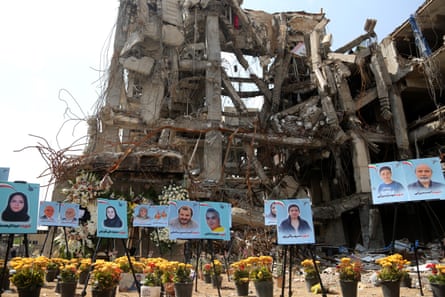
But any such gains will have come at an awful price. There are more than 5,000 people dead, including the 120 primary school children killed on the first day in Minab, and counting the casualties in Lebanon.
Then there are all the indirect global costs – economic and environmental – that will take years to play out. The UN estimates that 32 million people could be plunged into poverty as a result of the war, largely through its impact on energy and fertiliser supplies.
The UN humanitarian chief, Tom Fletcher, has said that the $2bn a day spent on the war could have saved about 87 million people’s lives if the money had been spent on humanitarian relief.
Harder to calculate is whether the relentless bombing has shortened or lengthened the life of Iran’s regime. For now, it appears to have entrenched the military and the hardliners.
As things stand, there are more unknowns than knowns surrounding this possible breakthrough, and any progress will remain extremely fragile. But even if the war is ended and Trump gets the peace plan sketched out in today’s reports, this war seems certain to rank right up there on the list of history’s most pointless conflicts.
Disclaimer : This story is auto aggregated by a computer programme and has not been created or edited by DOWNTHENEWS. Publisher: theguardian.com



