
Watch live: Day four of hearings in Sydney
The royal commission is streaming its hearings live. Watch at the link below:
Sporting, business, religious leaders must speak out, special envoy says
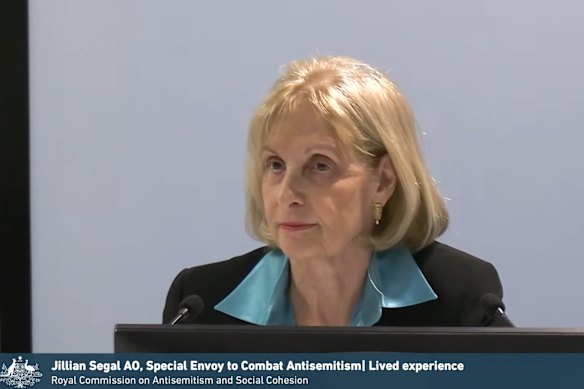
Segal is telling the royal commission that speaking up is not just the role of political leaders, it is also important for sporting, judicial, religious and business leaders to speak out.
Criticism of the actions of the Israeli government are fair but criticism of the existence of the state of Israel, or criticism of Jews, is stepping into “different territory”, Segal said.
“We’ve got values of civility, of mateship, of equality, of fairness, and antisemitism as a hatred of a particular group goes against all those. And I think we need to absolutely combat it,” she said.
Antisemitism envoy warns of ‘fashionable’ antisemitism
The royal commission is now hearing from Jillian Segal AO, the Special Envoy to Combat Antisemitism.
She’s been asked to summarise the assessments she has made about antisemitism in Australia since she took up her role.
“Antisemitism is a virus, it’s an illness that has morphed and mutated over time,” Segal said.
She is describing how antisemitism has evolved over time, from religious-based to the racism of Nazi Germany and to modern antisemitism, which she describes as much more concerned with the state of Israel.
“It’s almost fashionable,” Segal says. “If someone that they follow inline, an influencer, is of that view, they adopt that view.
“In one sense it’s the most pernicious because it just happens very easily, and in another sense I think, through my plan, it’s the form of antisemitism that we can tackle because I think it is subject to education.”
Children as young as seven abused on the football field
Players as young as seven years old have been subjected to antisemitic abuse on the football field, Ajax JFC president Daniel Onas is telling the commission.
One child went to shake the hand of the opposition player, who instead made an offensive gesture and said, “free Palestine”, the royal commission has heard.
“It’s a very difficult thing for young kids to have to endure when really all they should be doing is playing football, and they carry that with them beyond just the Sunday games,” Onas said.
The club engaged the Jewish Community Security Group (CSG) to run training for players and parents about how to manage the risks of antisemitism and how to handle in-game incidents.
In 2024 there was an average of one incident per week across the season, Onas said.
“So you can imagine the impact of that on our volunteers,” he said.
Jewish junior football players subjected to antisemitic abuse
The commission is now hearing from Daniel Onas, president of the Ajax Junior Football Club in Melbourne.
He’s describing incidents of antisemitism young players have faced from opposition teams.
“An opposition player asked one of our players if they were Jewish and, innocently enough, the player responded that he was, to which the opposition player remarked, ‘Hitler should have finished you off’,” Onas said.
In another game in the under-18 division a player said, “you f— Jews”, a parent was called a “bloody Jew” and an opposition player attempted to remove a Jewish player’s kippah.
“It was a finals game. Football is well known to be a very emotional, physical game, and so finals always bring additional levels of heat,” Onas said.
“But … the number of individual references and continued aggression shown towards our players was incredibly dehumanising.”
Food critic reads moving essay into evidence
Dani Valent, a food critic who writes for The Age, is reading a deeply personal essay about her experience as an Australian Jew after October 7.
In her essay, Valent recounts hiding her Star of David necklace in fear, of holding back on publishing an Israeli restaurant review, and of feeling the need to be vigilant.
“The rhetoric around the Hamas attacks and the Israeli response has been like screams in my face, footfalls chasing me from behind, when the only conversations I can have are quiet and horrified,” she said.
Her essay also recounted a trip to Europe with her father, visiting concentration camps and sites of her father’s childhood as a survivor of the Holocaust.
She said she chose to appear before the royal commission for her father, “who survived the worst expression of Jew hate”, and for her relative who lost a friend at the Bondi Beach attack.
Worker asked to use name ‘less obviously Jewish’
A Jewish woman who is giving her evidence anonymously is telling the commission that the chief executive of her workplace requested she use a “less obviously Jewish” name at work to avoid offending a client.
The woman, known as ABM, is relaying a conversation she had with her boss, who told her about the client’s sensitivities towards Israel. The woman’s name made her easily identifiable as a Jewish person, she said.
Ultimately, the chief executive requested she use a different name at work to avoid any negative commercial outcomes.
“I felt a sense of shame I hadn’t felt before. Not because I’m ashamed of being Jewish, I’m a proud Jew, but because I was made aware that something so deeply personal to me could be negatively viewed by others,” she said.
“I found myself questioning my value and questioning my impact.”
She ultimately left the company.
Jewish children ask ‘why do they hate us?’
Sarah, a clinical psychologist, is telling the commission about her experience as a Jewish person in academia and treating Jewish students in her practice.
Jewish children she has treated have asked “why do they hate us?” Sarah told the commission.
Counsel assisting Zelie Heger, SC, is now asking Sarah about her experience in a Facebook group for psychologists that was originally meant for sharing resources like books and journals.
Since October 7, posts about the war in Gaza became more frequent and “heated”, and included petitions and polls about the role of therapists as activists, she said.
Ultimately, hostility towards Jewish clinicians meant she had to leave the group, she said.
Hearing returns with evidence about antisemitism at school
The royal commission is now hearing evidence from Sarah, who is using a pseudonym. She is describing an incident as a child where students asked her “where are your horns and tail” after learning she was Jewish.
We’ve got about six more witnesses to hear from today, including some anonymous contributions.
Commission adjourns for lunch
The hearing is taking a brief break and will be back to hear from more witnesses after 2pm.
We’re still waiting to hear evidence from Jillian Segal, Australia’s antisemitism special envoy.
Former newspaper editor outlines fears for Jewish journalists
Now addressing the commission is Michael Gawenda, who was born in a displaced persons camp in Austria, where his parents had fled after escaping the Nazi regime.
He came to Australia as a two-year-old and has worked as a journalist, including as editor of The Age.
In his evidence he claims that in the current climate, holding strong views about Israel could be detrimental to your career as a journalist.
He told the commission he disagrees with current approaches by media outlets to covering social cohesion issues in Australia amid the conflict in the Middle East.
Disclaimer : This story is auto aggregated by a computer programme and has not been created or edited by DOWNTHENEWS. Publisher: www.smh.com.au


