
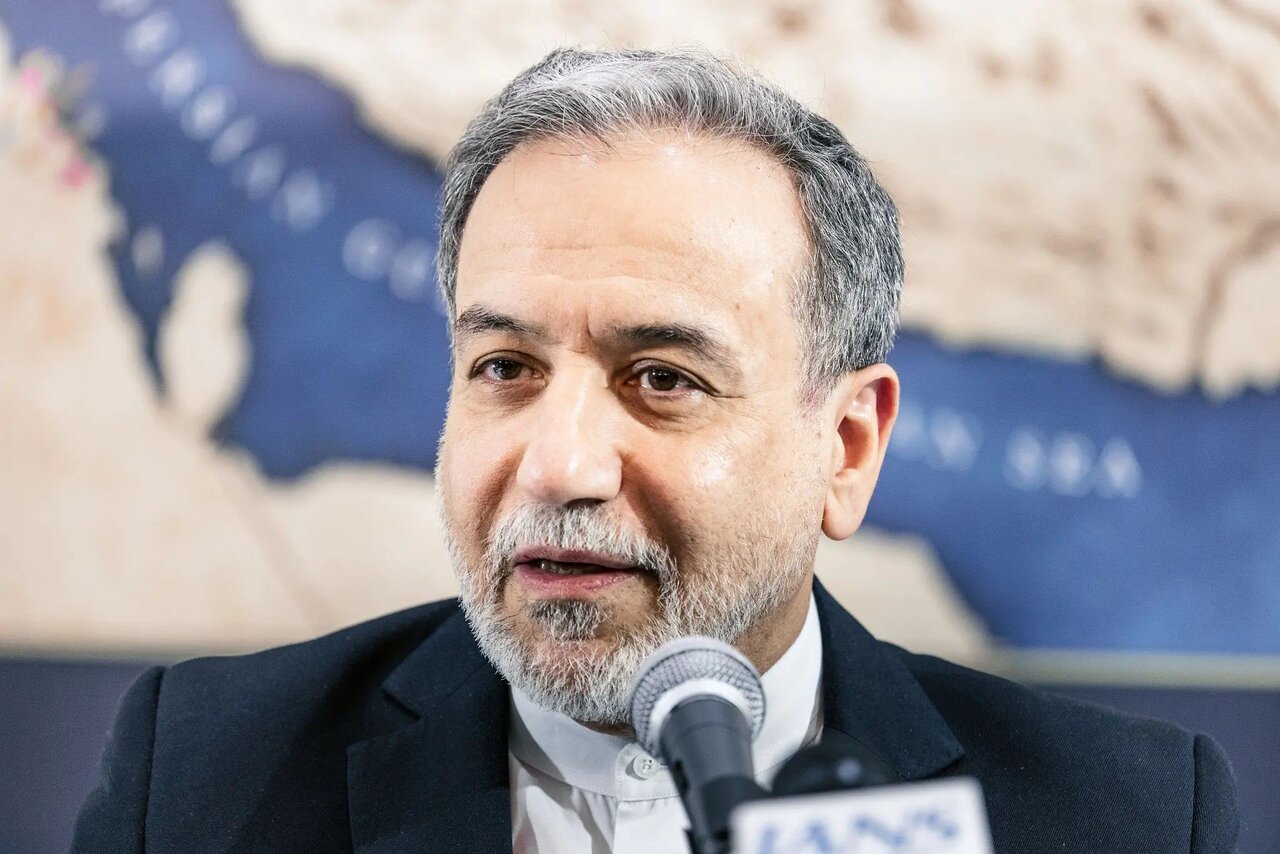
TEHRAN — Iranian Foreign Minister Abbas Araghchi has called for a fundamental shift in the international approach to security, urging the world to move away from militarism, foreign intervention and coercion toward sustainable development, respect for national sovereignty, equal application of international law and lasting peace.
Addressing the virtual forum of Global Town Hall 2026 on Saturday, September 19, Araghchi said the Middle East should pursue a security framework shaped by the countries of the region rather than imposed by foreign powers.
The forum, hosted by the Foreign Policy Community of Indonesia (FPCI), was held under the theme “Calling for a Global U-Turn: Recentering Development, Reclaiming Humanity, Restoring Justice in a Crazy World.”
In his address, Araghchi argued that war, intervention, sanctions and the use of force have increasingly become instruments of international policy rather than exceptional measures, raising fundamental questions about the effectiveness of the international system established to prevent war, protect human dignity and uphold justice.
He said decades of foreign intervention, military pressure and successive wars in the Middle East had demonstrated that military intervention does not produce sustainable security and that coercive pressure cannot provide a foundation for lasting peace.
Instead, he argued that the normalization of military force has entrenched cycles of confrontation and conflict.
Gaza and Lebanon: A broader regional pattern
Araghchi pointed to the situation in Gaza as one of the most severe manifestations of a failed approach to regional security.
“What is taking place in Gaza is not merely a humanitarian tragedy,” he said, describing the situation as a test of the international community’s collective responsibility.
He cited the killing of civilians, forced displacement, collective punishment and the destruction of vital infrastructure, and said the absence of effective accountability had allowed the pattern to extend beyond Gaza to Lebanon.
According to the Iranian foreign minister, military force is increasingly being used not as a last resort but as a mechanism for reshaping the region’s political and security landscape.
He warned that when aggression becomes normalized and escalation is institutionalized, destruction can evolve from a consequence of conflict into an instrument for pursuing political objectives.
Iran war and sovereignty
Araghchi also linked US and Israeli military aggression against Iran to the broader pattern of conflict and the erosion of restrictions imposed by international law.
He characterized the war as “illegal, unjust, aggressive and unprovoked,” and referred to ‘a wider record of unpunished aggression,’ including targeted assassinations of Iranian officials, threats against political authorities and violations of national sovereignty.
He warned that failure by the international community to respond effectively to such actions would gradually weaken the boundaries established by international law.
Araghchi also referred to the killing of 168 students in Minab, saying the victims should not be reduced to casualty figures.
“Behind each of these lost lives, there was a family, a future, and a life,” he said, asking when the international community would draw a line and say that enough was enough.
‘Multilateralism must be made more effective’
The Iranian foreign minister argued that the erosion of international law would ultimately undermine the credibility of the institutions responsible for upholding it.
If international law is disregarded whenever major powers’ interests are at stake, he said, the international community can no longer credibly speak of the rule of law.
Likewise, he argued that human rights cannot be considered universal if they are treated as inherent rights for some nations but conditional privileges for others.
Araghchi said the inability of international institutions, including the United Nations, to effectively respond to aggression and hold violators accountable would inevitably damage their credibility and legitimacy.
He nevertheless rejected abandoning multilateralism, saying the answer to the shortcomings of the existing international system is to build “genuine, effective and just multilateralism.”
From militarism to development
Araghchi said a genuine global turnaround would require the political will to change the current trajectory of international affairs.
He outlined a shift from militarism to sustainable development, interventionism to respect for national sovereignty, collective punishment to civilian protection, selective accountability to universal justice, and endless wars to lasting peace.
The world, he said, needs a new paradigm in which development is regarded as an integral component of security, national sovereignty is respected and international law is applied equally and without discrimination.
“No political, strategic or geopolitical interest,” he argued, should take precedence over human life.
Iran’s vision for regional security
Turning specifically to the Middle East, Araghchi said sustainable security could not be dictated from outside the region.
“Regional security must belong to the region itself,” he said, arguing that regional countries should be able to discuss their security, stability, development and common future and devise solutions without the intervention of foreign powers.
For Iran, Araghchi said, the position is rooted not merely in theory but in historical experience.
He said Iran believes sustainable regional security should be built through dialogue, confidence-building, cooperation and mutual respect among regional states rather than through the military presence of foreign powers or the imposition of their political will.
‘The time is now’
Araghchi concluded by describing the current international environment as a historic choice between continuing along a path of militarism, intervention, confrontation and recurring wars, or changing course.
He called for development to be returned to the center of the international agenda, human dignity to be placed ahead of power calculations, and justice to be freed from ‘monopoly and selectivity.’
He also called for the restoration of credibility to international law, saying the global turnaround he advocated was not a task for an uncertain future.
“Now is the time,” he said.
Disclaimer : This story is auto aggregated by a computer programme and has not been created or edited by DOWNTHENEWS. Publisher: tehrantimes.com




