
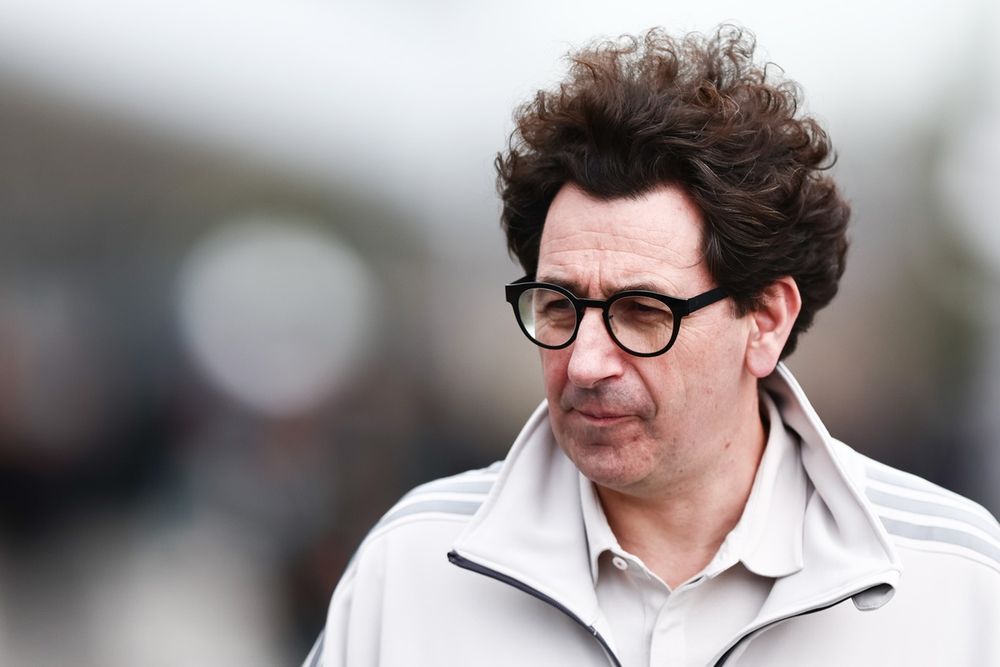
Mattia Binotto has very clear ideas about Audi’s objectives, especially in the long term, which is crucial as it means having a precise roadmap of the steps required to turn ambition into success in Formula 1. In its first season as a works outfit, Audi already has a strong foundation, as the Italian engineer claims his team has the fourth-best chassis in the field.
Speaking about the start of the season, Binotto outlined the strengths and weaknesses of the R26, revealing that based on the team’s data analysis and GPS estimates, Audi appears to have the fourth‑best chassis on the grid. The team, which currently sits ninth in the constructors’ standings, is presumably behind Ferrari, Mercedes and McLaren in Binotto’s eyes, with Red Bull currently further back but credited with the second‑best engine.
“I’m very pleased by the chassis,” Binotto told the Beyond the Grid podcast. “Even discussing that with drivers, not only GPS telemetry analysis. First, we got a good correlation with the wind tunnel and the simulator. That’s in terms of platform from the engineering, that was the most important thing. Again, in our process and methodologies, we’ve done a step forward.
“But, I think our car is pretty fast in the corners. We believe that maybe we’re even the fourth team in terms of chassis, which as an ex-Sauber, it’s an outstanding result.”
Mattia Binotto believes Audi has the fourth-best chassis in F1
Photo by: Jakub Porzycki / NurPhoto via Getty Images
This conclusion reaffirms, as Binotto himself has noted on several occasions, that Audi is still lacking on the power unit side, however. The team has faced reliability issues so far this year, with one of its drivers missing the start due to technical issues at both the Australian and Chinese grands prix. So far, its best race result saw Nico Hulkenberg finish 11th at the Chinese and Japanese events.
Naturally, the manufacturer should be able to access the ADUO concessions. Looking at the broader picture, the real surprise is not that Audi is behind on this front compared to other manufactures with more experience (after all, this is their very first F1 engine), but rather that Red Bull Powertrains managed to produce such a competitive unit on its first attempt, which is highly impressive.
With a solid foundation now in place on the chassis side, where obviously there is still margin to improve compared to top teams, the goal is to make a decisive leap forward with the power unit.

With a solid chassis, Audi is now targeting advances in its power unit
Photo by: CHARLY TRIBALLEAU / AFP via Getty Images
Binotto believes that closing the gap as early as 2027 is unrealistic, making 2028 a far more credible target regardless of how the regulations evolve. And it is not just a matter of pure power, but also of drivability, two elements that must operate in perfect harmony.
“In our way to 2030, I think the next true step will be in 2028, because to make, as you said, victories, podiums, good results, you need as well a great car. It’s not only about the infrastructure, the process of the team size. You need a great car. And if we are measuring our gaps to the top competitors today, maybe the biggest gap is more from the power unit performance, power unit controls and drivability, where we believe there is a significant step which is required to close the gap.
“And when it’s about the power unit, the time is always longer. The lead time of developing an engine is longer than the aerodynamics. So that’s why I’m saying maybe the next significant step cannot be a short step because we will need to change the hardware of the engine. So, to improve our current one to be a better engine or as good as the competitors’ engines, we believe that that cannot be possible by 2027, but to reach the right level by 2028.”

Audi could fight for F1 titles in 2030
Photo by: Clive Mason / Getty Images
In the long-term, Binotto has his eyes set on 2030 as the year that Audi will finally be able to fight at the front in F1.
On that front too, together with the team and the brand’s top management, Binotto has mapped out a step‑by‑step path, because transforming one of F1’s smallest teams in terms of personnel into a championship‑calibre operation takes time. It is a journey that will require advances through both people and infrastructure.
“We have agreed and discussed that with the team, and as much as we have set a 2030 objective, we have a roadmap to it, and we’ve got objectives for 2026, but the roadmap is first to become competitive as a team and maybe a challenger,” Binotto told Beyond the Grid. “And then a true, let me say, potential competitor for the win and final win.
“Now, 2026 is our very first season as Audi, and somehow to become competitive is really what we have set ourselves as an ambition and a target objective for the season, which is not the number of points, not the number of maybe Q3 or whatever positions in the championship. It’s the mentality transformation.”

Nico Hulkenberg and Gabriel Bortoleto have managed a best race result of 11th in 2026
Photo by: Clive Mason / Getty Images
This is one of the key points highlighted by Binotto. Building a championship‑level team requires more than top‑tier facilities and high‑level engineers; it also demands a title‑winning mindset. And it is only logical that a team which, until now, has fought in the lower‑midfield while operating on a tight budget must now make a significant step forward on that front as well.
“To become competitive means that every single person in the team understands what does it mean to compete and being Audi,” he continued. “Not anymore, as we said before, to be self-satisfied by participating, but no stones un-turned, moving forward, raising the bar and the challenge to become better each single race.
“And I would be very happy by the end of the season, that mentality, that mindset is not only obvious to us, but it’s obvious from the fans’ perspective or the media perspective, seeing the transformation of a team that by the end of the season, anyone may recognise Audi has joined and they are becoming serious.”
The work is multi‑faceted but interconnected, as attracting top‑tier engineers from other teams that have already won can undoubtedly strengthen that process. This is why, before his departure, Jonathan Wheatley had been chosen to lead the team: not only for his knowledge of the regulations and of who the best engineers in the paddock are, but also for the winning mentality he developed at Red Bull.
It is no coincidence that Audi has opened a facility in England to attract new personnel, just as it is working to expand the facilities in Hinwil to accommodate those arriving in Switzerland. However, the Hinwil headquarters is particularly interesting to examine, because it is there, in the former Sauber factory, that the chassis and aerodynamics of the car are developed, while the power unit is designed in Germany.
We want your opinion!
What would you like to see on Motorsport.com?
– The Motorsport.com Team
Disclaimer : This story is auto aggregated by a computer programme and has not been created or edited by DOWNTHENEWS. Publisher: motorsport.com



