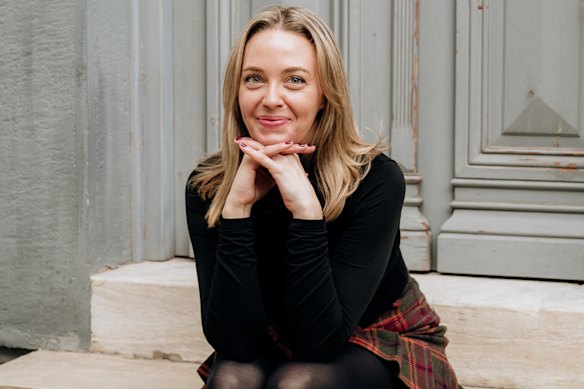
Speaking to me from her home in Athens, Ellena Savage admits she “hates” publicity. “I just want to write the book. And then I want everyone to love it.”
But the course of true love never did run smooth. “The problem is that when anyone does love it, I feel deeply ashamed.” And if someone hates it? “I feel even more ashamed! It’s like, what was all this for, really? At no point am I actually experiencing pleasure.”
Savage’s debut novel, The Ruiners, has much to say about the subject. At its centre is Pip, a woman employed at a “lobster shack” in an inner-metropolitan hellscape. Worried that life is passing her by, Pip unexpectedly becomes an heiress and plots her escape: putting paid to her mounting credit card debt repayments, she runs away to Greece. Once there, however, she must confront environmental devastation, a transformative lover – and the end of her 20s.
Pip and her creator both share experiences of debt, life in Greece and hospitality work (“degrading and annoying and underpaid and kind of brutalising”). Yet Savage is adamant Pip is not her. The autobiographical impulse was mostly exorcised by her first publication, the 2020 essay collection Blueberries.
“There are a few strains of thinking in the novel which object to the kind of proprietary logic we’ve inherited from the identity politics days: not your story, not my story. Who is the leaseholder, who is the licensing agent to a particular thought or experience? I think it’s a kind of nationalist or fascistic logic, to have neat categories which can’t overlap. Perhaps that comes from me having moved somewhere where I don’t really belong, and understanding that, by committing to anything, you build something that has a future outcome that might not benefit you personally.”
How to build a future is among The Ruiners’ central questions. Told in three parts, it examines the “collective disinheritance” of our nightmare present via the intellectual and emotional comings of age of Pip, her friend Viv, an “ageing bolshie twink” convinced the environmental degradation despoiling Pip’s Greek idyll can save him from social media evisceration (a left-wing journal he edits is under scrutiny for failing to pay its writers), and Pip’s partner, a narcissistically insecure literary academic named Sasha.
“These types,” Savage says, “they’re highly intellectual, but it doesn’t mean that they actually understand themselves in any way. They talk endlessly in theoretical or psychoanalytical terms. But can they say one true thing? We don’t know.”
Which brings us to Sasha, the transformative lover. Enviably learned, Sasha is the kind of man who has not only read everything but annotated it too. Given many of the best lines in a book that generously assigns all of its characters the best lines, he treats office-cubicle verbosity like a weapon – as if the right words, in the right order, repeated daily, can yield academic success. Yet he remains removed from the work he produces and emotionally stunted: a failed novelist with a failed writing style who convinces himself successful writers are simply naifs and savants. Sasha, in one Cuskian aside, describes his mother, a Bosnian refugee, as a woman whose unlived life he feels he is living, “but with neither her talents nor her constraints, which may have in fact produced one another.”
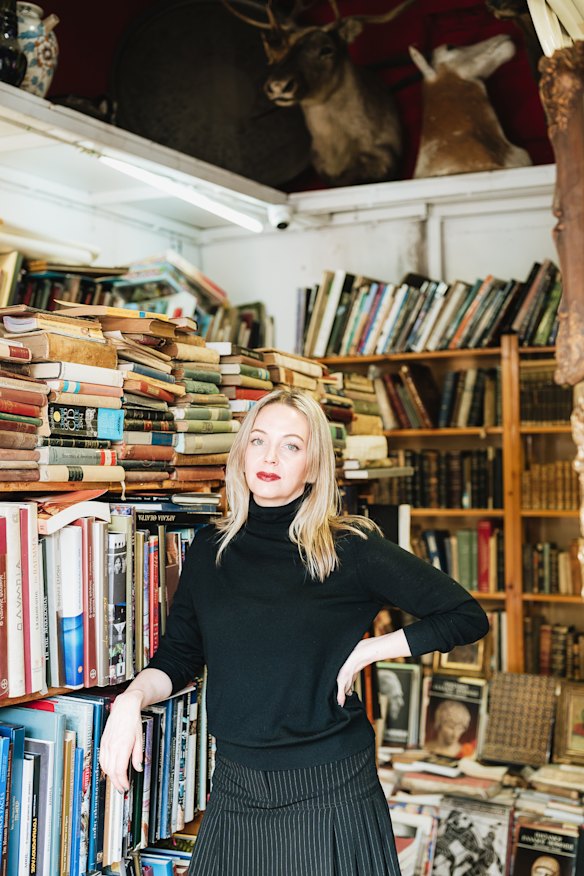
“I know a lot of people who are the children of women who’ve survived something catastrophic, and they’ve become Type A mothers: the best, warmest, kindest, most hard-working, loving, caring, nurturing, smart, successful women,” she says. “And it’s impossible for their kids to become fully human. Because they’re scared that if they mess up, they’ll be the thing that pushes their mother over the edge. But you can’t regard your parents as the architects of your misfortune. You have to start to differentiate yourself and become independent.”
Pip’s mother (“I changed her name a few times because I kept on naming her after my friends’ parents”) is an autodidact, a single mother living in public housing who sends Pip to school so she can experience “oppression” and a sharpened “instinct for class consciousness”.
“I wanted Pip to be an orphan who doesn’t mobilise her freedom. Everyone negatively affected by their childhood – which is to say most people – digs in. I did a little excerpt at a reading in Australia a year and a half ago. My mother-in-law was there. Pip was complaining quite dramatically about being stuck in Australia. And my mother-in-law said ‘it’s you.’”
Savage pronounces this in a campy, ominous tone, indicating her demurral. Talking to a hotshot literary agent who’s repped some of America’s most successful authors, Savage attempted to acquire representation for The Ruiners, but was advised the book was “too digressive” to sell easily. (The agent suggested leaning deeper into the novel’s romantic themes.)
“I said I’d been reading a lot of Philip Roth, who’s extremely digressive. They replied, ‘To be honest, I don’t think I could sell a Philip Roth novel right now’.”

She did, eventually, find an enthusiastic US representative. Yet The Ruiners already had one of literature’s biggest names attached: Charles Dickens.
“I was rereading him, and I’m like, ‘This guy is so f—ing funny’. He’s just hilarious. He’s a hoot. I thought, I want these silly characters. I want people’s speech to sound artificial. I want them to be verbose and obnoxious and over the top. Great Expectations informs so much of Pip’s story. I want my audience to laugh, because what I want to talk about is the inheritance of the political economy, the disinheritance that is environmental ruin, the microplastics that are eroding the conditions for life on Earth. I want to talk about leftist history and intellectual history. I wanted to hold the reader by the hand and make sure they were having a nice time, after dragging them through all of my cultural and social and political critique.”
The Ruiners is furiously funny, like hanging out at a house party with a well-read and occasionally cruel bestie. Open the novel at random: the jokes keep coming.
They talk endlessly in theoretical or psychoanalytical terms. But can they say one true thing?
Part of its comedy lies in the antic narrative detail. Staying at MacDowell (an artists’ residency program in New Hampshire) to work on the novel, Savage happened upon the logbooks of previous guests. “Everyone was running 10 kilometres every two days. Everyone was sleeping eight hours a night. People would not eat carbs. These are not punks. In the ’90s, there were people doing heroin. Today, they could be lawyers. They’re high achievers. A lot of friends that I grew up with are high achievers. You look at their lives and they’re flawless. But they haven’t been able to make ordinary mistakes. The closer you get, the more you realise something’s not quite right. It bothers me. Because how much do we really have to say about the world, the high achievers?”
High achievers or otherwise, Pip, Sasha and Viv’s shared journey to adulthood demands entanglement and the relinquishing of self-involvement. Should they want to grow up and take responsibility for their lives, they must accept that a perfectly controllable world of abstractions may also be a cold and loveless one. In an age when Silicon Valley relentlessly upsells new iterations of technologies designed to outsource feelings, thoughts, habits and passions, it feels timely.
“It’s tiresome to reject the experience of love because you’re too cynical, right? I wanted to be a little bit earnest. The experience of love is one of the most transformative, human things that you can experience. The characters haven’t experienced real love yet. They’ve been neurotically either f—ing or analysing the power dynamic between themselves. They’re not giving themselves to each other in a full way.”
Capacities of courage and vigour, of talent and constraint, are at the heart of what drives ambition and frustration in The Ruiners. Having released her debut novel, Savage reflects that giving oneself fully to something feels meaningful in ways that escape logical quantification.
“It doesn’t matter if it’s a bad book or a good book. It doesn’t matter if it pleases people or it’s a failure. There’s a profound sense of accomplishment. It’s the experience of producing this unified object: you know how hard it is, yet you’re able to do it. You gain a lot of self-respect from that process, I think.”
The Ruiners is published on April 28 (Summit Books, $34.99). Ellena Savage appears at Melbourne Writers Festival (May 7-10) and Sydney Writers’ Festival (May 19-24).
The Booklist is a weekly newsletter for book lovers from Jason Steger. Get it delivered every Friday.
Disclaimer : This story is auto aggregated by a computer programme and has not been created or edited by DOWNTHENEWS. Publisher: www.smh.com.au