As a young Englishman in Australia, artist Bruce Munro saw beauty in the everyday.
Drive west alongside the crease where Victoria meets NSW and you’ll find the Perry Sandhills, a site of 40,000-year-old rolling dunes. From this month, you’ll also find something a lot more contemporary but no less spectacular: a light installation created by an English-born artist who fell in love with Australia more than 40 years ago. Bruce Munro’s FOSO – the Fibre Optic Symphonic Orchestra – is an immersive installation in which fibre optic light and sound meet the land.
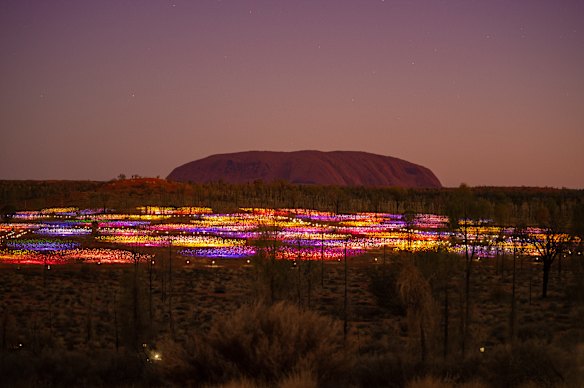
When we arrive for the launch party, the burnt orange sunset is still too bright. We will have to wait. There is anticipation born of the artist’s reputation for creating immersive artworks that take the breath away. Far away from here, thousands have been mesmerised by another Munro light installation in another patch of sand: 50,000 illuminated wildflower stems near Uluru in the Northern Territory.
Field of Light quickly became a global sensation when it was installed a decade ago by the ebullient Englishman. Now, thanks to a series of cascading events, and a concerted effort by the border settlements of Wentworth in NSW and Mildura in Victoria, the regions on both sides of the Murray River are playing host to not one but two fibre optic sequels.
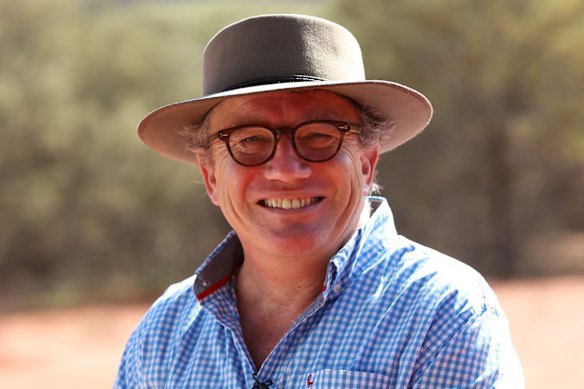
“This has been a five-year journey. And it’s been something of a dream,” Munro tells the crowd at the FOSO opening.
Had Munro been born in Australia, it is doubtful all this would have happened. When the then-24-year-old fine arts graduate arrived here in 1984, this ancient land, for him, was the shock of the new.
In fact, Australia was something of a dream for Munro. He had watched a season of classic Australian films including Gallipoli and Breaker Morant with his dad, Brian, and been inspired. They were living in the fishing village of Salcombe, in Devon, but Brian urged him: “You have got to go, don’t get stuck here.”
After arriving in Sydney, he told his dad that it felt “like coming home”. Brian told him: “You’d better stay there, then.”
Munro met his wife, Serena, in his first week here. They stayed eight years, becoming naturalised Australians, or as they term it, “Possies” or “Pommie-Aussies”. In the years since, they have travelled between their two countries.
Munro’s voice catches when he talks about his dad. Field of Light started as an idea scratched into his notebook during the couple’s farewell tour of Australia before they returned to Britain in 1992.
When Brian died, Bruce was 39. In what was an artistic epiphany, he thought: “I’m going to bring this moment to life by creating a piece of art.
“When my father died, and I recognised that I didn’t know what art was good for, and then I thought, actually, it should be about an expression of … the good things in life.”
He built a prototype behind his house in Britain. A version at the Eden Project, a reclaimed china clay pit in Cornwall, brought massive global recognition in 2008, and in 2016 he installed it at the original intended site: the Voyages Ayers Rock Resort just beyond the Uluru-Kata Tjuta National Park, where 50,000 globes in the sand have attracted 750,000 viewers since. Originally scheduled to run for one year, the installation has been extended to 2029.
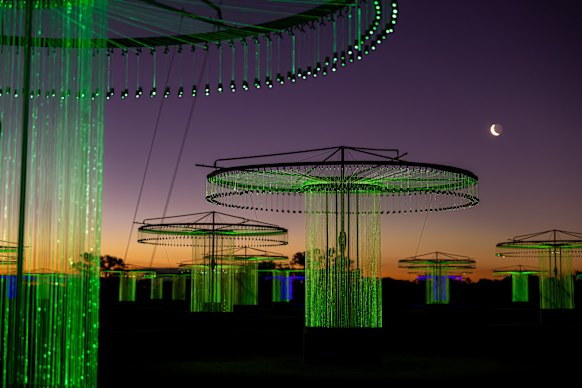
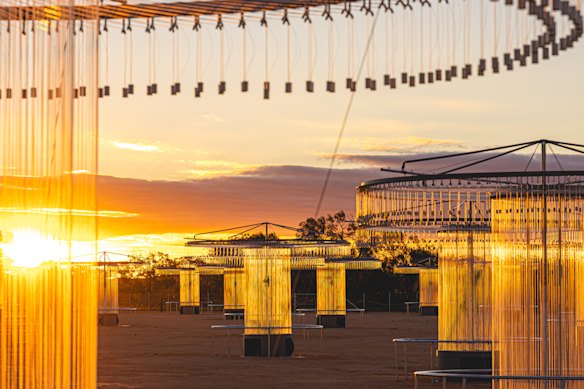
The FOSO installation sits in the dunes outside the NSW town of Wentworth, where the Darling River flows into the Murray River. A platform acts like a dress circle in a concert hall, and fanned out below us in a giant semicircle is an orchestra pit of something so familiar most of us would not give its sculptural form a second thought – the humble Hills Hoist clothesline.
“It is a beautiful form. I always find beauty in the usual stuff,” Munro says. “Part of our problem is that we aren’t taught to look as kids.”
Munro was sharing a flat in Sydney in his 20s when he had a memorable encounter with the Aussie invention, via an uninhibited flatmate.
“He was always hanging his socks on the line naked in the middle of Sydney. On the Hills Hoist.”
Instead of socks, the 80 clotheslines in FOSO are each festooned with about 240 drops – or fibres – which form a mesmerising and continually shifting curtain of light. Special weights keep the fibres under tension for each installation, which Munro describes as “distinct kind of slightly mushroomy form”.
“It has to be under tension because fibre’s natural inclination is to curl up, and I wanted to go against the grain. I wanted it to be quite geometrical and structural.”
When the sun goes down, the lights come to life, as does the swelling cinematic score by award-winning composer Nainita Desai, with each clothesline in sync with a specific instrument.
The audience can watch from the dress circle, or wander through the sands and get up close to each tower of sound and light.
“Look, it’s an expression of joy,” says Munro. “I want to make art about joy. And good things in life. Art can never be made by one person. In fact, nothing we will do is by one person. It’s about time we all recognised that we need each other. We are not this selfie-mad world where we all think we’re marvellous.”
Across the river, on an island next to the town of Mildura, is Munro’s companion installation, Trail of Light, which opened a year ago.
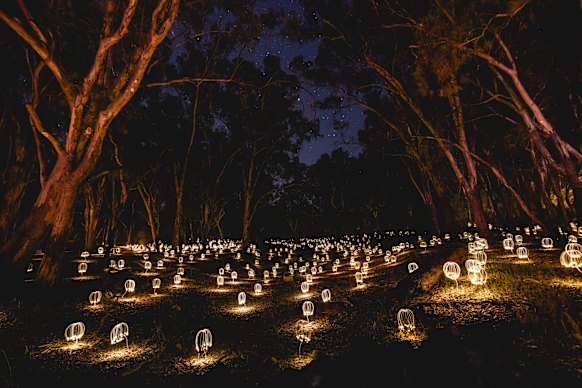
The paths on the island go past 12,500 Firefly lights, which seem to breathe in and out. At the river’s edge, tall multicoloured fronds loom out of the darkness, fanning out towards the water. On closer inspection, and in keeping with Munro’s artistic preoccupations, they turn out to be constructed of another familiar object, in this case fishing rods.
Munro, 66, was commissioned to create the installation by the Wentworth Shire Council, funded by the NSW government through the Regional Tourism Activation Fund and a $4.9 million grant. Trail of Lights, a project of the Mildura City Council, received a $3 million grant through the Victorian Regional Tourism Infrastructure Projects program.
Munro is happy to think that his art brings people together.
“Art is a good communication tool. We need people to come together. And the communities here, they need to be looking at each other, helping each other.
“I know it sounds cliched and saccharine, but there’s so much shit in the world that we should be saying, ‘Look at that, for God’s sake’ … You know, it’s humbling.”
The Fibre Optic Symphonic Orchestra opens on April 24. Stephen Brook travelled to Mildura and Wentworth as a guest of FOSO.
Start the day with a summary of the day’s most important and interesting stories, analysis and insights. Sign up for our Morning Edition newsletter.
Disclaimer : This story is auto aggregated by a computer programme and has not been created or edited by DOWNTHENEWS. Publisher: www.smh.com.au