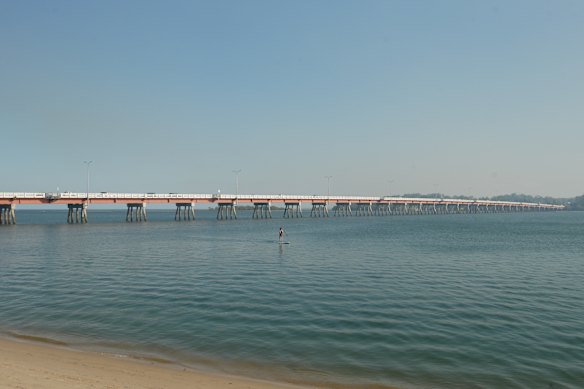

The body charged with keeping tabs on the health of Queensland’s waterways has cancelled a long-running toxic algae monitoring program in Moreton Bay, removing a key warning the state might receive about an oncoming bloom akin to that seen in South Australia.
The decision comes just months after the same body warned there was a growing risk of catastrophic algae burgeoning across the bay.
Lyngbya algae caused havoc in the bay in the late ’90s and early 2000s, choking seagrass meadows and driving fish and other sealife away.
The algae spread in giant sheets that could double in size every five days, particularly at the southern mouth of Pumicestone Passage, a wide sandy stretch of water between Bribie Island and the mainland.
At low tides, it washed up in huge festering piles of sludge on the region’s beaches, where heavy machinery was used to push it away.
Fisherman Greg Savige’s eyes burnt when he scraped the dried algae off his nets, which were full of the stuff, and he saw the welts that turned to scars on the legs of fishermen who touched it.
Most of all, he felt the effect it had on the once-thriving industry around him.
“It persisted for a lot of years. Most of the net fishermen moved or did something else,” Savige said last week after a morning of fishing.
“There was over 10,000 tonnes here one year, on that little bank.”
Savige became the face of the bloom, appearing in news segments and providing a connection between the academics trying to understand it and the fishermen trying to deal with it.
As the algae became better understood, and eventually less prominent, Savige began compiling reports on the state of Lyngbya around Deception Bay.
Once a month, when the tide is at its lowest, Savige gets on his jetski with wife Julie and heads out to hotspots where the algae has been known to grow.
Professor Michele Burford, an algae expert from Griffith University who was involved with identifying Lyngbya in the early days, said Savige’s work was vital.
“We can see a wonderful long-term picture that links up with things like periods of drought and periods of flood that you just wouldn’t get with a short-term data set,” she said.
But on April 8, Savige received an email from Healthy Land & Water – a body funded by the state and other stakeholders to monitor environmental health – telling him to cease the work.
“The Ecosystem Health Monitoring Program is currently undergoing a broader review [led] by the state government, and the steering committee has decided to pause this component for the time being,” the email from head of monitoring and research Wing Tsoi said.
The email also asked him to send any remaining invoices for the work, for which he had been charging $500 a month.
Burford, who is on the scientific advisory committee for the South Australian bloom, said the monitoring was essential to managing the risk of further blooms in Moreton Bay.
“It gives you early warning when there are issues, and you start to see blooms occurring before they get too serious,” she said.
A Healthy Land & Water spokesperson said the pause was part of a broader review initiated by the environment department aimed at ensuring monitoring methods were fit for purpose.
“Current funding constraints mean resources must be carefully balanced across sample collection, analysis, interpretation and reporting,” they said.
A report by consultants Broadstrokes was handed to the government in February, and the department of environment was working through its recommendations with stakeholders.
Healthy Land & Water, formerly known as Healthy Waterways, was formed as a response to Lyngbya outbreaks in the early 2000s, and now compiles annual report cards for the state’s waterways.
In its most recent report card, the body found the bay was ripe for another large bloom, with high levels of sediment and nutrients, perfect food for Lyngbya and other toxic algaes, which are native to the bay.
Savige said that during the past summer – when Lyngbya is most likely to grow due to warmer water – he started noticing blooms at the mouth of the Caboolture River.
“About two or three weeks ago, I was down there fishing and thought, gee whiz, it’s pretty thick here,” Savige said.
He believes recent works on the state-backed North Harbour development on the banks of the river could be a contributing factor.
Burford said the great blooms of the past were likely caused by a combination of run-off from land development, forestry and agriculture, but any development creating run-off could pose a risk.
North Harbour project director Bryan Finney said the development took sediment and nutrient control seriously, and monitoring showed water quality around the project had actually been improving.
“We support a transparent and open approach to these measures, and it is part of our annual reporting to the Commonwealth government under the project’s EPBC [environmental] approval,” he said.
But a walk around the site this week showed signs that sediment had been washing into the drains of the freshly paved roads, a sight not uncommon on greenfield sites such as this.
It’s insights like this that Burford fears will be missed. Savige has only been monitoring part of the bay, but Lyngbya has bloomed in other areas, such as Victoria and Wellington points, and the Broadwater on the Gold Coast.
“We really have no idea when the blooms are occurring until they get massive, or they’re close to where people are fishing,” she said.
“The risk is, we don’t even know what’s there.”
The Healthy Land & Water spokesperson said the organisation was committed to understanding Lyngbya in the bay, but could not confirm specific plans for future testing.
The government plans to make the Broadstrokes report public in the coming months.
Start the day with a summary of the day’s most important and interesting stories, analysis and insights. Sign up for our Morning Edition newsletter.
From our partners
Disclaimer : This story is auto aggregated by a computer programme and has not been created or edited by DOWNTHENEWS. Publisher: www.smh.com.au