
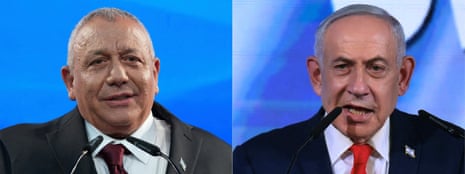
With more than 92% of ballots counted, the story of Israel’s first election since the October 7 attacks has become quite clear.
Netanyahu coalition government has lost its majority but his main opponents, an alliance of Jewish Israeli parties unofficially led by Gadi Eisenkot, have also failed to gain an outright majority.
Meanwhile the Palestinian Israeli parties, also seeking to oust Netanyahu, have received a historically strong vote with 19 seats in the 120-seat Knesset.
That means negotiations are underway for a coalition to be formed, and the key question is whether the Eisenkot-led ‘Change’ bloc will partner with Palestinian Israeli parties or if they will resort to a new election, or even working with Netanyahu.
Main result takeaways
-
Netanyahu lost support. His Likud party remains the largest in parliament but has fewer seats, and the vote also dwindled for his far-right, religious extremist allies Bezalel Smotrich and Itamar Ben-Gvir
-
The parties opposing Netanyahu received greater support, but are divided into a Jewish coalition of parties and a Palestinian-Israeli bloc.
-
As such, there’s fevered debate over whether the ‘Change’ bloc (consisting of right-winger Naftali Bennett’s Together party, centre-left Yair Golan’s Democrats and the right-wing Yisrael Beiteinu party) will strike a deal with the Palestinian Israeli parties
-
The Joint List, a new ticket of several Arab-majority parties, triumphed with at least 12 seats, while Ra’am, the other Islamic party, won seven.
-
The Palestinian Israeli vote, which represents around 20% of the population, had long been seen as a decisive factor for who will be able to form government and the high turnout this election was driven by the community suffering increased racism and discrimination under Netanyahu’s government
-
Netanyahu refuses to work with Palestinian Israeli parties and repeated this pledge at his 3am address the night of the election
-
This is the most-voted for election in Israel’s political history with many Israelis flying back into the country to cast their vote and nearly 80% of IDF soldiers voting.
-
Donald Trump said his endorsement had helped Netanyahu perform better than polling estimates
What now?
-
We can expect absentee ballots to be counted tonight with final results by Thursday
-
President Isaac Herzong will then direct the political leader he believes is best placed to form government
-
Netanyahu will remain as caretaker until those negotiations are complete
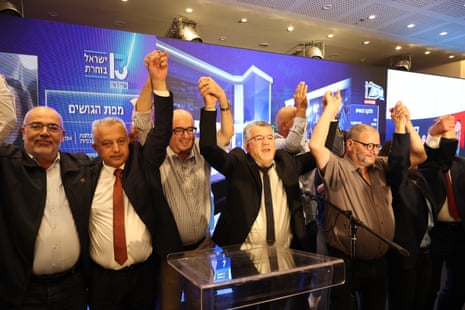
Ahmad Tibi, the leader of Ta’al, one of the three parties making up the Palestinian-led Joint List grouping, said he will work with Jewish Israeli parties “to pave the way for an alternative government led by Gadi Eisenkot.”
Prime minister Benjamin Netanyahu has lost his mandate but most of the Jewish-Israeli opposition have ruled out sharing power with Palestinian parties, who are forecast to claim up to 19 seats. Without them, there is no opposition majority.
“We have made a clear political decision: we will do everything within our parliamentary and democratic power to end Netanyahu’s rule and facilitate the establishment of a new government,” Tibi told the Guardian in written comments.
That could start as soon as a new Knesset is seated, even without a full coalition agreement he indicated.
“We extend our hand and are ready to cooperate with the opposition, including in replacing the current speaker of the Knesset with an opposition candidate and enabling the formation of an alternative government,” he said.
“The voters have given us a strong mandate, and we intend to use it responsibly and effectively.”
US president Donald Trump said he hadn’t thought about getting involved in efforts to form a Netanyahu-led government.
“I will take a look,” he told Axios.
Trump also said he thought Netanyahu was in “pretty good shape.” He endorsed the Israeli prime minister in the final stretch of his campaign and praised him as a strong partner in the war with Iran.
Israel’s high-turnout vote was brushed aside by some in the rest of the Middle East.
In Tehran, banners with images of slain supreme leader Ayatollah Ali Khamenei reminded Iranians of US and Israeli strikes launched in February which kicked off the war.
Just to the right was a poster of late Hezbollah leader Hassan Nasrallah, who was killed on Netanyahu’s orders in Lebanon.
“I genuinely see the possibility of attack,” said 50-year-old Iranian citizen Abdollah Karimi.
Frustration was also palpable in Egypt, the first Arab country to make peace with Israel in 1979.
Outhman Selim, a 62-year-old lawyer, said his hopes that a Netanyahu defeat would steer the country away from the far-right had been dashed.
Israeli prime minister Benjamin Netanyahu’s Likud accused Arab parties of having stolen the country’s election, after partial results showed they could play a kingmaking role in forming a new government.
“The elections in the state of Israel have been stolen by Arab parties who support terrorism and the annihilation of the Jewish state through serious criminal acts of corruption, threats, violence, falsehoods and the use of prohibited software to encourage voters to vote,” the party said in a statement, adding that it was submitting testimonies and evidence to the authorities.
With 85% of votes counted, two Arab-led parties – Ra’am and Joint List – had won 19 seats in the Knesset.
The mood was joyful overnight at the headquarters of the United Arab List, the lone Arab party to ever join a governing coalition, briefly, in 2021.
So far in the count it has won 12 Knesset seats.
“We are here, we are not on the sidelines,” party leader Mansour Abbas declared. Some Israelis found that an unusual, if not uncomfortable, prospect.
“We are little by little coming to a situation where we have to face reality,” said Hanna Doukhan, a voter in Tel Aviv. “I don’t see a possibility to form a government without the Arabs.”
Others were hopeful. “This would open the door to repairing our society” while preserving Israel as the national home of the Jewish people, said Eti Wissotzky-Cohen in Tel Aviv.
And in Nazareth, one of Israel’s largest Arab cities, Awni Zoabi thanked God for a possible return to rationality in a country where extreme rhetoric has increased . “The Arabic language has become as if it were a crime,” Zoabi told AP.
Israel’s president has voiced hope over avoiding a second election after a hard-fought vote produced no clear winner, leaving prime minister Benjamin Netanyahu and the opposition scrambling for options and making Israeli Arab parties possible kingmakers.
“We must do everything we can, certainly after yesterday, to avoid another round of elections,” said president Isaac Herzog, who is tasked with determining which candidate to tap to form a government, and who urged parties to keep “an open mind”.
Yousef Jabareen, head of the leftist Arab-majority Joint List, said the Israeli public had voted for new leadership and “anyone who wants to offer a substantive and genuine alternative to Netanyahu’s blood-soaked government will have to talk to us”.
“It’s either the continuation of racism, the continuation of exclusion and the continuation of supremacy, or a genuine Jewish-Arab partnership,” he said.
Hasan al-Masri, who was displaced from his home in Beit Hanoun in northern Gaza, told AP that he desperately hoped the election would bring change to Gaza.
“We pray to God that these elections bring a positive outcome for us,” he said.
“We have been utterly devastated; nothing remains. They have killed our children, destroyed our homes, and everything we had is gone.”
The future of Gaza was barely an issue in the Israeli election campaign and the only major candidate to talk in favor of the two-state solution was Yair Golan, the head of the small Democrats party.
In the southern Gaza strip, where Israeli airstrikes are still a regular occurrence despite a ceasefire, residents of the city of Khan Younis were following the results of Israel’s election closely, hoping that anyone but prime minister Benjamin Netanyahu will form the next government.
“All of their policies towards Gaza are tough, but we choose the lesser of two evils,” resident Ayman Ahmed told AP. Ahmed said that he hoped Netanyahu’s main challenger, Gadi Eisenkot, would prevail, noting that he supports US president Donald Trump’s roadmap for Gaza .
The plan calls for disarming the Hamas militant group and installing a new US-backed government. But it also requires Israel to withdraw forces and allow reconstruction to begin.
Netanyahu agreed to the Trump plan but never carried it out beyond the initial stage of a partial withdrawal and increased aid in exchange for the return of the final hostages, alive and dead, held by Hamas. The plan has been largely frozen for nearly a year.
In the rubble-strewn streets near the city’s Nasser Hospital, Mohammed Abed said that a Netanyahu win would be seen as a victory for his agenda, but that he didn’t expect major changes no matter who is in power.
“An Eisenkot victory will not dramatically change the situation, because their policies are almost similar,” Abed said. “In the end, it will be the same.”
With more than 92% of ballots counted, the story of Israel’s first election since the October 7 attacks has become quite clear.
Netanyahu coalition government has lost its majority but his main opponents, an alliance of Jewish Israeli parties unofficially led by Gadi Eisenkot, have also failed to gain an outright majority.
Meanwhile the Palestinian Israeli parties, also seeking to oust Netanyahu, have received a historically strong vote with 19 seats in the 120-seat Knesset.
That means negotiations are underway for a coalition to be formed, and the key question is whether the Eisenkot-led ‘Change’ bloc will partner with Palestinian Israeli parties or if they will resort to a new election, or even working with Netanyahu.
Main result takeaways
-
Netanyahu lost support. His Likud party remains the largest in parliament but has fewer seats, and the vote also dwindled for his far-right, religious extremist allies Bezalel Smotrich and Itamar Ben-Gvir
-
The parties opposing Netanyahu received greater support, but are divided into a Jewish coalition of parties and a Palestinian-Israeli bloc.
-
As such, there’s fevered debate over whether the ‘Change’ bloc (consisting of right-winger Naftali Bennett’s Together party, centre-left Yair Golan’s Democrats and the right-wing Yisrael Beiteinu party) will strike a deal with the Palestinian Israeli parties
-
The Joint List, a new ticket of several Arab-majority parties, triumphed with at least 12 seats, while Ra’am, the other Islamic party, won seven.
-
The Palestinian Israeli vote, which represents around 20% of the population, had long been seen as a decisive factor for who will be able to form government and the high turnout this election was driven by the community suffering increased racism and discrimination under Netanyahu’s government
-
Netanyahu refuses to work with Palestinian Israeli parties and repeated this pledge at his 3am address the night of the election
-
This is the most-voted for election in Israel’s political history with many Israelis flying back into the country to cast their vote and nearly 80% of IDF soldiers voting.
-
Donald Trump said his endorsement had helped Netanyahu perform better than polling estimates
What now?
-
We can expect absentee ballots to be counted tonight with final results by Thursday
-
President Isaac Herzong will then direct the political leader he believes is best placed to form government
-
Netanyahu will remain as caretaker until those negotiations are complete
The electoral committee’s count site has just refreshed its numbers and the Netanyahu bloc has dropped to 53 seats, the Jewish opposition Change bloc now has 48 seats and the Israeli Palestinian opposition parties have 19 seats.
More than 92% of the ballots have been tallied. Israeli news site Ynet says that’s essentially all of the votes cast at polling stations counted for as the remainder come from absentee ballots, which represent about 14% of votes.
So going by the in-country votes, the opposition, in total, have 67 seats.
Sixty one are needed for a majority in the Israeli parliament but there’s doubts over whether the Jewish opposition will enter a deal with Palestinian parties to form a coalition government.
Analysts have been pointing out what Democrats leader Yair Golan was emphasising earlier: Netanyahu has lost and the Jewish and Palestinian Israeli parties opposing him have won the most support.
Golan, who is a junior partner in the Change bloc, has been pushing for Jewish and Palestinian Israeli co-operation to form a government.
But because of the Jewish/Palestinian Israeli divide, it is a more complicated affair.
Mairav Zonszein, analyst at Crisis Group has written on X:
If Israel wasn’t a Jewish supremacist society [“Zionist] then all the headlines today would be that Netanyahu lost and that a strong Jewish-Arab government in Israel that champions democracy and personal security can place a way forward.
The refusal to partner with Palestinian Arab parties is not just about losing chance to replace Netanyahu government- it also has real implications for Israel’s already flawed democracy, for basic civil rights and will encourage further destruction of liberal institutions.
With Palestinian Israeli parties recording such a strong vote, they could play a decisive role in selecting Israel’s next leader.
However, Jewish Israeli and Palestinian Israeli parties teaming up to form a coalition is seen as a taboo – particularly after Netanyahu ramped up a racist, anti-Arab scare campaign in the wake of the October 7 attacks.
But a political deal is not unprecedented.
The Ra’am leader, Mansour Abbas, in 2021 took his party into a historic coalition government with then right-wing leader Naftali Bennett, now part of the opposition bloc.
Netanyahu had also started coalition negotiations with Abbas in previous years, although this election he’s described the idea as treasonous.
Among the Jewish opposition in the Change bloc, unofficial leader Gadi Eisenkot has said that he would be open to a partnership if the Palestinian Israeli parties recognised Israel as a Jewish state.
However, more right-wing parties in the bloc have refused to work alongside the Palestinians altogether.
Palestinian Israeli politicians have asserted that they would make a deal with a minority government of Jewish Israeli parties, in order to remove Netanyahu from government. The Joint List this morning called for a “genuine Jewish-Arab partnership”.
Yesterday my colleague Julian Borger was in Nazareth, the largest Palestinian-majority town in Israel.
Palestinian Israelis make up about 20% of the population, and their turnout this year has been critical to the results we’re seeing, where the two main Palestinian ticket options have secured at least 17 seats between them.
The Joint List, an alliance of Palestinian-Israeli parties, has performed particularly well, securing at least 11 seats in parliament.
The general secretary of Hadash, the leading party in the Joint List coalition, had told Julian that although the Jewish opposition bloc had ruled out working with Palestinian parties, he thought their approach might change after the elections.
“He cannot sit down [in coalition] with Netanyahu, and he won’t want to go back to another round of elections, so we think he can be flexible,” said Amjad Shbita.
Manar Hassan, an observer from Ra’am, the other significant Palestinian Israeli party, had also described the turnout as “amazing”.
“It’s never been this strong,” she said, adding that the reasons for the higher level participation were not hard to find.
“We witnessed a catastrophe in Gaza,” Hassan said. “Here we live in fear and anxiety. We need drastic change.”
Disclaimer : This story is auto aggregated by a computer programme and has not been created or edited by DOWNTHENEWS. Publisher: theguardian.com




