
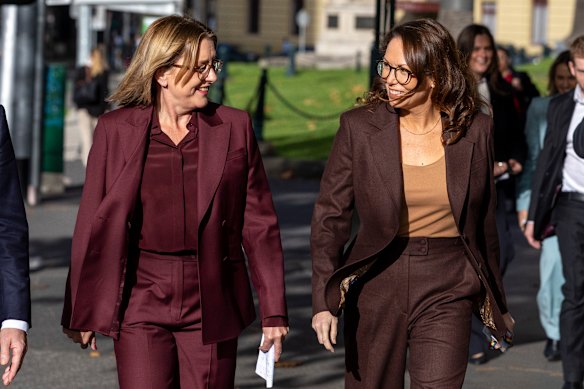

Treasurer Jaclyn Symes has handed down an election-year budget targeting the hip-pockets of Victorian voters, steering away from the big-spending Big Build even as the state’s net debt soars to almost $200 billion.
Despite some savings efforts and plans to scale back money for new projects, the state’s bill for interest repayments on the debt pile will be $11.8 billion by the end of the decade, up from $6.8 billion in 2026-27, as net debt hits a record $199.3 billion.
This will largely be driven by the refinancing of existing loans and the additional debt Victoria will take on over the next four years to continue paying for infrastructure projects such as the Suburban Rail Loop
Ahead of the November state election, Symes sought to make cost of living the headline of her second budget, centred around $759 million for a 20 per cent discount on car registrations and $433 million to extend free public transport until the end of May and introduce half-price fares for the rest of 2026.
There are also billions of dollars set aside for unallocated “decisions made but not announced”, which may include election announcements to be rolled out later this year.
A total of $13.8 billion in new spending over the next four years overshadows just $607 million in new savings measures, described in the budget papers as public service efficiencies including the centralisation of government IT services.
The budget also includes funding for Thriving Kids – a replacement program for autistic NDIS recipients – and an increase to state teacher wages which is still subject to negotiations.
Symes said the government was always going to focus on the cost of living, given public feedback that households were going backwards amid stubborn inflation.
But she said the price shock on oil sparked by the war in the Middle East, which pushed petrol price well above $2 a litre, had cemented transport discounts as the best way to achieve this.
“We didn’t anticipate for petrol prices, so we responded late in the piece in relation to, what is the biggest impact for Victoria?
“You can’t go to a barbecue without something talking about how much it costs to fill up petrol.
“We know it’s making decisions about what they do and where they’re going more difficult.”
The budget includes $2.5 billion overall in cost of living measures, including $120 million for school uniforms, glasses and breakfast programs, alongside the transport concessions.
An $860 million commitment to add 7000 social houses over the next decade has been included in this figure.
Another $3.9 billion will go towards health, including $1.6 billion to help services keep up with demand, and an extra $1.6 billion will go towards new schools, upgrades and maintenance. About $2.2 billion will fund support for children with disabilities in schools.
Allowances for foster, kinship and permanent carers, which have long lagged other states, will be boosted. The lowest level of support will be an extra $400 year while the highest will boost annual carer incomes by $1700.
But the budget also contains grim economic warnings for a government whose fiscal strategy is to grow the economy to the point that its debt represents a small portion of gross state product.
The Victorian economy is forecast grow by 1.5 per cent in 2026-27, nearly half of the 2.75 per cent forecast in last year’s budget, and remains 0.25 points lower than expected over the forward estimates.
Although net debt will grow to $199 billion, this growth will still be enough for the government to claim it is gradually easing as a percentage of the economy. Net debt to GSP will peak at 24.9 per cent in 2026-27 and decrease to 24.4 per cent by 2030.
Symes defended the state’s finances by comparing government debt to the size of the overall budget.
“The budget costs around $115 billion each year … Debt is nearly $200 billion, at the end of the forwards, that’s less than half our revenue,” she said.
“So in terms of the household, if your mortgage is less than half your annual wage generally you’re doing okay.”
Since last year’s budget, the government received an extra $5 billion in revenue across 2025-26.
But Victoria only posted a modest increase in its operating surplus, up to $727 million compared to $710 million in December. Symes defended the decision not to put this windfall into retiring debt.
“What you are asking to do is to identify out of the government expenditure, where you remove $5 billion,” she said. “We made choices to spend that, 58 per cent on health and education, for example.”
Victoria’s operating surplus does not include capital expenditure, which can be financed by loans and adds to net debt, such as for roads and hospitals. When this is accounted for, Victoria will spend $10 billion more than it brings in across 2026-27 and these annual deficits continue to be above $7 billion over the forward estimates.
Government expenditure will increase from $114.5 billion next financial year to $123 billion by 2030.
Start the day with a summary of the day’s most important and interesting stories, analysis and insights. Sign up for our Morning Edition newsletter.
From our partners
Disclaimer : This story is auto aggregated by a computer programme and has not been created or edited by DOWNTHENEWS. Publisher: www.smh.com.au


