TEHRAN — Benjamin Netanyahu arrived at the United Nations determined to turn the General Assembly into a stage for Israel’s military narrative.
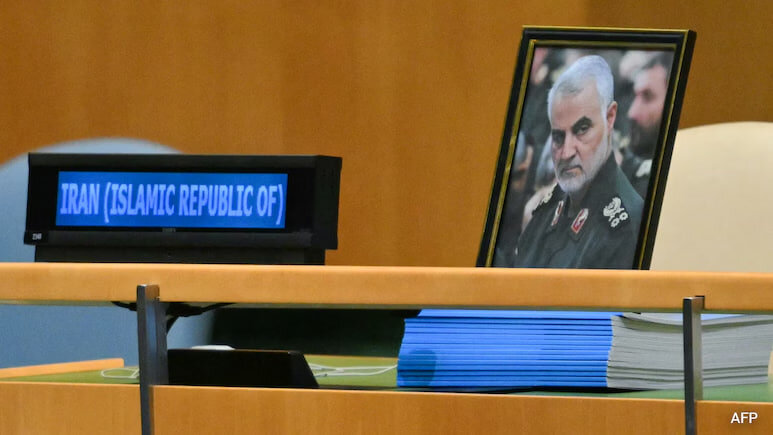
But behind the speeches and threats was a more striking image: the portrait of Lieutenant General Qassem Soleimani sitting on the desk of the absent Iranian delegation.
Netanyahu, the subject of an International Criminal Court arrest warrant over war crimes and crimes against humanity in Gaza, was permitted to enter the United States and address the world’s foremost international body without arrest. The war criminal spoke as if international accountability were a concept reserved for others.
As he began speaking, dozens of delegations rose from their seats and walked out. Israeli officials counted 77 delegations as absent or having walked out — nearly 40 percent of the UN’s 193 member states.
Netanyahu brought a pager to the UN podium—a device now associated with Israel’s September 2024 operation, when thousands of pagers exploded in Lebanon, killing many and wounding more than 3,000, including civilians.
And the symbolism did not stop there. Netanyahu had also presented Donald Trump with a pager, turning a device associated with the deadly operation into a political prop shared with the U.S. president. Then, standing before the world, Netanyahu raised one at the UN and issued threats. The message was stark: a device associated with bloodshed had been transformed into a symbol of defiance on the world’s diplomatic stage.
At the institution created in the name of international peace, the Israeli leader chose to display technology associated with a mass-casualty operation as a symbol of military achievement.
He insulted delegations that had walked out, calling them “moral cowards.” He celebrated Israel’s military actions, repeated lies about the war in Gaza, defended the occupation of Palestinian and Syrian territories, and labeled human rights defenders as “antisemites.”
He also claimed the bombardment of Iran’s nuclear facilities was one of the easiest decisions he had made as prime minister.
But there was another object in the room.
On the Iranian delegation’s desk, where diplomats should have been seated, a portrait sat quietly: the face of Lieutenant General Qassem Soleimani — Iran’s commander assassinated in a U.S. drone attack in Baghdad in January 2020 — watching over the empty chairs.
That photograph carried a message of its own.
Netanyahu displayed the weaponized technology associated with Israel’s war of atrocities. Iran left behind the face of a commander whose death was supposed to demonstrate the reach of American power.
Washington and Tel Aviv believed that assassinating Soleimani would eliminate a major figure of the resistance. They believed that removing a man from the battlefield would weaken the cause he represented. Years later, his portrait remains capable of transforming an empty diplomatic desk into a political statement.
For Iran, Soleimani remains an embodiment of the resistance strategy that challenged American and Israeli influence across West Asia. For Israel and the United States, he represented a major adversary. His assassination did not eliminate an individual; it became another chapter in the confrontation between Iran and the American-Israeli security order in the region.
The legal dimension of Netanyahu’s appearance was equally difficult to ignore.
The ICC issued arrest warrants for Netanyahu and former war minister Yoav Gallant in November 2024. The ICC said there were reasonable grounds to believe they bore criminal responsibility for acts including starvation as a method of warfare, murder, persecution, other inhumane acts and intentionally directing attacks against civilians.
The United States, which presents itself as a guardian of a rules-based international order, has meanwhile challenged the authority of the very institution that issued the warrants.
Trump called on ICC member states to withdraw from the court during his UN address, while his administration has pursued measures against the ICC. Washington’s campaign has targeted an institution that has acted against Israeli officials and investigated U.S. conduct in Afghanistan.
This is the contradiction at the heart of the so-called rules-based order: when an international court takes action against a close American ally, Washington moves against the court itself. When Israel faces allegations of war crimes, the United States provides diplomatic and political protection. When Iran defends its sovereignty, it is portrayed as the aggressor.
Iran’s representative, Nasser Asadi, delivered a forceful response at the UN, criticizing the decision to give Netanyahu a platform while Palestinians are denied one. He condemned Israel’s actions, criticized U.S. support for Israel and rejected the narrative presented by Netanyahu.
He closed with a direct warning: “Any further act of aggression against our sovereignty, territorial integrity, or national interests will be met with a decisive and devastating response.”
This is where the Soleimani portrait acquires its deeper meaning.
Washington and Tel Aviv repeatedly kill commanders, destroy infrastructure and launch attacks beyond their own borders. But military superiority does not automatically produce political surrender. The continued resonance of Soleimani’s image illustrates the limits of that assumption.
Netanyahu can stand at the UN podium and declare victory. He can display a pager and recount battlefield achievements. But he cannot decide what the region remembers.
Washington can pressure international institutions, deliver advanced weapons to Israel and blindly provide political and diplomatic protection for it. But Iran continues to deliver its own message. General Soleimani remains a powerful symbol of resistance to Israel and the U.S. His portrait remained while Netanyahu spoke to empty seats.
That is perhaps the most striking image of Netanyahu’s UN appearance: while the war criminal spoke, General Soleimani — the immortalized and unforgettable figure— was still sitting in the room.
Israel cannot kill an idea. America cannot bomb a memory. The resistance runs in our blood, and no pager, drone or speech at the United Nations can extinguish it.
The Zionists have weapons. The Americans have their veto. But Iran has its martyrs — and martyrs never die.
Disclaimer : This story is auto aggregated by a computer programme and has not been created or edited by DOWNTHENEWS. Publisher: tehrantimes.com