

Even wearing his school uniform, Jason Taumalolo had “an aura about him”. But what he brought to the North Queensland Cowboys convinced the NRL’s most battle-hardened to entirely change their game.
“[I realised] if I get a quick play the ball and the next ball goes to big Jase, we were a chance of making a good 20–30 metres down field,” James Tamou tells this masthead.
“Before then, because I was playing Origin and all that, I was quite selfish – how many runs I did and metres I made. Everything evolved … into what can I do to make someone else better.”
Taumalolo’s legacy was already etched in Cowboys’ folklore – the powerhouse lock who inspired the club’s maiden title in 2015. On Friday, he will surpass Johnathan Thurston as their most-capped player (295).
While Thurston was the premiership’s mastermind, Taumalolo – along with Tamou and Matt Scott – were the brute force.

Tamou was halfway through a career spanning 307 NRL, 14 State of Origin and 12 Test appearances when Taumalolo inadvertently dealt him a reality check.
“When Jase solidified himself, I thought this isn’t about me any more. This guy can take us to places I cannot,” Tamou says.
“You knew straight from then you were witnessing something special.”
The ‘ratbag’ sensation
Tamou looked across the Cowboys’ fields in 2009 observing the young guns eager to stand out. Taumalolo was simply picking at the grass. Then training began.
“He blew everything away – speed, jump, all that,” Tamou recalls.
“That was my first vision of him that he was something special.”
Tamou began arriving to training early to watch Taumalolo’s under-20s, coached by Dolphins and Tonga honcho, Kristian Woolf.
Taumalolo was only 16 and attending Kirwan State High School after his move from Auckland – still “a young boy with a bit of ratbag in him”.

“He was doing what he’s done in first-grade – running 300 metres every week, running over people and [being] bloody hard to tackle,” Woolf says.
“He’s always had a confidence about him that he knows what his body can do.”
What caught Tamou’s eye was how quickly Taumalolo took to senior standards.
“We had Matt Scott, Shane Tronc, Carl Webb, so you had to earn your place and respect,” Tamou says.
“But he was up to par with men standards at that tender age with the wrestle, contact, and the way he ran the ball was so impactful. Every game he’d do something spectacular, and you just had to see it.”
Career crossroads
Accolades followed Taumalolo – his premiership exploits and 2016 Dally M Medal preceding a historic 10-year contract.
Then his body failed him. Lisfranc and calf issues kept him to 10 games in 2025. He also battled a degenerative knee concern.
There were even fears Taumalolo would not see out his contract as his output diminished.
But Tamou knew Taumalolo’s character would ensure he rose again. A Queensland Cup encounter, when Taumalolo returned from injury with Mackay against Tamou’s Blackhawks, proved that.
“There was a drop out, and I spotted big Jase and ran straight at him. He half-winded me,” Tamou said with a laugh.
“It’s not even the time you put into your body to make sure you’re doing the right things, but the mindset to keep turning up.
“He shapes the identity of a team. Having him impacts the psychology, he just has that force about him that makes you second guess yourself.”
Come 2026, as Cowboys coach Todd Payten reduced his minutes to roughly 46 per game, the Taumalolo of old has returned – only trailing 80-minute players Jackson Ford, Kulikefu Finefeuiaki and Haumole Olakau’atu for post-contact metres (602).
“I knew if I could get myself back to not carrying around injuries and being able to play freely, I’d eventually get back to where I was,” Taumalolo said, after his heroics against Brisbane this year.
“I’ve had the last three or four years injury-plagued, and I knew if I had a clean-out [in my knee] last year going into this year then I could give it a red-hot crack, and get close to where I would be.”
Global impact
When Taumalolo announced his Test football defection from New Zealand to Tonga, he couldn’t know the ripple effect he would trigger.
“Everyone jokes he’s the King of Tonga,” Woolf said.
“He’s not quite the king, but he’s not far off.”
Tamou recalls seeing Taumalolo after his Kangaroos took on the Kiwis, and sensing he felt uncomfortable. Soon after, Taumalolo and Andrew Fifita’s allegiance shift transformed international rugby league.
Others followed their lead, as did those from Samoa, to create contenders to finally rival Australia and New Zealand. While visiting Tonga last year, Woolf saw how Taumalolo’s impact went beyond the game.
“Everyone loves seeing him in the flesh, everyone gravitates towards him and wants to be around him and touch him. They’re scenes I’ve been privileged to see and will always remember,” Woolf said.
“The influence he’s had on Tonga, but international footy as well, has been outstanding.”
So seismic was the cultural shift Taumalolo began, Tamou admits he could not “completely rule out” his great mate emulating those feats with the Papua New Guinea Chiefs once his contract ends in 2027 – by which time, he will be 34.
“I can’t see him making a move, but obviously, you can’t say no,” Tamou says.
“He’s shown within these last few years he’s able to push through the other side and still ignite a team.”
But while the reserved Taumalolo – who regards sharing the field with his dog Ollie before he passed away last year as a career highlight – remains unsure if he will play beyond his current deal, he expressed his desire to remain in Cowboys colours.
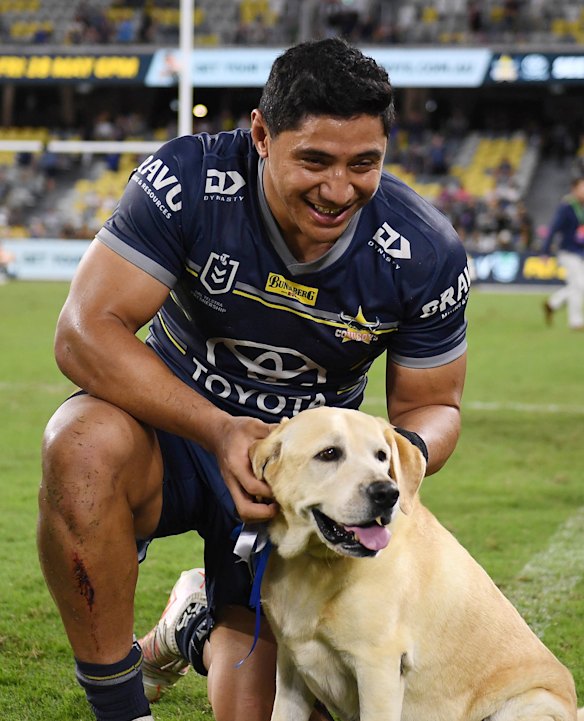
“I’d love to finish as a one-club player,” he said.
“To be the most capped Cowboys player, it hasn’t hit me. I had a few moments there where I thought I wouldn’t get here.”
Start the day with a summary of the day’s most important and interesting stories, analysis and insights. Sign up for our Morning Edition newsletter.
Disclaimer : This story is auto aggregated by a computer programme and has not been created or edited by DOWNTHENEWS. Publisher: www.smh.com.au


