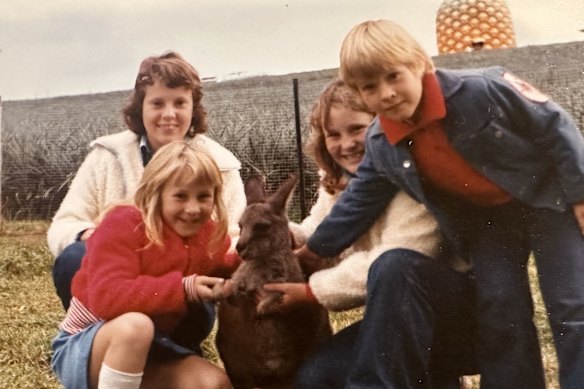

Until I was eight, I shared a bedroom with my next-up sister. We read Trixie Belden books together, she was generous with her Derwent pencils and we got so obsessed with the 1969 hit song Lily the Pink that, to this day, she’s always Lil to me. But we had to negotiate over where to stick the pony posters that came with our “Juliette” school shoes and when to turn out the light.
Meanwhile, our big sister had her own room with Dolly magazines, finger-knitted door curtains and a record player. Our little brother’s room was a toy treasure chest, with Nerf balls and Stretch Armstrong and Steve Austin dolls.
Lil and I felt it was an ongoing stitch-up.
At night, we’d lie in our twin beds cataloguing the injustices of middle-child life. Lack of privacy and autonomy. Nobody noticing our latest art project. An insult we couldn’t get past? Being forced into daggy outfits for the 1973 family portraits while the golden oldest and youngest looked cool.
Convinced our parents preferred our siblings, we packed a little case and ran away. To the side driveway, where we simmered with injustice until it got boring and Mum came out with hot cookies and lured us back inside.
In hindsight, it was an extremely middle-child way to stage a protest.
Everyone remembers Jan Brady’s frustrated “Marcia, Marcia, Marcia!” from The Brady Bunch. The stereotype exists for a reason. Parents are often preoccupied with the eldest child’s firsts – sleepover, high school crisis, unsuitable boyfriend – while the youngest exists to be doted on. The middle child can end up disappearing into the domestic blur. And now middle children themselves are disappearing too.
According to the Australian Bureau of Statistics, Australia’s fertility rate fell to a record low of 1.48 babies per woman in 2024, well below the level needed to maintain our population. And as family sizes shrink, the classic three-kid dynamic is in danger. Declining birth rates could “irreversibly change family dynamics”, SBS reported in 2024, quoting demographer Liz Allen: “Gone are the days of the middle children.”
People, we should be freaking out. Because while eldest children are pushing boundaries and the youngest are charming their way out of consequences, “middlers” are the glue holding the whole operation together. We’re the negotiators. The people who can read a room without needing to be the centre of it.
You need us.
For decades, middle children have had branding issues. Thanks to sitcoms and psychology shorthand, we became synonymous with “middle child syndrome”, a kind of tragic emotional limbo where no one notices your haircut and your baby photos stop at around age three.
But recent research suggests middle children may actually end up better adjusted than their siblings. An international personality study of 770,000 adults found that middle-borns scored highest for honesty, humility and agreeableness.
Apparently, we’re patient and flexible. Which makes perfect sense. Middle kids are armed with neither power nor novelty so, like small hostage mediators in second-hand school uniforms, we survive through negotiation and diplomacy and understanding everybody else’s motivations.
Yep, we’re who you want when the family group chat goes pear-shaped.
A middle child knows instinctively when to push and when to back off because they’ve spent their lives navigating sibling politics and are the “most willing to wheel and deal”, as US birth-order researcher Frank Sulloway put it. Middle children are also less rattled by life. We learn early that carrying on like pork chops gets you nowhere good. One 2013 Spanish study even found that middle children are less likely to develop emotional disorders.
Certainly, I wouldn’t swap being a middler. Being wedged between a glamorous older sister in a velour top and an absurdly loveable younger brother made me hyper-aware of other people’s moods. Good at smoothing over awkwardness and reading dynamics. Put me in any crowd, I’ll bedazzle with my line of chat and probably solve your problems.
Thing is, as a middle child, you have to differentiate yourself. I decided pretty early my niche would be “interesting”. By age three, I’d taught myself to read chapter books. By 10, I was a minibike daredevil. As a teenager, I had a crack at competitive synchronised trampolining. Mum and Dad, look at me!
Being a writer? Middle-child thing. Years spent off to the side clocking everyone’s behaviour made me curious. Made me notice small things that matter. Made me realise if I wanted to build a career, à la fellow middlers Emily Brontë and Jackie Collins, nobody was coming to help.
Researchers have found that middle children are often creative because they have to carve out their own identity. Maybe that’s why so many of us are performers, politicians and change makers. Madonna is still reinventing herself. Princess Diana understood emotional intelligence before it had a name. Abraham Lincoln and Winston Churchill built legacies on knowing when to push and when to pull back.
Middle children tend to soften extremes. We know what it’s like to be overlooked but still expected to hold it together. And in a world increasingly fuelled by main-character energy, we probably need middle children more than ever.
I text my son Felix and ask how he finds being sandwiched between a big brother and little sister.
“Being a middle child is basically Eastern bloc philosophy. Self-sufficiency, propaganda, hard work, meritocracy. You gain nothing for free so you fight for it,” he texts back. “Fly under the radar and accumulate influence. You aren’t a child forever. Adulthood is the main stage.”
Bravo. Let’s keep the curtain up on middle kids.
Get the best of Sunday Life magazine delivered to your inbox every Sunday morning. Sign up here for our free newsletter.
From our partners
Disclaimer : This story is auto aggregated by a computer programme and has not been created or edited by DOWNTHENEWS. Publisher: www.smh.com.au