
Jumping on the trampoline, riding bikes and playing games with your siblings are among the joys of childhood. However, for nearly half of Australian families, their reality looks very different.
According to the 2022 ASB national health survey, two in five Australian children live with at least one chronic health condition, ranging from asthma and mental health disorders to cancer, cardiovascular and congenital disorders.
While the child with the chronic health condition faces challenges, another group is also directly affected yet often overlooked: their siblings.
“When a child has a complex health condition, it reshapes the entire family,” says Dr Shannon Schedlich, chief executive of Siblings Australia, a national support organisation for siblings of children and adults with disability or illness.
“Parents are often navigating hospital appointments, and systems with which they are unfamiliar. Uncertainty, fear and high levels of stress, can impact their capacity, relationships, and wellbeing.”
As a result, Schedlich says that family routines shift and roles change, often leaving very little space left for anyone else’s problems.“The needs of the brothers and sisters of children with complex health conditions can be deprioritised as parents and caregivers understandably focus on keeping their siblings alive.”
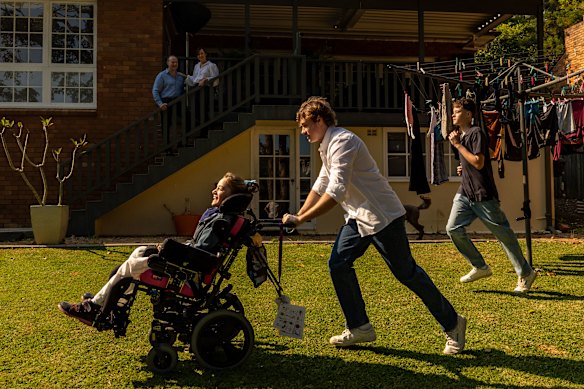
For Emma Maly, a Sydney-based registered nurse and mother of three, whose 10-year-old daughter Grace was diagnosed with the rare chronic health condition ADCY5‐related movement disorder (ADCY5‐RMD) at age three and a half, this accurately describes her and her family’s situation.
“Grace is challenged every day with unpredictable movements; it affects her whole body, so she is a full-time wheelchair user, and needs help to get out of bed in the morning, to feed, to dress, to toilet – everything,” Emma says.
The primary carer for Grace, having given up her job to support her daughter full-time, Emma says she is “acutely aware” of the impact Grace’s health has on her two sons, 18-year-old Will and 15-year-old Ollie.
“My life is shaped by love, but there’s also a constant undercurrent of worry that I have that doesn’t switch off,” she says.“It’s that guilt that their life is not simple or carefree, and that they have a sense of duty on their shoulders that you didn’t wish on them; It’s just part of their circumstances.”
While Emma and her husband, Adam, try to carve out one-on-one time with their sons,, Emma says it isn’t always possible.
“I try to give them each their time, but it’s not always easy because Grace’s needs are so great at times, and her disorder is very unpredictable,” Emma says. “There is a level of uncertainty that other families don’t even have to think about.”
For Ollie, this uncertainty makes even everyday activities like meeting up with friends or taking part in extracurricular activities difficult.
“Because Grace gets tired easily, she goes to bed early, and you can’t be too loud or come home late,” he says.
“Schedules are also made around her, so when I plan something with my friends, I worry about how it’s going to affect my family and Grace. It’s definitely on my mind a lot because I don’t want to make it harder for my parents.”
Siobhan Rogers, practice lead at Canteen, says that although every sibling’s experience is unique, Ollie’s situation is commonly reported by those in similar positions.
“Some siblings may try to be the child who does not make things harder, and hold a lot in,” she says. This can also make siblings feel on the sidelines or want more information about what is happening.
Ollie’s older brother, Will – who was eight when Grace was born and 11 when she was diagnosed – says this was the case for him, especially at the beginning.
“It was very confusing. I didn’t really understand what was going on. My parents were very stressed, and they shielded us. The doctors wouldn’t tell us [either], so we had no idea what was going on,” he says.
Now that he’s older, Will says he is now heavily involved in his sister’s healthcare, taking on a more hands-on role, helping bathe, feed and toilet Grace.
“Being the oldest, I was expected to step up, especially now, as Grace is bigger and I can help mum lift, so she doesn’t destroy her back.”
For Will, this role means greater responsibility than that of his friends his age.
“I’m a bit more mature than all my friends because that’s just been required as an early carer for a complex disorder,” he says. “I always have to consider my family, while my friends can just do whatever they want, whenever they want. For me, it’s less carefree.”
While Will and Ollie sometimes confide in each other or pursue escapism through video games and physical exercise, neither has sought professional support.
“To be honest, I feel like the support is a bit lacklustre,” Will says. “I didn’t really know where to find support. None of the medical professionals involved with Grace ever told us.”
Although currently limited, Schedlich says that dedicated professional support is available through external charities and non-governmental organisations such as Siblings Australia, Canteen and Drenched, for those in Will and Ollie’s position.
“Siblings Australia is the only organisation nationally focused on supporting the needs of the brothers and sisters of people with chronic illness and disability, with a range of programs and supports available across the lifespan, including peer support, counselling, and parent programs,” she says.
“[But] we are also seeing a growing awareness [from hospitals and support organisations] that ‘family support’ needs to include siblings and not just focus on supporting parents.”
For Will and Ollie, despite the challenges, they both see positives in their circumstances.
“There are a lot of things that you miss out on, but there’s also a lot of good that comes out of it,” says Will.
“It was what inspired me to study medicine and has influenced the way I see the world; I’m so much more empathetic, more grateful.”
Make the most of your health, relationships, fitness and nutrition with our Live Well newsletter. Get it in your inbox every Monday.
From our partners
Disclaimer : This story is auto aggregated by a computer programme and has not been created or edited by DOWNTHENEWS. Publisher: www.smh.com.au