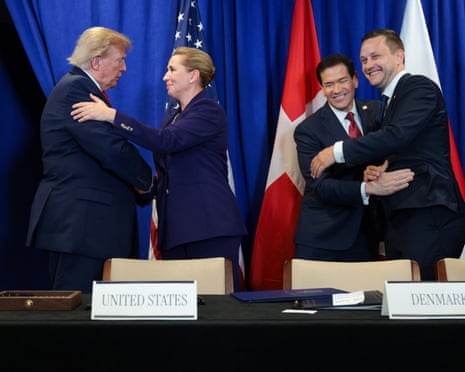
We are getting a bit more detail on the deal as signed by the three leaders just now.
In a big win for Denmark and Greenland, it includes a specific explicit provision on “reaffirming the sovereignty and territorial integrity of the Kingdom of Denmark, and recognising that the People of Greenland constitute a people pursuant to international law with the right to self-determination.”
The US will “modernise and expand its activities in Pituffik Space Base,” – that’s the base visited by JD Vance last year – and establish military bases in Narsarsuaq (it already had a military base there in the 50s) and in Mestersvig, “in accordance with modalities and technical details to be mutually agreed by the parties.”
“The United States may establish additional defence areas in Greenland and strengthen its military operations or facilities,” the text says.
US aircraft may also “fly over and land in any territory in Greenland,” the agreement stipulates, including the territorial waters.
Denmark and Greenland also agreed to “review requests to establish unmanned military installations in Greenland outside of the defence areas under accelerated governmental approval procedures.”
In what Trump touted as his win, the agreement is explicit in what was anyway believed to be true already when it says that “no state that is not a member of Nato shall be allowed to establish its own manned or unmanned military installations in Greenland nor shall they be allowed a persistent presence of military forces in Greenland, unless otherwise agreed by the Parties.”
There is also a further provision that any investment from a non-Nato member of partner country should not be allowed to “have control, significant influence or access to non-public information that may constitute a threat to national security or public order.”
This paragraph will be seen by the US as an attempt to fend off any interest from China or Russia. A different part of the deal also talks about working together to counter the threat of espionage.
The agreement has no end date, and curiously considers potentially relevant future scenarios, such as Greenland’s independence in the future.
It says the independent Greenland would need to “agree to remain in Nato” and continue all arrangements as agreed in the treaty.
The full text is here.
Brussels correspondent
The EU has agreed to remove two Russian billionaires, Alisher Usmanov and Mikhail Fridman, from its Russia sanctions list, while extending restrictions on nearly 3,000 individuals and companies accused of supporting the war on Ukraine for the next three years.
With an end-of-Tuesday deadline looming to preserve the nearly 3,000-strong Russia blacklist, the EU’s 27 member states found a compromise that meant delisting the two oligarchs, although very few countries wanted this outcome. EU sanctions have to be approved by unanimity.
France stunned and infuriated EU governments earlier this month when it called for Usmanov, a Russian-Uzbek national, to be removed from the list on “national security” grounds, reported to refer to a prisoner exchange deal involving French nationals and Azerbaijan.
Luxembourg then asked for the same treatment for Fridman, the Russian-Israeli magnate, who is suing the Grand Duchy for $16bn for freezing his assets.
The exemptions angered many EU countries that believe it sets a bad precedent by allowing member states to weaken sanctions in defence of national interests.
Ukraine slammed the removal of the men from the sanctions list as unacceptable.
Shortly after the decision emerged, Ukraine’s president Volodymyr Zelenskyy tweeted “No name on the sanctions list is there by accident: each one represents a reason why this war started and continues to this day,” without direct reference to the EU process or the individuals.
To enable the delistings that many EU member states found unpalatable it was proposed rolling over the sanctions for 36 months, rather than the usual six.
A spokesperson for Ireland’s EU presidency, which brokered the talks, said the bloc had reached “a difficult compromise”.
The person said:
“Until now, these listings have been reviewed and assessed on a 6 monthly basis; today’s decision to renew on a 36 month basis enhances the durability and predictability of the EU sanctions framework.”
A decision had been expected earlier this week, but Latvia’s government, facing parliamentary elections on 3 October, announced a last-minute objection to the delistings on Monday.
Latvia’s prime minister Andris Kulbergs tweeted late Monday night that he could not accept the proposed compromise and instructed his foreign minister to enter talks with Paris and Brussels to find a solution.
Diplomats said Latvia had finally agreed to abstain on the two delistings. The blacklist includes Vladimir Putin, foreign minister Sergei Lavrov, Duma deputies, Russia’s major banks, energy companies and military industrial complex.
EU senior officials have promised to present around 1,600 new designations – individuals and entities involved in the Russian military industrial complex – to foreign ministers next month.
But the latest standoff over the two listings, which followed the tortuous agreement on the EU’s 22nd round of sanctions in July, suggests the process could be difficult.
Back to Brussels, let’s cross to our correspondent Jennifer Rankin one more time for her final take on today’s sanctions discussions in the EU (11:15, 16:13, 17:02, 17:24).
Denmark’s foreign minister Lars Løkke Rasmussen is also pleased with the deal, even as he explicitly acknowledged that “it has been a bumpy ride.”
On his social media, he posted a picture with fellow chief diplomats of the US, Marco Rubio, and Greenland, Múte B. Egede.
He said:
“It’s been a bumpy ride. But here we are – with a deal in hand that we can all be very satisfied with.
We share a long history. And we share a responsibility for the security of our region. Today, we take another important step together – with full respect for the sovereignty and territorial integrity of the Kingdom of Denmark and the Greenlandic people’s right to self-determination.
History binds us together. Our future demands that we stand together.”
Nato’s Mark Rutte has just responded publicly to the deal (17:49).
In a brief statement, he said:
“Great to see the deal signed by the United States, Denmark, and Greenland today. We know the threats we face, and greater security in the Arctic and North Atlantic is essential for Europe and North America alike.
This agreement, along with Nato’s growing role in securing this vital region, enhances our collective security and supports a safer and more stable future for us all.”
We are getting a bit more detail on the deal as signed by the three leaders just now.
In a big win for Denmark and Greenland, it includes a specific explicit provision on “reaffirming the sovereignty and territorial integrity of the Kingdom of Denmark, and recognising that the People of Greenland constitute a people pursuant to international law with the right to self-determination.”
The US will “modernise and expand its activities in Pituffik Space Base,” – that’s the base visited by JD Vance last year – and establish military bases in Narsarsuaq (it already had a military base there in the 50s) and in Mestersvig, “in accordance with modalities and technical details to be mutually agreed by the parties.”
“The United States may establish additional defence areas in Greenland and strengthen its military operations or facilities,” the text says.
US aircraft may also “fly over and land in any territory in Greenland,” the agreement stipulates, including the territorial waters.
Denmark and Greenland also agreed to “review requests to establish unmanned military installations in Greenland outside of the defence areas under accelerated governmental approval procedures.”
In what Trump touted as his win, the agreement is explicit in what was anyway believed to be true already when it says that “no state that is not a member of Nato shall be allowed to establish its own manned or unmanned military installations in Greenland nor shall they be allowed a persistent presence of military forces in Greenland, unless otherwise agreed by the Parties.”
There is also a further provision that any investment from a non-Nato member of partner country should not be allowed to “have control, significant influence or access to non-public information that may constitute a threat to national security or public order.”
This paragraph will be seen by the US as an attempt to fend off any interest from China or Russia. A different part of the deal also talks about working together to counter the threat of espionage.
The agreement has no end date, and curiously considers potentially relevant future scenarios, such as Greenland’s independence in the future.
It says the independent Greenland would need to “agree to remain in Nato” and continue all arrangements as agreed in the treaty.
The full text is here.
As the three leaders sign the deal together, it is impossible not to reflect on the role of Nato secretary general Mark Rutte, who played a key behind-the-scenes part in bringing the parties together back at the height of the Greenland crisis in January.
There is a reason he even got a shout-out in Trump’s UN general assembly speech earlier (16:59).
Often criticised for what opponents call his sycophancy towards Trump, Rutte will feel vindicated today as he gets all sides to sign on the line – and put an end to a damaging episode of political clashes over Greenland between major Nato allies.
Denmark’s Frederiksen and Greenland’s Nielsen appeared relieved as they repeated their key lines on sovereignty and self-determination – their comments on these points felt very pointed – while Trump got to talk up the new provisions on defence.
All got what they wanted, in the end. The three leaders signed the agreement and swiftly departed without taking questions.
Whatever the ultimate merits of this deal, it should at least provide some political closure. For now, anyway.
It’s done.
Greenland’s Nielsen is speaking next.
He says it is “a very important day for our security” that “builds on 85 years of security cooperation” since the second world war.
He stresses that “this is not only an agreement about us, but an agreement with us.”
“It takes into account the people of Greenland, our rights, our livelihoods and the development of our country. This has been a key priority for us throughout this process,” he says, saying this is why Greenland “insisted on engaging in a constructive dialogue.”
“Greenland matters for North American security and for transatlantic security. And this agreement reflects that we understand our responsibility and act accordingly,” he says.
He continues:
“Nato matters. We believe that it is vital to keep Nato strong, also in the Arctic, where the alliance has a key role to play.
This agreement should put to rest any doubt today and in the future about where Greenland’s loyalty lies.
Our commitment to this alliance and to the security we build together is not in question. We are, have been, and will remain a steadfast friend of the United States and a part of the western alliance. Your security is our security, and our security is your security.”
He calls it a “win-win-win agreement.”
Danish prime minister Frederiksen is up next.
She says Denmark has “always kept our word” and been the US ally.
“You have always been able to rely on, and this day represents a milestone in our longstanding cooperation,” she says.
She says the parties are signing “an even bigger and better agreement, a deal that can last forever.”
“This deal is good for the United States. It’s good for Greenland, for Denmark, for the Nato alliance, and therefore also good for Europe,” she says.
“In other words, we are strengthening our common security, boosting our common deterrence, showing our adversaries who we are and we are doing it together.”
Frederiksen says any adversaries “will not be allowed to get any control or significant influence in Greenland.”
She also says the agreement “underlines the importance of the Nato alliance.”
In tricky, carefully worded paragraphs, she says the agreement “recognises the US defining historical and ongoing contributions to the security and defence of Greenland,” but it also “respects the sovereignty and the territorial integrity of the Kingdom of Denmark, as well as Greenland’s right to self-determination.”
“I think everybody knows that we live in difficult times where we have to show our strength. If we let ourselves be divided as allies, then we do our votes a favour. We will do everything we can to prevent that from happening.”
She says the deal is “good for the US, Greenland and Denmark.”
Trump is speaking now.
He says it “has been an amazing journey with tremendous people” in Frederiksen and Nielsen.
“We’re going to have a tremendous relationship, a secure relationship,” he says.
He thanks them for the deal, and says they will be working “very hard” on its implementation.
He says the deal has been “long in the making” – “many decades, probably centuries” – and it will be “tremendous for Europe and for the US and for everybody.”
And – I swear to God, I’m not making this up – “Send in the Clowns” proves to be the final song building up to the entrance of Trump, Frederiksen and Nielsen.
Erm.
They are here now.
Watch along:
As the wait continues, we’re now listening to Judy Collins and “Send in the Clowns”.
“Don’t you love farce?
My fault, I fear
I thought that you’d want what I want
Sorry, my dear
But where are the clowns?
Quick, send in the clowns
Don’t bother, they’re here.”
(I prefer not to comment. If I comment, I will be in trouble.)
Disclaimer : This story is auto aggregated by a computer programme and has not been created or edited by DOWNTHENEWS. Publisher: theguardian.com